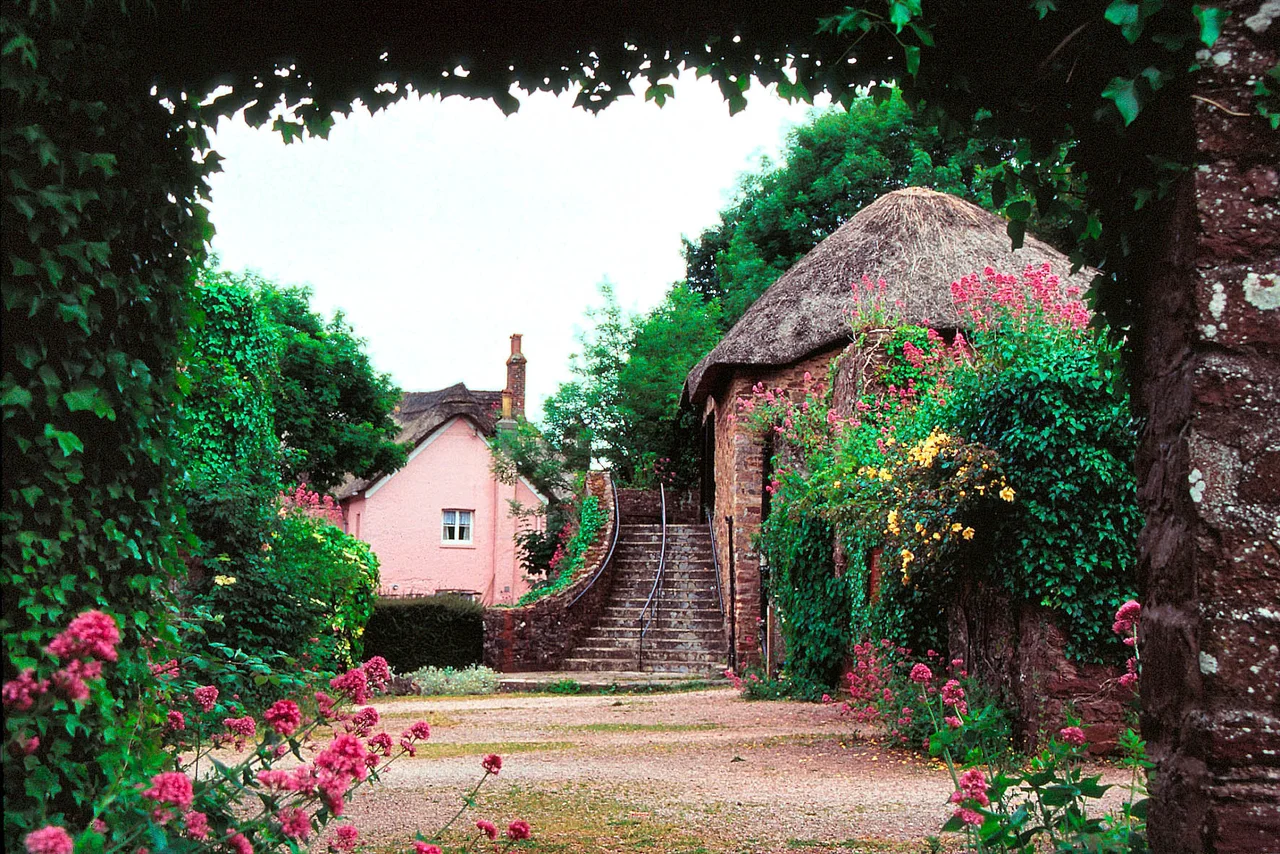

Cockington
In 1929, A. R. Powys of the Society for the Protection of Ancient Buildings had to issue a public statement: no, an American was not going to buy the Cockington forge, dismantle it, and re-erect it across the Atlantic. The rumour spread because Cockington is exactly the kind of place that triggers that kind of fantasy. Two miles inland from the bustle of Torquay, the village clusters around a thatched smithy, a thatched pub, and a series of cob cottages so unselfconsciously English that they appear in tour guides as proof of concept. The American never came. The forge stayed. The fantasy of taking a piece of Cockington home, though, has never quite gone away.
Iron Age to Domesday
Long before the cottages, there were hill forts. Two of them, dating from around 500 BC, stood on the ridges flanking Cockington Valley. Their builders left little behind, and the centuries that followed are mostly silent until the Saxons arrived, fishing the streams and farming the valley floor. By the 10th century the manor appears in written record: held by Alric the Saxon, later passed to William Hostiarus, William de Falaise, and Robert FitzMartin, whose son Roger took the name de Cockington and held it from 1048 to 1348. The Cary family of Elizabethan worthies inherited it next, and they in turn sold it in 1654 to the Mallocks, a family of wealthy Exeter silversmiths who would shape the place for nearly three centuries. The parish was finally swallowed into Torquay on 1 October 1928.
Lutyens Builds a Pub
In 1936 the Drum Inn opened on the site of a former sawmill, and the village got its first significant new building in living memory. The architect was Sir Edwin Lutyens, the man who designed the Cenotaph in Whitehall and the viceregal palace in New Delhi. The Drum cost seven thousand pounds, used 16th-century-style bricks imported from Belgium, and was thatched in the local manner. Its two largest chimney stacks echo the shape of the Cenotaph, a quiet signature from a famous hand. The pub was meant to be called the Forge Inn, but the Cockington Trust worried this might be "prejudicial" to the actual forge across the way, and changed the name. The poet and glass engraver Sir Laurence Whistler presented Lutyens with a window pane engraved with a poem titled "The Drum." It is still in the building.
The Forge That Wasn't Quite Medieval
Visitors have been told for at least a century that the Cockington forge is medieval. The story is irresistible: a 14th-century smithy still in continuous use. The evidence, when you look at it, is thinner. An 1810 source dated the building to 1552. A 1971 history quoted that date but admitted the source could not be verified. What can be traced is a sequence of named blacksmiths: William Davy at the anvil from about 1851 to 1896, Thomas Stevens until 1913, Bill Brooking giving demonstrations from 1947 onward. In the 1930s the Cockington Trust started selling miniature horseshoes to tourists, which is when the forge began its long second career as gift shop. By 2001 the blacksmithing equipment had been comprehensively removed. The building remains, thatched and convincingly old. The story sells itself.
Almshouses, Cricket, and a Pony Mayor
The almshouses, seven terraced cottages built in the reign of James I by the Cary family to house villagers who could not work, fell into disrepair under the Mallocks and were rebuilt between 1790 and 1810. The cricket ground was once a medieval deer park; play began there in 1947. The Cockington church goes back to William de Falaise around 1069. And then there is Patrick, a four-year-old therapy pony who was elected honorary mayor by local charity campaign in July 2022. He worked with patients in hospitals and mental health wards, made appearances in the village, and occasionally visited the Drum Inn. Two weeks into his term, after a complaint, Torbay Council opened an enforcement case against the Drum Inn over unauthorised fencing and signage in the conservation area — effectively forcing the removal of the pen where Patrick held court. The story made the international press. Cockington, almost by accident, generated another perfect English headline.
From the Air
Cockington village sits at 50.463 N, 3.556 W, in a wooded combe two miles west of Torquay harbour. Best viewed from 1,500 to 2,500 feet for the contrast between thatched cottages and the surrounding woodland. Nearest airport is Exeter (EGTE), about 18 nautical miles north-east. The combe is barely a mile wide, so you will spot it as a cluster of pale walls and dark thatch in a green hollow between Chelston and Cockington Court. South Devon's red soil shows clearly in spring fields. Best light is morning, when the combe is still in mist while the higher ground catches sun.
Nearby Stories
- Torcross 2.8 km away
- Cotehele 4.6 km away
- HMS Formidable (1898) 9.1 km away
- Holsworthy 9.4 km away
- Eddystone Lighthouse 11 km away
- Tiverton Castle 18 km away
- 1890 Norton Fitzwarren Rail Crash 24 km away
- Lyme Bay Canoeing Disaster 26 km away