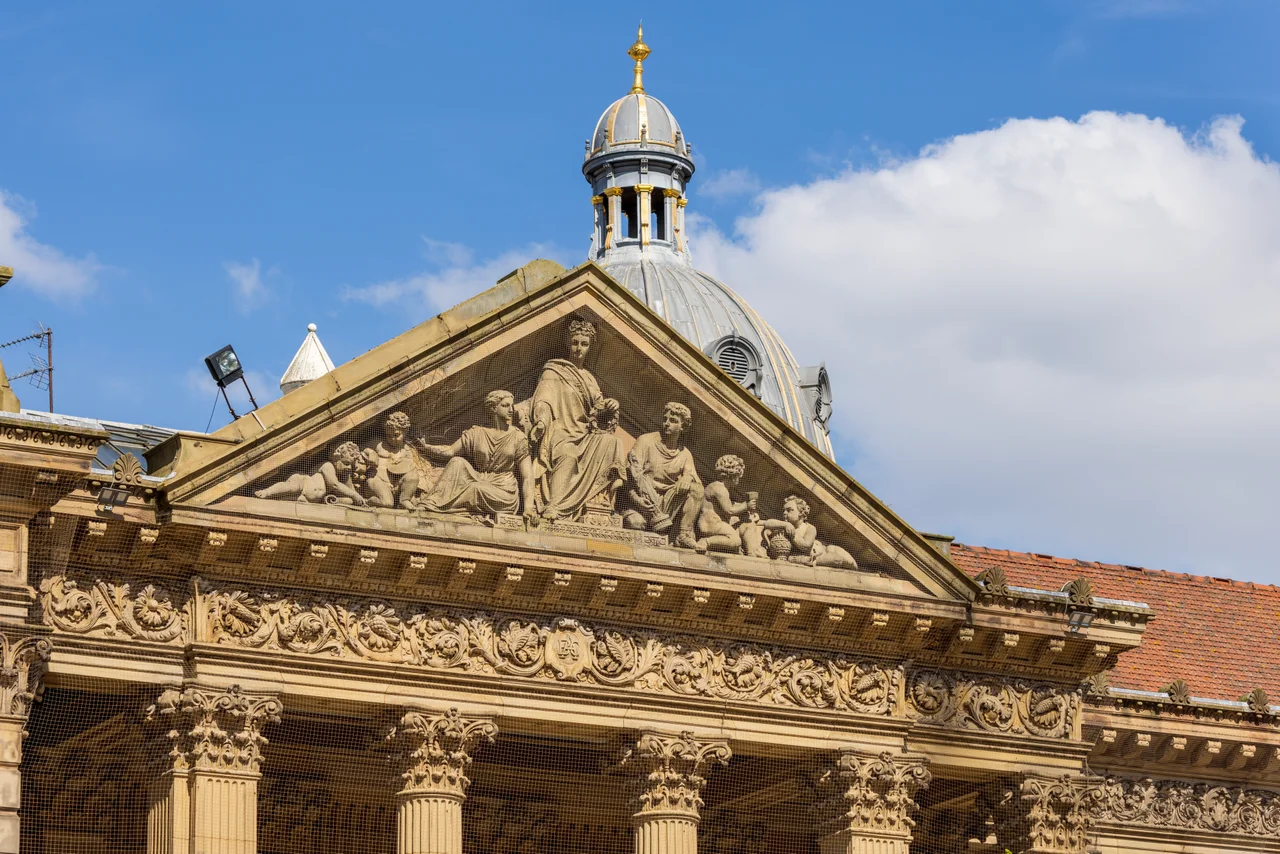

Council House, Birmingham
Only one building in the United Kingdom holds the postcode B1 1BB. It is this Grade II*-listed Italianate pile in Victoria Square, all rusticated stone and gilded mosaic, completed in 1879 for £163,000 and never quite stopping the small dramas of Birmingham politics that have happened inside it since. The mosaic above the main entrance shows Britannia receiving the manufacturers of Birmingham - small bronze plumbers and brass-founders and screw-makers presenting their wares to the seated allegory of empire. Salviati of Venice made the tiles. The City of Birmingham has been running itself from inside this stonework for nearly a century and a half.
Tolkien's Family Lived Here
The land where the Council House now stands was Ann Street, a row of shops and small properties that the Town Council bought up in 1853. One of those shops was the Cabinet of Curiosities, a clothes dealer advertising itself as 'an exhibition for the curious observer of natural phenomena.' The building had a castellated, whitewashed clock tower covered in handpainted advertisements. The last family to live there before the demolition was the Suffields - ancestors of J. R. R. Tolkien. The future creator of Middle-earth was born thirty-nine years after his mother's family was cleared off this land. The clearance went unmourned. The Tolkien connection is the kind of small footnote that the building's official histories often skip past, but it sits in the city's chain of literary biography: Birmingham produced both Baskerville's typography and Tolkien's prose, and both got their start with families like the Suffields keeping shop on streets that became civic stone.
Twenty-Nine Entries, One Argument
The council finally agreed to build in 1871 after two decades of financial difficulty. They held a design competition. Twenty-nine entries arrived, a poor showing compared to the 179 entries Sheffield had attracted for its own town hall. The council split bitterly between two finalists: a Gothic scheme from Martin and Chamberlain, and a classical scheme from Yeoville Thomason. Thomason won. Construction began in 1874, with Joseph Chamberlain, then mayor, laying the first stone. Five years later the building opened. They debated naming it the Municipal Hall, the Guildhall, or the Council House. The third name won, and stuck, even though most British cities call their equivalent building a town hall or city hall. Birmingham preferred to be different.
A Bridge of Sighs Above the Corridor
Between 1911 and 1919 the architects Ashley and Newman extended the building northward with a new block, connected to the original by a stone archway that crosses a side street. The corridor inside the archway forms a covered walkway between the two halves. The result faintly resembles the Bridge of Sighs in Venice, which Birmingham seemed willing to take as a compliment despite the fact that the original bridge connected a Venetian palace to a prison. The new wing contains the Feeney Art Galleries. Together with the Museum and Art Gallery housed in the same complex, the Council House is one of those Victorian buildings that grew sideways: government, art, and civic ceremony all stacked together because the council kept finding more things it needed to do.
The Memorials Inside
The building's interior memorials are a quiet record of Birmingham in the twentieth century. A plaque from the Belgian exiles thanks the citizens of Birmingham for shelter during the First World War. The staff of the Board of Guardians, the Public Works and Town Planning Department, the City Treasurers, the Electric Supply Department, the Veterinary Department - each lost colleagues to the wars and recorded them on these walls. There is a plaque for Captain Ronald Wilkinson, killed on 17 September 1973 trying to defuse an IRA bomb in Edgbaston. There is a Blue Plaque for the Martineau family, five consecutive generations of Birmingham mayors. There is a memorial for John Skirrow Wright, the radical Liberal who collapsed and died inside the building. Read together, the memorials make the case that being a city employee in twentieth-century Birmingham was sometimes dangerous work.
The Balcony and the Camera
The first-floor balcony above the main entrance is the building's most photographed feature, because it is where Birmingham gathers its crowds. Visiting royalty wave from it. Lord Mayors deliver speeches from it. Victorious sports teams, as the building's own descriptions put it, address the crowds assembled below - a tradition the source article specifically calls out, in carefully neutral municipal language, as one of the balcony's main civic functions. The foyer also gets film work. Cliff Richard's 1973 musical Take Me High dressed the entrance as a hotel lobby. Stephen Poliakoff's BBC drama Dancing on the Edge used the banqueting suite and glass corridor as a 1930s hotel. The mosaic Britannia keeps receiving the manufacturers; the city outside keeps doing whatever the city does; and inside, the council still meets in the chamber Yeoville Thomason designed for it in 1874.
From the Air
The Council House occupies the eastern side of Victoria Square at 52.48 degrees north, 1.9028 degrees west, in central Birmingham. From cruising altitude in clear conditions, look for the pale stone Italianate facade with a central pediment and clock tower, immediately east of the open Victoria Square. The Town Hall, modelled on the Temple of Castor and Pollux, stands just to the southwest. Birmingham Airport (EGBB) lies about seven miles east-southeast; Coventry Airport (EGBE) is roughly eighteen miles southeast. Best viewing altitudes are 1,500 to 3,000 feet.
Nearby Stories
- Shepshed 8.5 km away
- Battle of Evesham 11 km away
- Hixon rail crash 12 km away
- Battle of Cropredy Bridge 12 km away
- Wenlock Priory 15 km away
- RAF Shawbury 16 km away
- Market Bosworth 17 km away