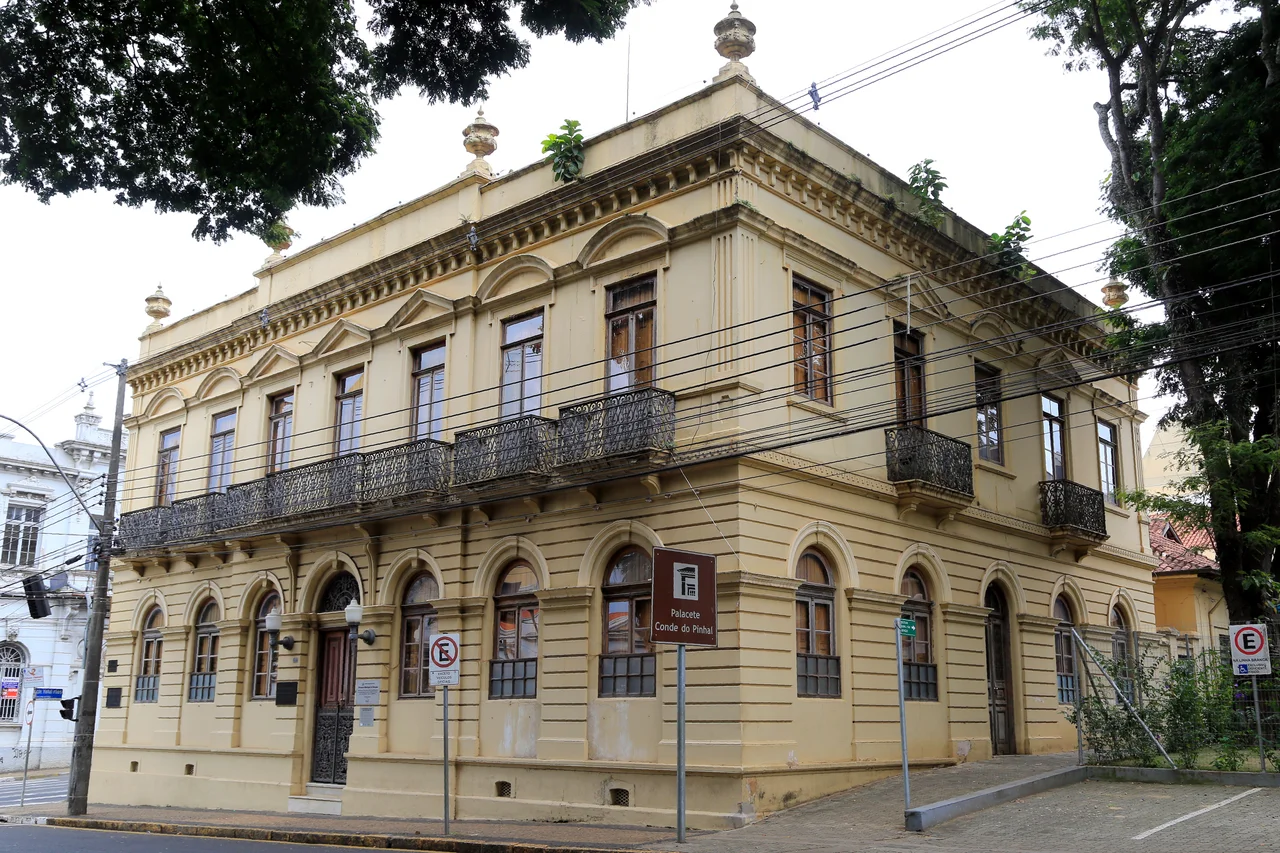

Count of Pinhal Mansion
Pietro David Cassinelli died in 1898 at the age of forty-three, three years after the building he was finishing for Brazil's Count of Pinhal was inaugurated. Yellow fever took him - one of many Italian immigrants in Sao Paulo state killed by the tropical diseases that the old Genoese architecture books had never prepared them for. He was born in Genoa in 1854. He came to Brazil at twenty-eight, settled in Sao Carlos, opened a furniture factory and then an ice factory, helped found an Italian cultural association with a name that reached back to the homeland - Societa Ginastica Educativa Cristoforo Colombo - and designed a mansion for a coffee baron whose wealth he would not live to see replicated. The mansion is still there. So is Cassinelli's signature on the iron gate.
A Coffee Baron's House
The land was acquired in 1867, according to a date engraved on the property's iron gate - more than two decades before construction began. On December 27, 1890, the Count of Pinhal formally hired Pietro David Cassinelli to design the building. Construction began in 1893 and finished in 1895. The count wanted an eclectic, neo-Renaissance style across two floors, patterned loosely on the Marquis of Tres Rios mansion - a building he had admired enough to want his own version in Sao Carlos. The main facade carries seven balconies. The garden facade adds two more, along with a separate guest chalet positioned so that visitors could sleep apart from the family's daily life. The rest of the grounds preserved a large wooded area, enclosed by rammed earth walls. Carriage access ran along what is now Major Jose Inacio Street.
The Coffee Economy That Paid For It
Eclecticism came to Sao Carlos for economic reasons. The coffee boom of the late nineteenth century had filled the pockets of landowners across the interior of Sao Paulo state, and they wanted architecture that reflected their status. The 1884 completion of the railroad accelerated the transformation - both by making it faster and cheaper to ship coffee out, and by enabling the import of materials and skilled labor. European construction techniques arrived with the workers. Italian stonemasons. German iron fabricators. Spanish tilers. In Sao Carlos, the Count of Pinhal's mansion was part of a larger urban expansion. The same workers and the same aesthetic produced a wave of other eclectic buildings, most now lost. Some were demolished in the twentieth century to make way for taller development. Others still stand, quietly listed on preservation registers, their balconies rusted but intact.
What Cassinelli Also Built
Pietro David Cassinelli did not build just one mansion. He contributed to the construction of several notable buildings around Sao Carlos during his sixteen years in Brazil. The main house of the Santa Maria do Monjolinho Farm, owned by the powerful Camargo Penteado family, carries his work. The Bento Carlos Mansion at 2056 Treze de Maio Street still stands. The Pillegi family residence at what is now 1993 Jesuino de Arruda Street survives, though the Fehr family residence at 2137 on the same street was demolished. Cassinelli also built the Ipiranga Theater on Major Jose Inacio Street - lost as well, another casualty of mid-twentieth-century urban change. Together, his portfolio represents a compressed career: arrive in Brazil at twenty-eight, work intensely for sixteen years, die of yellow fever at forty-three, leave behind buildings that define a city's architectural character a century later.
From Mansion to Municipal Building
The Count of Pinhal died in 1901. His family stopped living in the mansion soon after. In 1906, the Sisters of the Blessed Sacrament took over the building and ran the Colegio Sao Carlos there, educating local girls until 1913. In 1918, the municipality took possession of the property. Between 1921 and 1952, the building housed both the town hall and the city council. From 1952 until 2008, it housed only the town hall. Today it contains the Sao Carlos Municipal Secretary of Education. The trajectory is one often repeated in Brazilian cities: a private palace built at peak coffee wealth, abandoned when the family moved on, converted to civic use during the twentieth century, and finally designated as heritage once the twentieth century began to care more about preservation than about newness.
Two Rounds of Heritage Listing
The mansion now carries two separate heritage designations. The state council CONDEPHAAT - the Council for the Defense of Historical, Archaeological, Artistic and Tourist Heritage - listed it in October 1978, with the formal inscription in the Livro do Tombo Historico on June 26, 1979. In 2012, the municipal CONDEPHAASC added a second listing, published in the official gazette on September 21. Between 2002 and 2003, the Sao Carlos Pro-Memory Foundation surveyed more than 3,000 buildings across 160 city blocks. Of these, 1,410 were original late-nineteenth-century architecture. Only 150 still retained their original features; 479 had significant alterations; 817 were largely unrecognizable from their original forms. The Count of Pinhal Mansion fell into the first group - rare enough to warrant the highest protection category the city could offer. Cassinelli's work, nearly all taken from him by yellow fever before he was fifty, is now protected by two levels of government a hundred and thirty years after he signed the gate.
From the Air
Located at 22.02 degrees S, 47.89 degrees W in central Sao Paulo state. Elevation roughly 850 meters in the Sao Carlos region. Nearest airport is Sao Carlos-Mario Pereira Lopes (SDSC) for regional flights; major connections through Campinas-Viracopos (SBKP), Ribeirao Preto (SBRP), or Sao Paulo-Guarulhos (SBGR). Best viewing altitude 2,000-4,000 feet over Sao Carlos, a university town visible among the rolling coffee country of the Paulista plateau. The mansion sits within the historic city center polygon defined by the Sao Carlos Pro-Memory Foundation.
Nearby Stories
- Brazilian Air Force Academy 15 km away
- Torrinha 22 km away
- Pederneiras 27 km away
- Vassununga State Park 42 km away
- Titanochampsa 58 km away
- Bauru 63 km away
- Itapira 67 km away
- Poços de Caldas 93 km away