.jpg)
Poços de Caldas
The mountains that ring Pocos de Caldas are actually the rim of a volcano. Ninety million years ago, a caldera roughly thirty kilometers across collapsed here, and the geology has been rewriting itself ever since. The same volcanic activity that produced the sulphurous hot springs also seeded the soil with thorium, zirconium, uranium, and bauxite. A city grew up inside the ring wall. Bathers soak in the mineral waters at Thermas Antonio Carlos. A few kilometers away, Alcoa operates one of the world's largest bauxite mines, and Brazil's first uranium-concentration plant turned the same rocks into fuel for a nuclear reactor at Angra dos Reis. Everything in Pocos de Caldas sits on top of what the volcano left behind.
The Cable Car to Christ
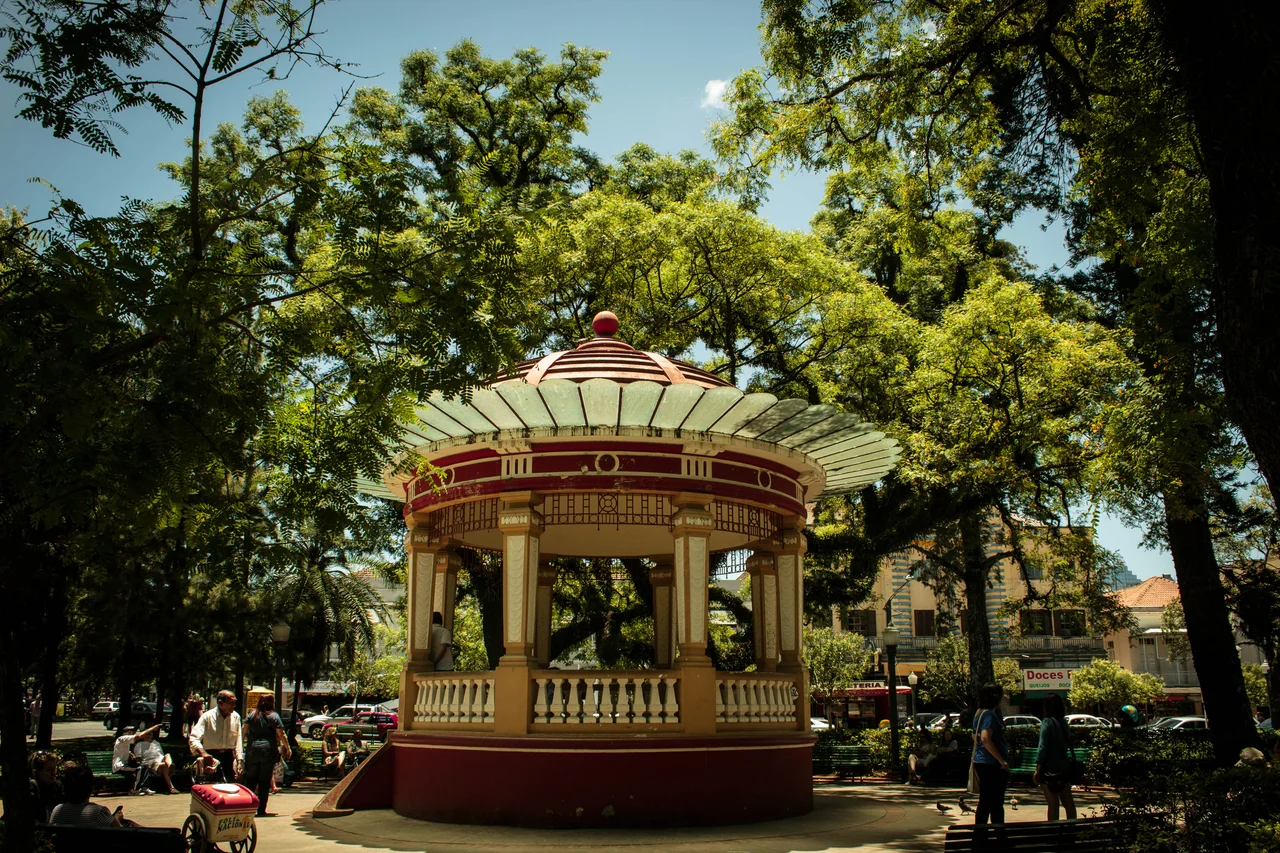
An aerial tram climbs Morro do Cristo Redentor, ending at a statue of Christ the Redeemer at 1,686 meters - not the famous one in Rio, but a smaller cousin gazing over a different landscape. From the summit you can see the ring of caldera peaks stretching to every horizon, the town nested at the bottom, the luminous fountain that draws crowds after dark. The city has leaned into its identity as a hill-station resort since the nineteenth century, when Brazilian elites discovered that sulphur-rich water bubbled out of the ground at drinking temperature. The bathhouses came, then the Palace Casino, then the Japanese tea garden and the theaters and the yearly Music in the Mountains Festival. For a country that often forgets it has genuine mountain weather, Pocos de Caldas is a reminder.
Glass from Murano, by Way of Minas
The glass industry here has an unlikely pedigree. The founders of the factories - Ca'D'oro, Sao Marcos, Veneza, Bonora - were descendants of glassmakers from the Venetian island of Murano, carrying techniques refined over centuries in Italy's lagoon. They brought the knowledge across an ocean and up to 1,200 meters elevation in southern Minas Gerais, where the volcanic silica-rich sand and the mineral waters of the region suited their craft. Pocos de Caldas glass is exported internationally. Alongside the factories, four soapmakers - Raizes, Antares, Sarandi, Terra Brasil - draw on the same hydro-mineral tradition, packaging the scent of sulphurous springs into bars that ship across Brazil.
The Rocks Beneath
The same geology that made the bathhouses rich made the mining companies richer. A rare zirconium ore was named caldasite for the region. The soils yield thorium, used in some nuclear applications, and enough uranium that Brazil built its first ore-concentration plant here - fuel for the Angra Nuclear Power Plant on the coast at Angra dos Reis. But the big extraction is bauxite, the ore that becomes aluminum. Alcoa's operation is among the largest bauxite mines in the world. The smelter produces 90,000 tons of primary aluminum per year, plus 14,000 tons of aluminum powder - material that ends up in ferroalloys, pigments, explosives, and solid rocket fuel. The city's hydroelectric plants, built with local resources, keep it independent from the state grid. Pocos de Caldas runs largely on what its volcano gave it.
Mauro and the Cup
Mauro Ramos de Oliveira grew up in Pocos de Caldas. He was part of the Brazilian national football team that won the World Cup in 1958 and captained the squad to victory in 1962 - the era of Pele's emergence, the two trophies that turned Brazilian football from a regional sport into a global religion. The city has kept its pride in him quiet, the way Minas Gerais tends to keep things. Xando, born here around 1961, went on to win an Olympic silver in volleyball. For a municipality of about 170,000 people, the athletic ledger punches above its weight.
Sister Cities, Scattered
Pocos de Caldas's sister-city list reads like a thoughtful atlas entry rather than a random assortment. Takasaki, Japan, paired in 1968, for the cherry-blossom resonance with the Japanese tea garden in town. Caldas da Rainha in Portugal, paired in 2001, the thermal-springs town that shares its ancestry in name. Jundiai and Sao Joao del-Rei and Bage, Brazilian cousins. Mount Vernon, New York, paired in 2014. General Pueyrredon in Argentina, 2009. The connections are cultural, thermal, diasporic - a reminder that even a spa town hidden in a Brazilian caldera sits inside a wider network of shared water and shared history.
From the Air
Coordinates: 21.79 S, 46.56 W. Southern Minas Gerais at approximately 1,200 meters elevation, inside an extinct volcanic caldera rim. Served by Emb. Walther Moreira Salles Airport (SBPC). The surrounding ring of peaks averages around 1,500-1,700 m, with the Christ the Redeemer statue at 1,686 m offering the best visual anchor. Nearest major airports: Campinas/Viracopos (SBKP) 160 km east, Ribeirao Preto (SBRP) 240 km northeast. Visual landmarks: the roughly circular caldera outline, the central luminous fountain, the cable car line up Morro do Cristo.
Nearby Stories
- Guaxupe 21 km away
- Brazilian Air Force Academy 23 km away
- Pouso Alegre 31 km away
- Vassununga State Park 50 km away
- Três Pontas 57 km away
- Itapira 57 km away
- Varginha UFO Incident 66 km away
- Ribeirão Preto 79 km away