
Varginha UFO Incident
The afternoon was humid and the sky was gray - just another hot January day in southern Minas Gerais. Around 3:30 p.m. on January 20, 1996, three young women walking home on Dr. Benevenuto Braz Vieira street saw something crouched in a vacant lot. Biped, tall, large-headed. Three bumps on the skull. Red eyes. Dark markings on the skin that looked like exposed veins. The creature seemed sick or injured, they said - wobbly on its feet. The women, ages 14, 16, and 22, ran home and told their mother they had seen the devil. What happened next depends entirely on who you ask. Military investigators eventually concluded a local resident with an unusual appearance had been mistaken for an alien, and that army truck movements nearby were routine. Ufologists reached different conclusions. The city of Varginha, caught in the middle, did the practical thing: it built a tourism industry.
The Afternoon That Wouldn't End
Liliane, Valquiria, and Kátia were the three women. Their account - a humanoid crouched in the grass, seemingly wounded - reached local ufologists quickly, and ufologists began hearing from others. Someone had seen a strange flying object in the sky days earlier. Someone else had noticed army vehicles moving through town. A 23-year-old military police officer named Marco Eron Chereze died two months later from multiple organ failure, and his family wondered whether he had handled something he shouldn't have. Four animals at the Varginha Zoo died in the period - a tapir, an ocelot, and two gray brocket deer - and that fact, too, entered the circulating theories. The Brazilian Army eventually ran an inquiry. Its conclusion: the creature had most likely been Luis Antonio da Silva, a local man with developmental differences who sometimes wandered shirtless near that lot. The troop movements were ordinary training exercises. The zoo deaths were unrelated. None of this satisfied believers, who had by then built a parallel narrative.
What Ufologists Said Happened
According to the version that coalesced in books, documentaries, and eventually video games, multiple creatures came down that weekend in one or more craft. Military personnel captured them, living, and transported them to Hospital Humanitas in Varginha for observation. Some were transferred to São Paulo, where at least one died. A woman was allegedly impregnated through contact with an extraterrestrial. American surgeon and ufologist Roger Leir wrote a book titled UFO Crash in Brazil in 2005. Filmmaker James Fox released Moment of Contact in 2022. A 2025 documentary by Ricardo Calil and Paulo Gonçalves, O Mistério de Varginha, revisited the case with new interviews on the 30th anniversary. Skeptic Brian Dunning, summarizing the skeptical position, wrote that it is 'the most compelling example of a case where literally nothing at all happened that was remotely unusual, and was magnified into a case considered unassailable proof of alien visitation by many.' Thirty years on, the two narratives still do not touch.
A City Built a Spaceship
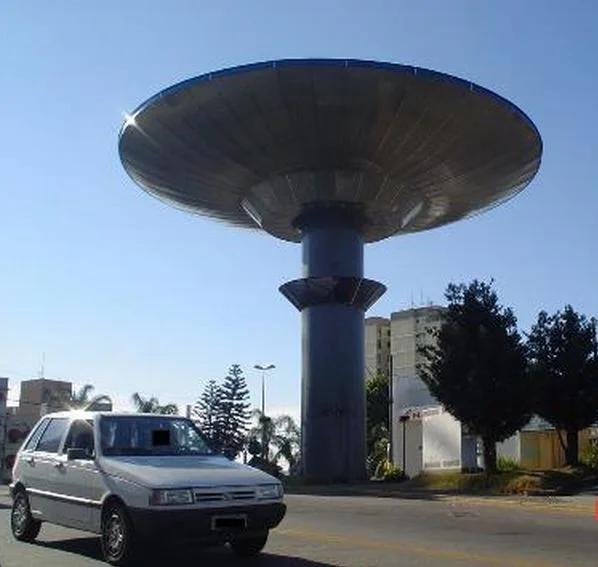
What Varginha did with the ambiguity is remarkable. Rather than deny the story or embrace it credulously, the city turned it into infrastructure. In the central park, workers erected a 20-meter water tower shaped like a flying saucer - the Nave Espacial de Varginha, officially a utility structure, unofficially a tourist magnet. Bus stops around town were rebuilt in the form of spaceships. Shops sell grey alien dolls dressed in the jersey of Varginha's local football clubs. Billboards and municipal advertising lean cheerfully into the imagery; the city's visual identity for tourism purposes is unapologetically extraterrestrial. A character named Ginho - an anthropomorphized 'ET de Varginha' in comic books and on merchandise - serves as informal mascot. The annual anniversary of the sighting draws visitors. There are walking tours of the sighting sites. The city's approach is neither believing nor debunking; it is profiting, gently, from a good story that will not go away. Few municipalities have monetized ambiguity so successfully.
Coffee Country's Cultural Legacy
Varginha is a coffee-trading city of about 120,000 people, 300 kilometers south of Belo Horizonte in the heart of the south Minas coffee belt. Before 1996 it was nationally known mostly for its commodity role - a hub for roasters and export houses, an unglamorous place where harvests were graded and warehoused. After 1996 it became the Brazilian Roswell. The Incidente em Varginha video game appeared in 1998, followed by the Nintendo Switch game ET Varginha in 2022. Books in Portuguese, English, and French. Documentaries on National Geographic and in national theatrical release. The teenage witnesses, now in their forties, have mostly declined to do press. The skeptics' explanation involving Luis Antonio da Silva - a vulnerable man whom the story treated with insufficient dignity - lingers uncomfortably in the official record. Whatever one believes about extraterrestrials, that part of the case deserves remembering. He was a person, not a plot point.
From the Air
Located at 21.57°S, 45.43°W in southern Minas Gerais. Varginha sits in the coffee-growing south Minas region at about 925 m elevation. The Nave Espacial de Varginha, a 20 m disc-shaped water tower, is a distinctive feature of the central park. The Rodovia Fernão Dias (BR-381), a major highway connecting São Paulo to Belo Horizonte, passes through the city. Major Trompowsky Airport (SBVG), approximately 5 km from downtown, serves general aviation. Belo Horizonte's Pampulha (SBBH) is the nearest large airport, 300 km north.
Nearby Stories
- Our Lady of the Rosary Church, Lavras 2.7 km away
- Boa Esperança, Minas Gerais 20 km away
- Cambuquira 25 km away
- Poços de Caldas 60 km away
- Serra da Mantiqueira 71 km away
- Vargem Grande do Sul 87 km away
- São João del-Rei 88 km away
- Southeast Brazil 148 km away