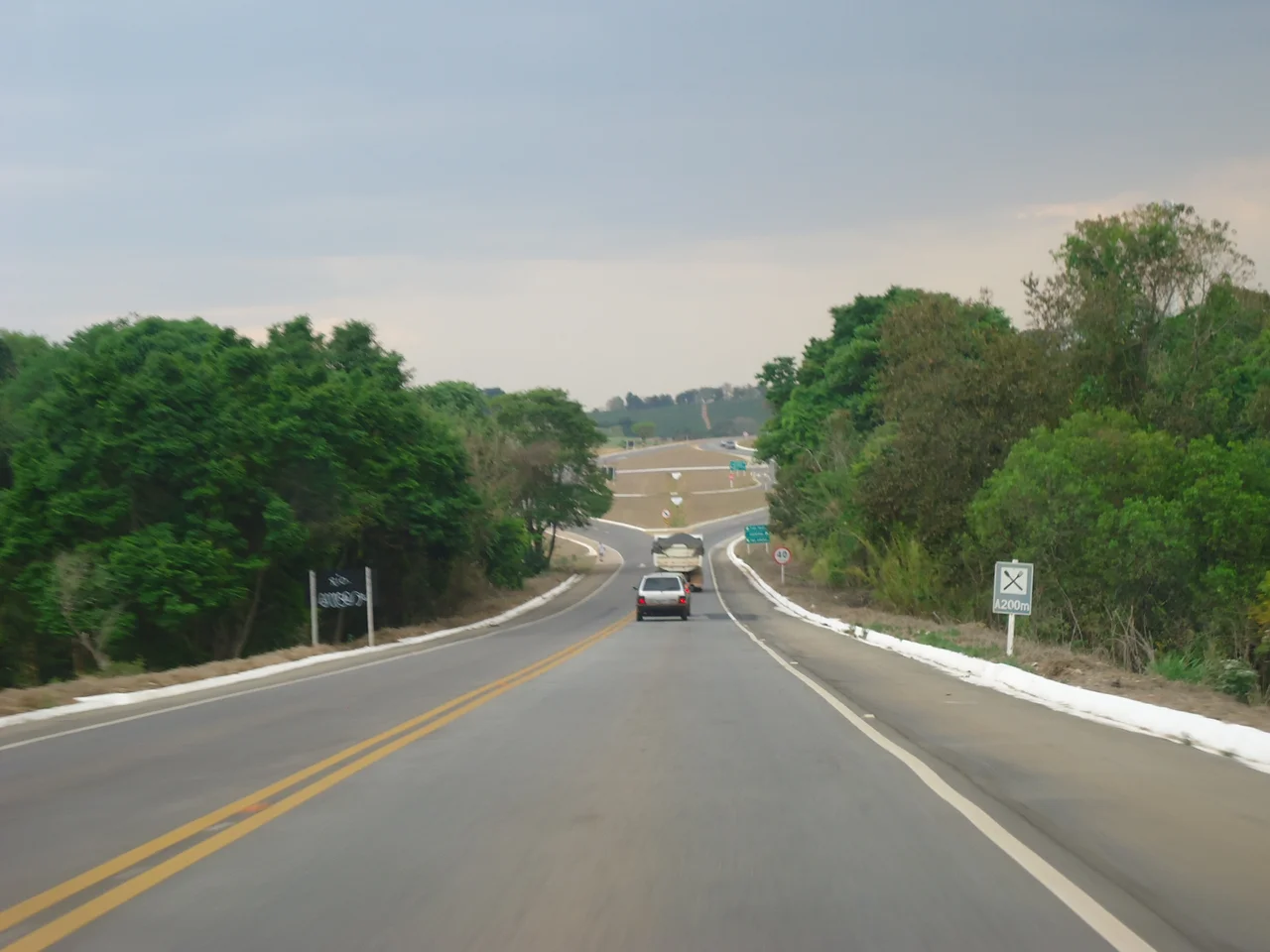

Três Pontas
Three peaks. That is what travelers saw first as they crossed the southern reaches of Minas Gerais in the 1700s, and that is what gave this town its name. Três Pontas - Three Tips - after the serra that rises above the coffee hills, visible for kilometers across the high tableland. The runaway slaves who fled the plantations of colonial Brazil used the same peaks as a compass point, and near the mountain's flank they built the Quilombo do Cascalho, a settlement of escaped people trying to become free. The quilombo was destroyed, but its memory lingers in trails on the mountain and in a stone wall, still standing, that enslaved hands laid without permission. The mountain has outlasted its trespassers, its slavers, and its emperors. It has not outlasted coffee.
Three Peaks, Three Histories
The Serra de Três Pontas rises to 1,234 meters, the highest point in the municipality. From the streets of the city below, which sits at around 905 meters, the three summits form a distinctive profile against the sky - the reason bandeirantes once used the mountain as a landmark and the reason runaway slaves once used it as a hiding place. On October 15, 1768, Captain Bento Ferreira de Brito founded a chapel at the mountain's base, dedicated to Nossa Senhora d'Ajuda, Our Lady of Help. That chapel marks the beginning of Três Pontas as a permanent settlement. A village grew around it, then a town, then a city - formally recognized in 1857. Today the Matriz Nossa Senhora d'Ajuda still stands in the center of Três Pontas, and the remains of Padre Victor, a locally venerated priest, rest inside it. Nineteen kilometers away, the mountain keeps its trails and waterfalls and the wall the enslaved built, now a destination for hikers who often do not know what they are walking past.
A City Built on Coffee
The soil here is red and yellow oxisol - acidic, nutrient-poor by default, but remarkably productive once fertilized. The climate is tropical semi-humid with dry winters and afternoon rains in summer. The altitude sits high enough to give coffee plants the slow ripening they prefer. Put those three facts together and you have one of the largest coffee-producing regions in Brazil, which is to say one of the largest in the world. When trade in coffee took off in the mid-19th century, farmers in Três Pontas shipped their harvests to Rio and Santos, and from there to Europe and North America. Coffee built the city, and coffee still sustains it. The June Expocafé turns the whole region into a commercial fair, millions of dollars changing hands over cuppings and contracts. Between Três Pontas and neighboring Varginha a Coffee Museum preserves the tools and stories of the old plantations - the carts, the drying patios, the sorting tables where women separated beans by hand for wages that kept entire families just above destitution.
The Boy From Três Pontas
Milton Nascimento was born in Rio in 1942 and adopted as an infant. His adoptive family moved him to Três Pontas when he was two years old, and the small Minas Gerais coffee town became, in every meaningful sense, his home. He grew up singing in the choir at Nossa Senhora d'Ajuda, learning guitar from the local radio, absorbing the rhythms of rural work and Catholic ritual that would later pour into his compositions. By the 1960s he had moved to Belo Horizonte and then the wider Brazilian music scene, where he helped found the Clube da Esquina movement alongside the Borges brothers - a generation of songwriters who wove folk melody, jazz harmony, and a distinctly mineiro sensibility into some of the most influential Brazilian music of the 20th century. Nascimento became internationally famous. But he has always returned to Três Pontas. The town still counts him as its own. His voice - high, searching, often wordless - carries, for anyone who knows where to listen, the shape of those three peaks.
The Shape of the Land
Três Pontas sits in the transition zone between two of Brazil's great biomes - the Mata Atlântica coastal forest and the cerrado savanna of the interior. Most of the original vegetation is gone, cleared for coffee over two centuries of cultivation, but woodland patches remain on ridges too steep for plantation rows. The municipality drains into the Furnas reservoir to the south, a Cold War-era hydroelectric lake that flooded part of the old Trespontana Railroad in 1964 and ended an era of steam whistles through the coffee valleys. The old rail terminal became the City Hall. Today the only paved road through town is MG-167, and the fastest way out is the 50-kilometer jog to BR-381, the highway between São Paulo and Belo Horizonte. The population is about 57,000. Most people know each other. And almost everyone, eventually, points to the mountain.
From the Air
Located at 21.37°S, 45.51°W in southern Minas Gerais. The Serra de Três Pontas, rising to 1,234 m, appears as a distinctive three-peaked ridge roughly 19 km northeast of the city center. The Furnas reservoir spreads south of the municipality, its shoreline tracing a complex pattern of submerged valleys. Coffee plantations give the surrounding countryside a characteristic striped appearance from altitude. Leda Mello Resende Airport (SNTF), 3 km from downtown, has a 1,150 m paved runway suitable for small and medium aircraft. Nearby major airport is Pampulha (SBBH) in Belo Horizonte, 290 km north.
Nearby Stories
- Boa Esperança, Minas Gerais 4 km away
- Our Lady of the Rosary Church, Lavras 13 km away
- Três Corações 29 km away
- Poços de Caldas 56 km away
- Guaxupe 68 km away
- Itatiaia National Park 89 km away
- Crucilandia 105 km away
- Southeast Brazil 131 km away