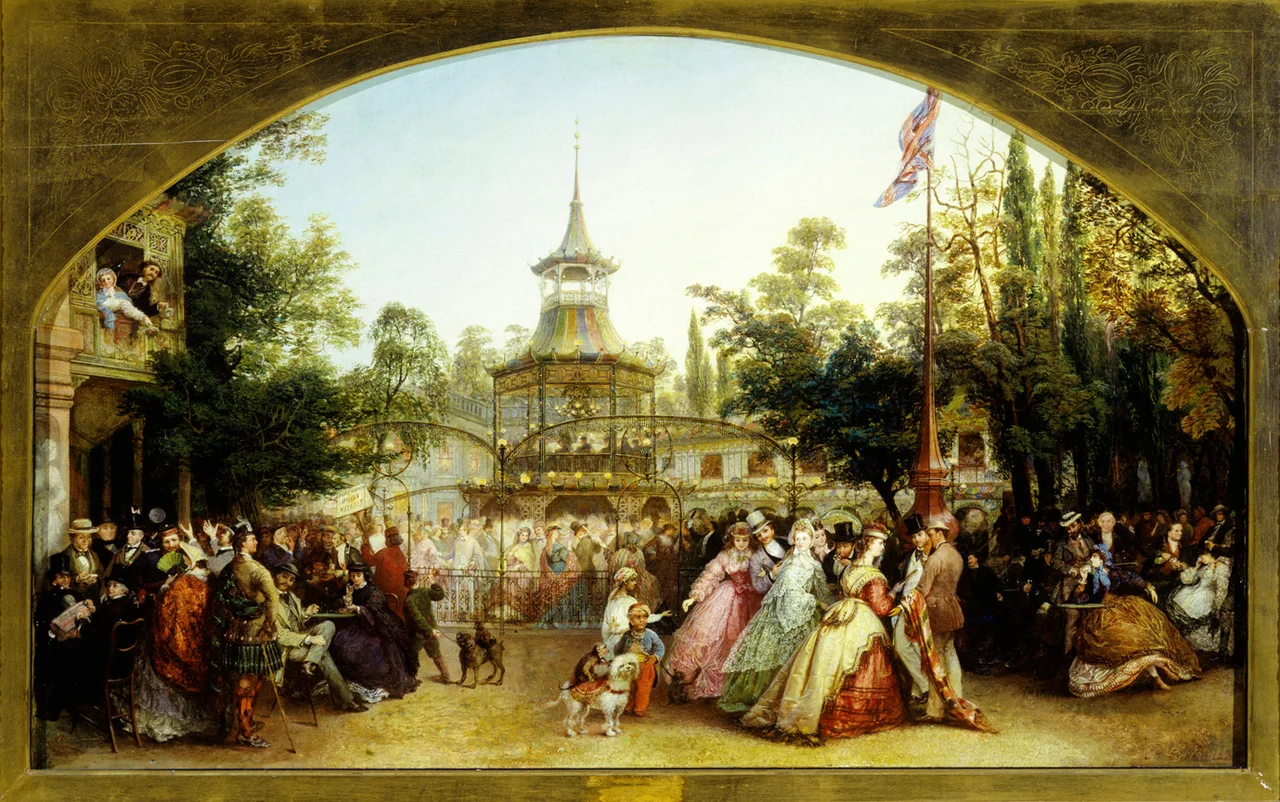

Cremorne Gardens, London
On 12 August 1861, a young performer billed as Pauline Violante stepped onto a tightrope strung from Battersea Bridge to a Victorian pleasure ground on the Chelsea side of the river. Twenty thousand Londoners stood watching. The wire was too slack on her first attempt and she failed. She went back, had the rope tightened, and crossed the Thames on her second try, dressed in Albanian costume, paid for the night by the impresario Edward Tyrrel Smith. The crowd had come to Cremorne Gardens, twelve acres of dancing, drinking, ballooning, fireworks, and faintly improper behaviour. Another tightrope walker, Carlo Valerio, would later die on a wire here. That, too, was part of the show.
From Mansion to Stadium to Spectacle
Cremorne began as a quiet riverside estate. Around 1750 the Earl of Huntingdon built a mansion on the land. It passed through several hands and ended up with Thomas Dawson, 1st Viscount Cremorne, an Irish peer from County Monaghan who lent the property its strange name; "Cremorne" is an Anglicisation of the Irish Críoch Mhúrn, the Bounds of Mourne, the same root that gives us the Mountains of Mourne in Northern Ireland. In 1831 the Dawson family sold up to a Baron de Berenger, a man whose real name was Charles Random and who had once been convicted of fraud. De Berenger turned the riverside grounds into a sports facility called The Stadium and became, of all things, a pioneer of self-defence techniques. His venture collapsed in 1843. James Ellis took over in 1845 and reinvented the site as Cremorne Gardens, a commercial pleasure resort to rival the more famous Vauxhall.
Gas-Lit Nights
The centrepiece was the Crystal Platform, a pavilion three hundred and sixty feet in circumference, ringed with ornamental pillars, gas jets, and over forty plate-glass mirrors in black frames. A reporter from the Illustrated London News in May 1857 admired its "inclosing ironwork enriched, by Defries and Son, with devices in emerald and garnet cut-glass drops, and semicircles of lustre and gas jets, which have a most brilliant effect." Above the dance floor, in the pagoda where the orchestra played, seventeen gas-lit chandeliers blazed. Visitors came by river to the Cremorne Pier, or through the north gate from the King's Road. They danced, they drank, they watched balloon ascents, they listened to orchestras, and they noticed that the women they met were not all who they appeared to be. The gardens quickly acquired a reputation as territory of the demi-monde.
Whistler's Nocturnes
James Abbott McNeill Whistler lived a few hundred yards away on Cheyne Walk, and he came to Cremorne again and again between 1872 and 1877 to watch the gas light and the fireworks. The results were the Nocturnes, atmospheric paintings of the riverside gardens that look almost abstract: smudges of dark blue and gold, with figures and lanterns dissolving into evening air. Two were called Nocturne in Black and Gold: the Firewheel and Nocturne in Black and Gold: the Falling Rocket, both painted around 1874. The Falling Rocket was the painting that John Ruskin attacked as "flinging a pot of paint in the public's face," provoking the famous libel trial of 1878 in which Whistler won a farthing in damages and went bankrupt paying his lawyers. Walter Greaves and his brother Harry, sons of a Chelsea boatbuilder, became Whistler's unpaid assistants and pupils. Walter said: "He taught us to paint, and we taught him the waterman's jerk."
The Respectable Win
What made Cremorne thrilling also made it doomed. The noise carried across the river. The crowds got rowdier. The neighbours, increasingly respectable Chelsea residents in the rising suburb, grew increasingly furious. By the 1870s the gardens were attracting prostitutes and the men who paid them, and the local petition campaign against renewal of the entertainment licence grew impossible to ignore. In 1877 the magistrates refused to renew the licence. Within a year, the gates closed for good. The twelve acres were sold and built over, and a piece of Victorian London that had stood for thirty-two years simply disappeared. Only the road name, Cremorne Road, kept the place alive on a map. Donald James Wheal's memoir of working-class Chelsea, World's End, gives the closest thing we have to a first-person account of what was lost when the gas lamps went out.
A Vestige by the River
Today, just east of Lots Road Power Station, a small green space by the Thames carries the Cremorne name. It is mostly paved over, with two jetties that echo the landing stages where pleasure-seekers once arrived by boat, and one of the original ornamental iron gates, restored and reinstalled. In 2010 it won a Green Flag award. Twice since then the surviving fragment has been threatened, first by Thames Water as a proposed access point for the Tideway super sewer, then in 2014 as a possible site for a Crossrail 2 station. Both times residents pushed back hard, and both times the plans were abandoned. The gardens persist in fiction, too: in Dorothy L. Sayers's Strong Poison, in George MacDonald Fraser's Royal Flash, in Ken Follett's A Dangerous Fortune. Whenever a novelist needs a setting where a Victorian gentleman might lose his reputation, they reach for Cremorne.
From the Air
Cremorne Gardens sits at 51.48 N, 0.178 W on the north bank of the Thames in Chelsea, between Chelsea Harbour and the end of the King's Road, just east of Lots Road Power Station. From the air, look for the bend of the river where it turns south below Battersea Park, with the chimney of Lots Road as a landmark and the four chimneys of Battersea Power Station visible to the east. The vestigial green space is small, hard to spot. Nearest airports: London Heathrow (EGLL) about 10 nm west, London City (EGLC) about 9 nm east. Approach altitudes 2,000 to 4,000 feet on a clear day; expect haze and dense controlled airspace over central London.
Nearby Stories
- Battle of Britain, Northfleet 1.1 km away
- Bayham Old Abbey 5.4 km away
- Catharine Macaulay 6.4 km away
- Hatfield rail crash 8.8 km away
- Chequers 8.9 km away
- Chelmsford Cathedral 10 km away
- Queen Victoria Hospital 13 km away
- Fishbourne Roman Palace 36 km away