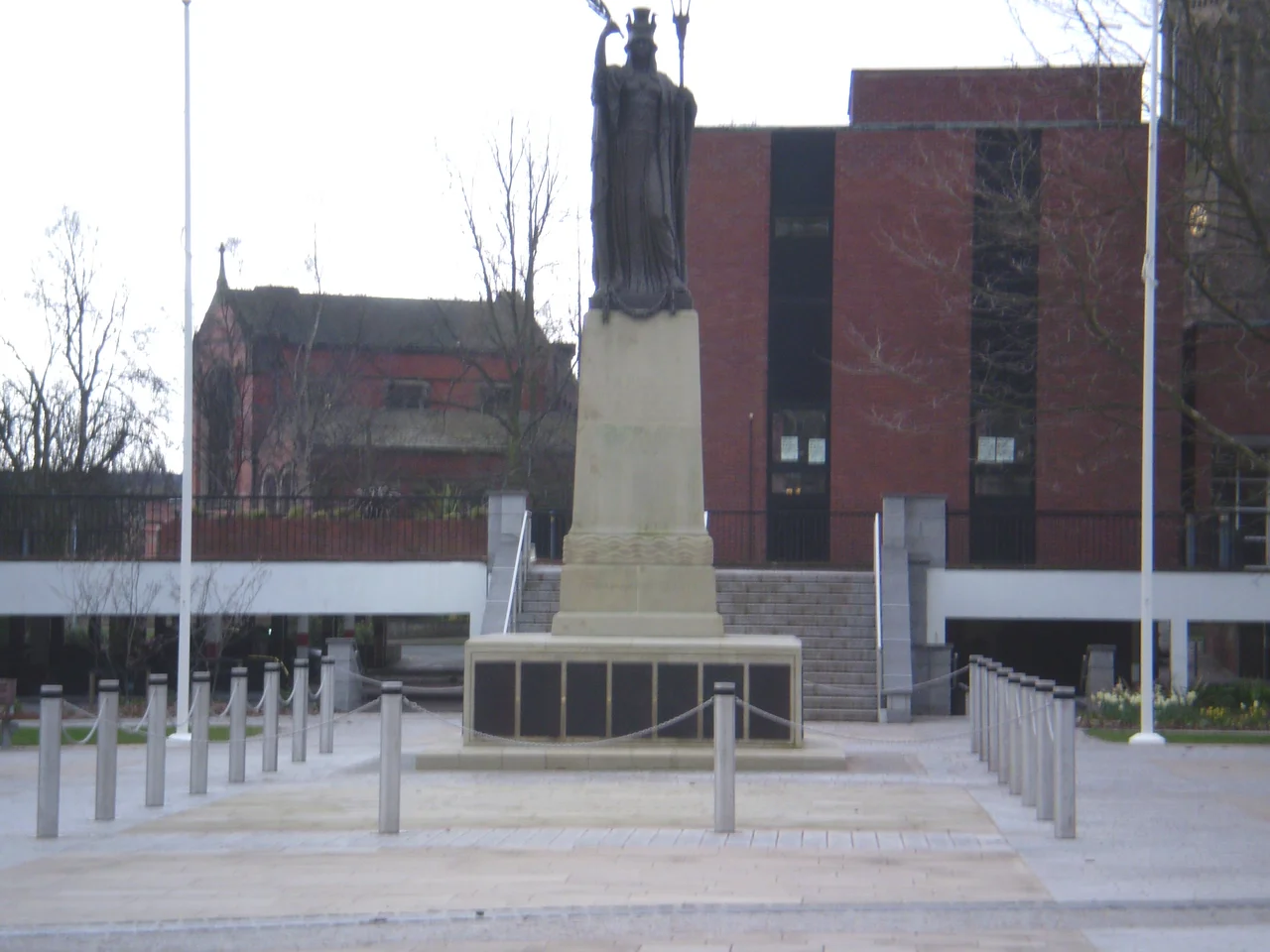

Crewe
The old riddle, repeated by local historians for well over a century, runs like this: the place which is Crewe is not Crewe, and the place which is not Crewe is Crewe. It is not a joke. It is an accurate description of the town's geography. The original village of Crewe lay east of the modern town, in the parish of Barthomley. When the Grand Junction Railway opened its station in 1837, the directors built it on farmland not in Crewe township but in the neighbouring township of Monks Coppenhall. They called the station Crewe anyway, because that was the name of the nearby hall and the nearest community of any size. The town that grew up around the station took the station's name. The original village, now called Crewe Green, formally changed its name in 1984 so that the postman would stop getting confused. The town of Crewe, in other words, is named after its own railway station.
The Town That a Junction Built
Joseph Locke, chief engineer of the Grand Junction, drew up a plan for a new settlement around the station in 1840. The railway company built most of the early houses through the 1840s and 1850s, a planned industrial colony with terraces, churches, schools and a co-operative store, laid out with the rigour of an engineer's drawing. The population was forty thousand by 1871. Francis Webb, Locomotive Superintendent of the LNWR from 1871 to 1903, came close to being the town's de facto governor. He oversaw a workforce of eighteen thousand, eight thousand of them at the Crewe Works, and his political influence in local elections was so heavy that the editor of the Crewe Chronicle published charges in 1885 that the railway's Tory management was crushing Liberalism out of the town. The borough council formally debated the same accusation in 1889. Webb was not subtle, but he was effective. The town as it survives today, with its grid of red-brick terraces, owes its layout to him.
Where the Bentleys Are Made
The Pyms Lane factory on the west side of town has built motorcars since 1946, originally for Rolls-Royce, then for Bentley, and only Bentley since 2003. The split happened when BMW won the rights to the Rolls-Royce brand and Volkswagen kept Bentley, which kept the Crewe factory. About 3,500 people now work at the site, building the marque's flagship Continental and Flying Spur models. Bentleys assembled in Crewe go to buyers in every continent that has a paved road. A short distance away at Radway Green, BAE Systems makes small-arms ammunition for the British armed forces in a discreet factory that has been there since wartime. The Crewe economy is less railway-and-cars-only than it was a generation ago: business parks and distribution centres surround the town, and the Alstom site at Crewe Works has been chosen as one of the assembly sites for the HS2 high-speed trains, though the planned northern leg of HS2 itself was cancelled in October 2023 by Prime Minister Rishi Sunak.
Why Trains Stop Here
Crewe station is one of the most important interchanges on the British railway network. Twelve platforms in use, served by Avanti West Coast for the inter-city services to London Euston and Glasgow, by Transport for Wales for Cardiff and Wrexham, by London Northwestern for Birmingham and Liverpool, by East Midlands Railway for Derby and Nottingham, and by Northern for the two Manchester routes. Trains from Holyhead pause here, picking up passengers off the Dublin ferries. The Glasgow sleepers thread through here in the night. The station opened in 1837 and grew to fit the traffic; the elaborate Edwardian Municipal Buildings on Earle Street, opened in 1905, are the civic counterpart to the railway buildings a few hundred yards away. The Crewe Heritage Centre, in the old LMS railway yard, holds the British Rail Class 370 Advanced Passenger Train as its star exhibit, the tilting prototype that almost worked in 1981 and that pointed the way to the Pendolinos that pass through Crewe today on the West Coast Main Line.
Beyond the Tracks
There is more to Crewe than the railway and the car factory, though both shape almost everything else. Queens Park, restored at a cost of £6.5 million in 2010, is the town's main green space, with walks, a play area and a boating lake. The Grade II-listed Edwardian Lyceum Theatre, built in 1911, hosts the touring drama, ballet and pantomime that keep many British market towns culturally alive. Crewe Hall, the Jacobean mansion built between 1615 and 1636 for Sir Randolph Crewe, sits east of town near the original Crewe Green and now operates as a hotel. Roald Dahl name-checked the town in a limerick in Matilda, which says something about the place's status in the British imagination, somewhere between famous and absurd. There is even a crater on Mars named Crewe, mapped by NASA on the basis of an Ordnance Survey naming convention. Author Alan Garner, born in Cheshire, called Crewe in his novel Red Shift the ultimate reality. He did not entirely mean it as a compliment. He did not entirely mean it as an insult, either.
From the Air
Crewe sits at 53.10N, 2.44W in the Cheshire Plain, 158 miles northwest of London. From the air, the dominant feature is the West Coast Main Line running north-south through the town, with Crewe station as the busiest junction in the area; multiple lines fan out from the station including the routes to Chester, Manchester, Stoke, Cardiff and Holyhead. The Bentley factory at Pyms Lane is a large rectangular industrial site about a mile west of the station. Crewe Hall and the original Crewe Green village lie a few miles east of the modern town. The terrain is flat agricultural country, mostly dairy. Recommended viewing altitude 3,000-5,000 ft to take in the railway fan and the town's relationship with the surrounding farmland. Nearest airports: Manchester (EGCC) 27 nm north, Liverpool John Lennon (EGGP) 25 nm northwest, Hawarden (EGNR) 26 nm west-northwest.
Nearby Stories
- Battle of Rowton Heath 1.1 km away
- Knowsley Hall 1.7 km away
- Old Trafford 2.9 km away
- Tutbury Castle 7.2 km away
- Haddon Hall 7.5 km away
- Whittington Castle 14 km away
- Stafford Castle 16 km away
- Wentworth Castle 19 km away