.jpg)
Crime Museum
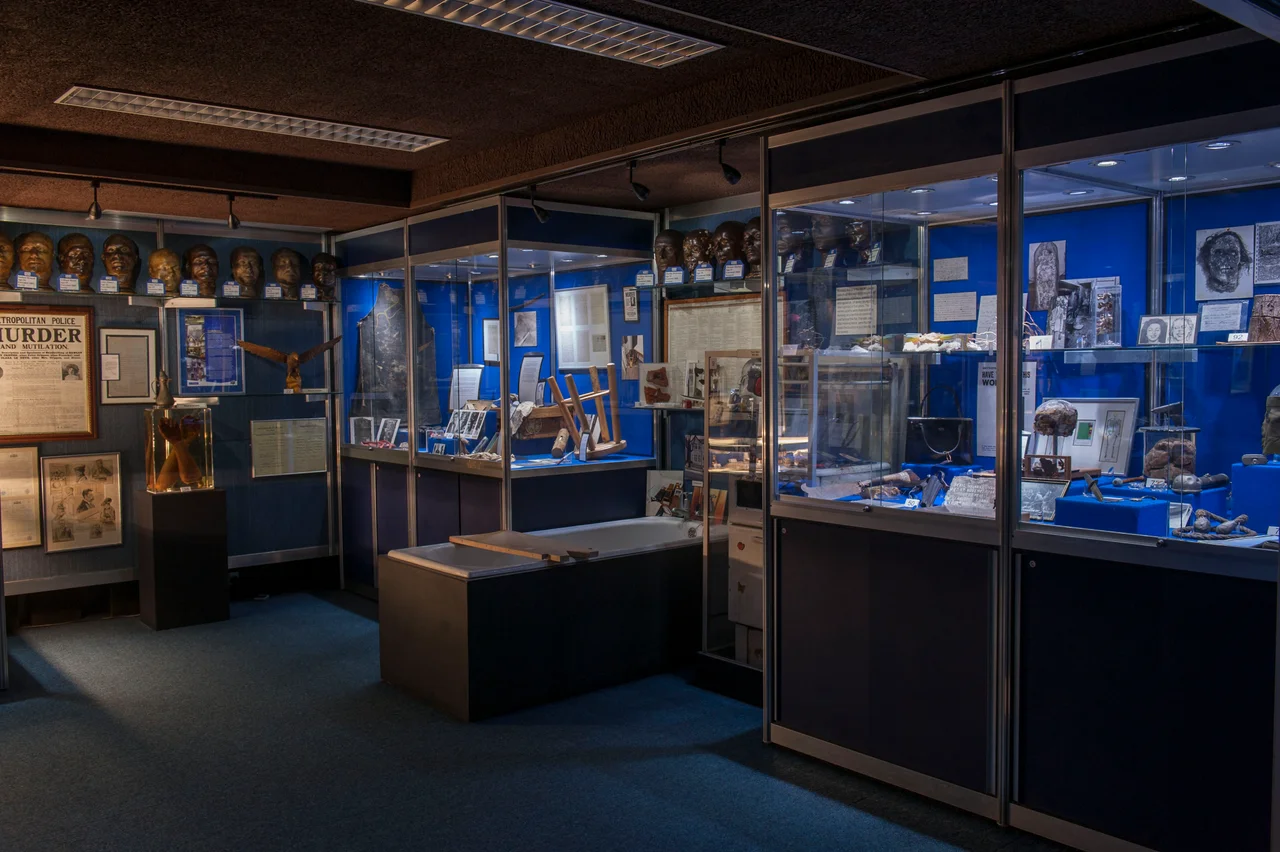
There is a museum in central London with more than 500 exhibits, each one kept at a constant 17 degrees Celsius. You cannot buy a ticket. You cannot book a tour. Unless you are a serving police officer, a lawyer involved in an ongoing case, a member of the royal family, or a similarly vetted VIP, you cannot get in at all. The Crime Museum sits in the basement of New Scotland Yard, the headquarters of the Metropolitan Police, and almost no one outside the Met has ever seen it. The exhibits include the ricin pellet that killed a Bulgarian dissident on Waterloo Bridge, the noose used to execute the last woman hanged in Britain, and Dennis Nilsen's actual stove. It is, by some distance, the strangest museum in London.
Origins in a Property Room
The collection began as a filing problem. The Forfeiture Act 1870 gave the police authority to keep, rather than return, items used in crimes. Within a few years they had so many items that an Inspector called Percy George Neame decided to organise them. In 1874 he started gathering objects with the explicit intention of teaching young officers how to recognise the tools and techniques of criminals. The first exhibits, sombrely, were clothing and personal effects belonging to Jane Clouson, a seventeen-year-old girl murdered in Eltham. Neame and a constable called Randall received permanent appointments to the Prisoners Property Store on 12 April 1875, which is the closest thing the museum has to a birthday. Officially there was never an opening. On 8 April 1877, a reporter from The Observer was refused entry by Neame. To get even, the journalist coined the name that stuck for over a century: the Black Museum.
Suicide and Scandal
Neame retired on the last day of 1901. Six months later, on a June morning in 1902, Chief Inspector Arthur Fair and another officer arrived at his front door to ask him about "a few things in his accounts which they could not understand with reference to money seized at gaming houses." Standing inside, Neame put a gun to his head and pulled the trigger. The man who had spent twenty-seven years cataloguing other people's last moments left no explanation of his own. The museum he had built survived him. It moved with Scotland Yard in 1890 to Norman Shaw's granite building on the Thames Embankment, the granite itself quarried by convicts on Dartmoor, then again in 1967 to Victoria Street, and finally to its current home in the basement of the Curtis Green Building, redesigned in 2018 by Allford Hall Monaghan Morris into what the architects called a "dark and dramatic" space.
An Index of Cruelty
What is in there is hard to absorb. The hangman's nooses include the one used to execute Ruth Ellis in 1955, the last woman hanged in Britain, alongside the revolver she used to shoot her lover David Blakely. There are death masks made of criminals executed at Newgate Prison, acquired by the Met in 1902 when the prison closed. There is the poison kit of the Lambeth Poisoner, the Scottish-born serial killer Thomas Neill Cream. There is the trunk from the Charing Cross Trunk Murder, the uniform of Constable Keith Blakelock killed at Broadwater Farm in 1985, the pistol the Indian revolutionary Udham Singh used to assassinate the former Lieutenant Governor of the Punjab. There is a cast of the hole drilled into the vault wall during the Hatton Garden burglary of 2015. Each object stands in for someone who suffered, or someone who caused suffering, or both. The museum's purpose is instruction, not voyeurism, but it requires a strong stomach.
The Bulgarian Umbrella
Some exhibits read like fiction. The ricin pellet that killed Georgi Markov in 1978 is the size of the head of a pin. Markov was a Bulgarian dissident writer working for the BBC World Service. While he was waiting for a bus on Waterloo Bridge, a stranger jabbed him in the leg with the tip of an umbrella, apologised, and walked away. The umbrella had been modified to fire a tiny platinum-iridium sphere containing a hollow charge of ricin. Markov went home, complained of a sore leg, developed a high fever, and died four days later. The murder has never been formally solved, but the pellet recovered from his body sits in the basement of Scotland Yard, and a model of the suspected umbrella sits beside it. So does the fake De Beers diamond from the Millennium Dome heist of 2000, and Dennis Nilsen's stove and bathtub, in which one of Britain's worst serial killers cooked and disposed of his victims.
A Museum That Travels
For most of its history the Crime Museum has been a rumour. Orson Welles hosted a 1951 BBC radio series called The Black Museum that turned individual exhibits into dramatised half-hour stories. A 1958 horror film called Horrors of the Black Museum borrowed the name. Charlie Brooker's Black Mirror used it for one of his bleakest episodes. The collection finally went public, briefly, when 600 objects were lent to the Museum of London for the exhibition The Crime Museum Uncovered, which ran from October 2015 to April 2016. Since then, the museum has lent individual exhibits to other institutions: Great Train Robbery materials to the Postal Museum, espionage items to the Science Museum, Roger Casement trial pieces to Kerry County Museum in Ireland. But the door in the basement remains shut. You have to be the right kind of person to walk through it.
From the Air
The Crime Museum is housed in the Curtis Green Building, the present New Scotland Yard, at 51.4986 N, 0.1331 W on Victoria Embankment, just north of the Thames between Westminster Bridge and Charing Cross. From the air, the building is a six-storey 1930s block with a curved facade facing the river, two blocks west of the Houses of Parliament. Nearest airports: London City (EGLC) about 8 nm east, London Heathrow (EGLL) about 13 nm west. Approach at 2,000 to 4,000 feet for the best view of the Whitehall complex, with the Thames as your primary navigational reference.
Nearby Stories
- Battle of Britain, Northfleet 1.1 km away
- Bayham Old Abbey 5.4 km away
- Catharine Macaulay 6.4 km away
- Hatfield rail crash 8.8 km away
- Chequers 8.9 km away
- Chelmsford Cathedral 10 km away
- Queen Victoria Hospital 13 km away
- Fishbourne Roman Palace 36 km away