_crop.jpg)
Cromer Pier
Queen Elizabeth I wrote a letter about it in 1582. That alone sets Cromer Pier apart. While most English seaside piers were Victorian novelties built for promenading Londoners, Cromer's relationship with its pier stretches back to at least 1391 — when the structure was little more than a timber jetty jutting into the grey North Sea. The queen's letter granted the town rights to export wheat, barley, and malt, with the proceeds earmarked for the pier's upkeep. Even then, keeping it standing was the hard part.
Six Centuries of Obstinate Persistence
The history of Cromer Pier is largely a history of things going wrong and being rebuilt anyway. A cast-iron jetty constructed in 1822 lasted just 24 years before a storm reduced it to rubble. Its wooden replacement became so popular for evening strolls that a keeper was hired to enforce rules: no smoking, and ladies off the jetty by nine o'clock. That jetty survived until 1897, when a coal boat smashed into it. The timber was sold for £40.
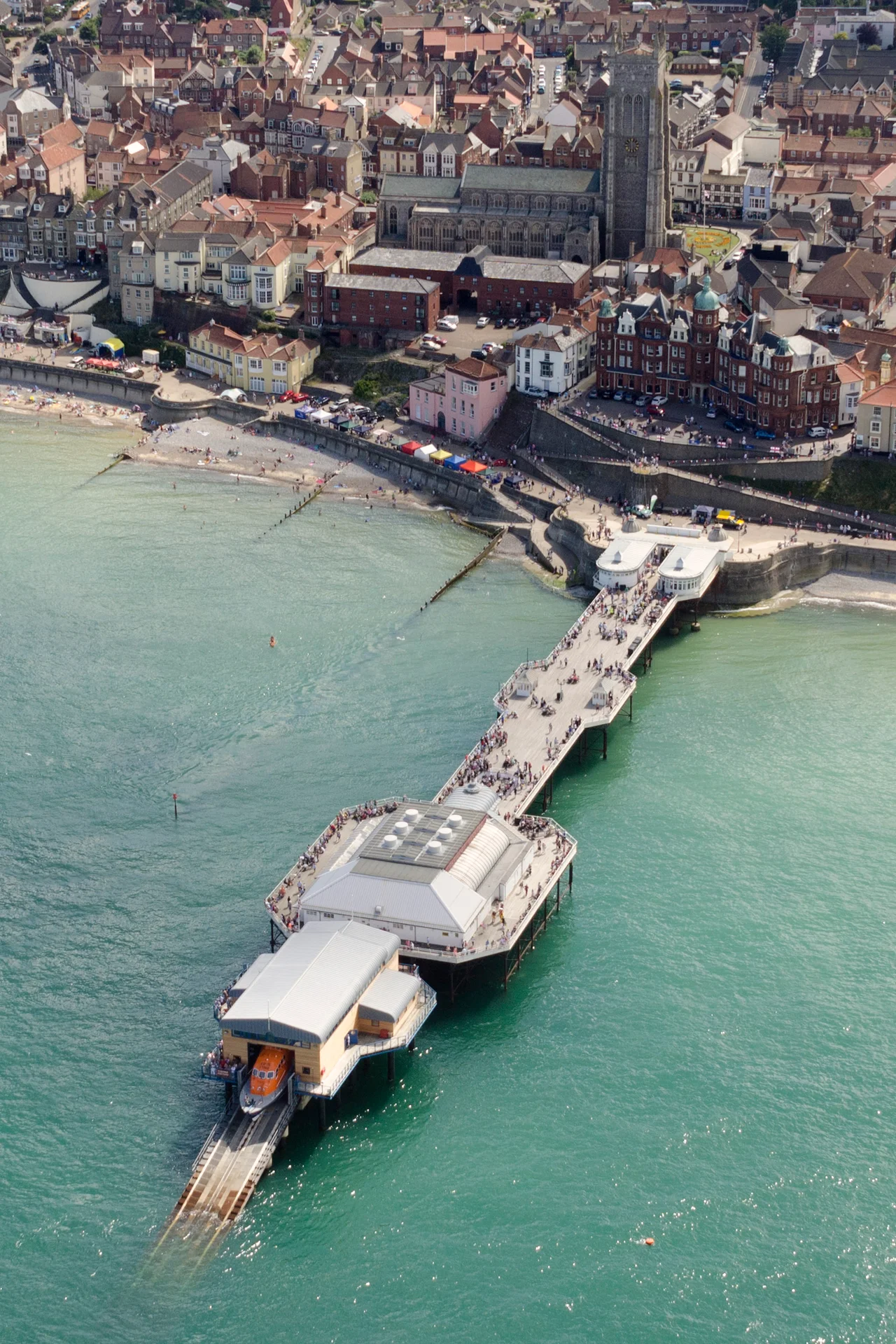
The current pier — 450 feet long, designed by Douglass and Arnott, opened in 1901 — cost £17,000 and was an immediate civic pride. Glass-screened shelters lined its length. By 1905 they had been roofed over into a proper pavilion, the bandstand swapped for a proscenium arch and a stage. By 1907, that stage was given over to roller-skating, the Victorian craze that briefly swept seaside resorts across Britain. The pier has outlasted them all.
The December Surge
The closest the current pier came to destruction was not in the Edwardian era but in December 2013. Storm surge Cyclone Xaver sent a wall of water along the North Sea coast on the 5th, and Cromer took the hit. Decking boards buckled. The souvenir shop flooded. The box office caved in. The floor of the Pavilion Theatre cracked and lifted.
The surge arrived just months after a £1.2 million repair scheme had been completed — new metal trusses, replaced cross braces — and that timing almost certainly saved the pier's core structure. What would have been catastrophic damage was reduced to serious but repairable harm. Within a week, engineers revised repair estimates upward from tens of thousands to hundreds of thousands of pounds. Within a week after that, the Christmas show was back on. The theatre opened on 12 December, barely a week after the surge, to a sold-out audience.
The Last End-of-Pier Show
At the far end of the pier, beyond the lifeboat station, the Pavilion Theatre does something almost no other venue in Britain still does: it stages a live variety show, night after night, every summer season. The tradition dates to when the pier first opened. Dancers, comedians, singers, and magicians have performed here decade after decade, through wars and storms and the long decline of the British seaside holiday.
The Pavilion has appeared in film and television precisely because it looks the part. The 2013 comedy Alan Partridge: Alpha Papa climaxed on Cromer Pier. The 1979 ITV series Danger UXB used the pier as a location. In 2018, a BBC Christmas ident filmed here froze time for a mother and son to share a perfect day by the sea. The pier has been voted Pier of the Year by the National Piers Society in 2000, 2015, and 2024 — a hat trick that reflects how seriously the town takes what could easily have been abandoned long ago.
Lifeboats at the End of the Plank
The pier's far end has served a more serious function since the 1920s: it houses the Cromer Lifeboat Station, elevated above the surf line to allow motor lifeboats to launch beyond the breakers that roll in from the North Sea. The station covers a long and exposed section of coast — Great Yarmouth is 40 miles south-east by sea, Wells-next-the-Sea 25 miles west, with no harbour in between.
The most famous figure associated with this station never worked from the pier end at all. Henry Blogg, whose museum sits on the seafront just yards away, won the RNLI gold medal for bravery three times and the silver medal four times — the most decorated lifeboatman in the institution's history. The pier became, in a sense, the physical extension of that tradition: a plank of civic will thrust into the sea, daring it to do its worst.
From the Air
Cromer Pier is located at 52.9343°N, 1.3016°E on the north Norfolk coast. From the air at 2,000–3,000 feet, the pier is immediately visible as a thin structure extending due north from the town seafront into the North Sea. The Pavilion Theatre at the pier's far end appears as a white building. The nearest airport is Norwich International Airport (EGSH), approximately 23 miles south. Northrepps Aerodrome (private) is 3 miles south-east of Cromer. Coastal winds from the north and north-east can be significant.
Nearby Stories
- Castle Acre Castle and Town Walls 3.5 km away
- Brancaster 5.8 km away
- City of Norwich Aviation Museum 6.8 km away
- HMS Cobra 21 km away
- Alford Windmill 35 km away
- Battle of Lowestoft 83 km away
- SM U-97 95 km away
- Battle off Texel 119 km away