
Crystal Palace, London
The area got its name from a building that does not exist. Crystal Palace, the great glass-and-iron exhibition hall that Joseph Paxton had thrown up in Hyde Park for the Great Exhibition of 1851, was dismantled and rebuilt on top of Sydenham Hill between 1852 and 1854, enlarged, glittering, the largest glass structure of its age. The neighbourhood that grew around it took on the building's name. Then, on the night of 30 November 1936, the Palace burned. Smoke from the fire was visible across most of southern England. By morning it was gone. The name stayed. So did the hill, one of the highest points in London at 367 feet above sea level, and the strange habit of a district being defined by a ghost.
On the Ridge
Stand on Norwood Ridge and on a clear day you can see central London to the north, the Queen Elizabeth II Bridge and Greenwich to the east, and the North Downs rolling away south. For centuries this hill was part of the Great North Wood, a wilderness of oak forest at the edge of the expanding city, a place where Londoners came to escape the smoke. The Vicar's Oak, an ancient tree at the crossroads where Church Road meets Westow Hill, was used to mark the parish boundaries. Five boundaries, in fact: the modern district of Crystal Palace straddles five London boroughs (Bromley, Croydon, Lambeth, Southwark, and Lewisham) and three postcodes, none of which can quite agree on where it begins or ends. The Vicar's Oak is gone, but the disagreement remains.
The Triangle
The shopping heart of the district is the Crystal Palace Triangle, three streets - Westow Street, Westow Hill, and Church Road - meeting in a flatiron of independent restaurants, vintage furniture shops, art galleries, and a farmers' market on Haynes Lane. The bohemian-village feeling earned Crystal Palace a top-ten spot in The Sunday Times list of best places to live in London in 2016, then the number one spot in April 2022. The building at 25 Church Road tells the story of how this happened: it opened as the Rialto cinema in 1928, became the Picture Palace, closed in 1968, was a bingo hall, then a Pentecostal church, and after considerable restoration reopened in 2018 as the 25th Everyman Cinema. The neighbourhood keeps reinventing itself without losing the bones.
The Park and the Dinosaurs
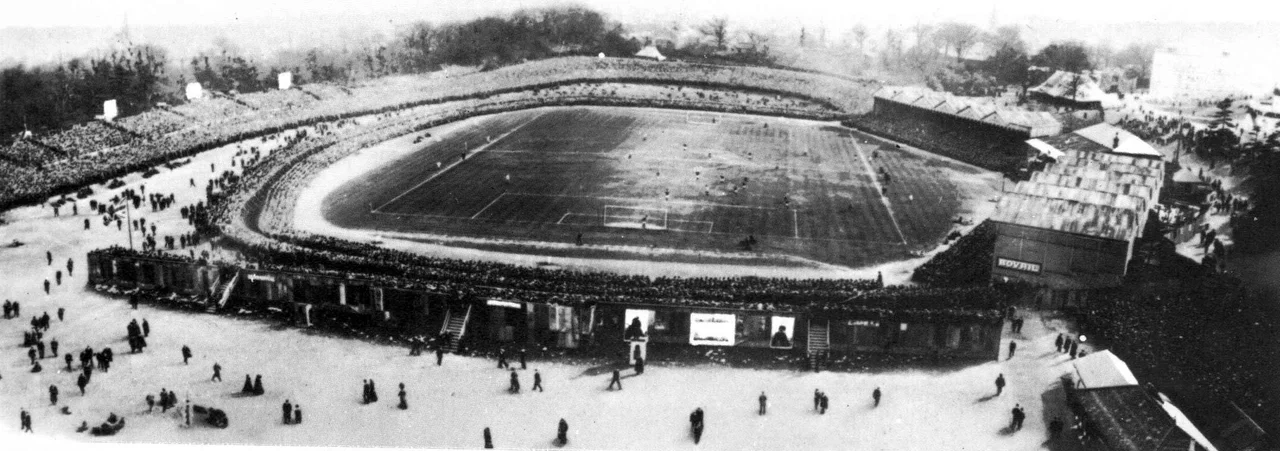
The hilltop site of the lost Palace is now Crystal Palace Park, a Victorian pleasure ground that survived the fire. It contains the National Sports Centre, built in 1964 on the foundations of the old football stadium that hosted FA Cup Finals from 1895 to 1914, and a famous group of life-size dinosaur sculptures created by Benjamin Waterhouse Hawkins in 1854. Their anatomy is hilariously wrong by modern standards (the iguanodon is built like a rhino) but they were the first attempt by anyone to render extinct creatures at full scale, and they are protected as Grade I heritage assets. The Bob Marley plaque on the Crystal Palace Bowl marks his last and largest London concert, on 7 June 1980. The park passed to the Crystal Palace Park Trust in 2023 after decades of being shuttled between London government bodies.
Two Towers
From almost anywhere in south London you can see two enormous lattice masts rising from the ridge. The Crystal Palace transmitter, built in 1956 on the site of the Palace's destroyed aquarium, is 219 metres tall and is currently the eighth-tallest structure in London. Beside it stands the Croydon transmitter, finished in 1962, slightly shorter at around 152 metres. Together they handle the main TV and FM signals for the capital and the surrounding Home Counties, which is why the masts have been there since the 1930s in one form or another. John Logie Baird ran his television experiments from the original Crystal Palace itself, his transmitter perishing in the 1936 fire. The masts are unsubtle reminders that this hill has been broadcasting at London for a very long time.
Writers, Painters, and a Rapper
Arthur Conan Doyle was elected President of the Upper Norwood Literary and Scientific Society in May 1892, in the Foresters Hall on Westow Street. He served three years while writing the early Sherlock Holmes stories. The French novelist Emile Zola, on the run after his J'Accuse open letter and a criminal libel conviction in France, hid out in what is now the Queen's Hotel on Church Road from October 1898 to June 1899. The Impressionist Camille Pissarro stayed here in 1870 and 1871, painting the suburb during his exile from the Franco-Prussian War. The Shakespearean actor Ira Aldridge, one of the first major Black actors on the European stage, lived on Hamlet Road. The British rapper Speech Debelle was born here and left, she said, "because of traffic and parking problems." The neighbourhood persists. The Italian Job filmed Michael Caine's "You were only supposed to blow the bloody doors off!" sequence at the sports centre. The Chemical Brothers shot the video for Setting Sun in the park. Crystal Palace remains a place to leave and a place to come back to.
From the Air
Crystal Palace sits at 51.4203 N, 0.0705 W on Sydenham Hill in south London, about 7 miles southeast of Charing Cross. From the air, look for the two enormous lattice masts on the ridge, the Crystal Palace transmitter at 219 metres being unmistakable in the London skyline south of the river. The green of Crystal Palace Park surrounds them. Nearest airports: Biggin Hill (EGKB) about 8 nm southeast, London City (EGLC) about 8 nm north, London Gatwick (EGKK) about 18 nm south. Best viewed at 2,500 to 5,000 feet on a clear day; the hill is one of the highest points in London and the masts are visible from much of the city.
Nearby Stories
- Battle of Britain, Northfleet 1.1 km away
- Bayham Old Abbey 5.4 km away
- Catharine Macaulay 6.4 km away
- Hatfield rail crash 8.8 km away
- Chequers 8.9 km away
- Chelmsford Cathedral 10 km away
- Queen Victoria Hospital 13 km away
- Fishbourne Roman Palace 36 km away