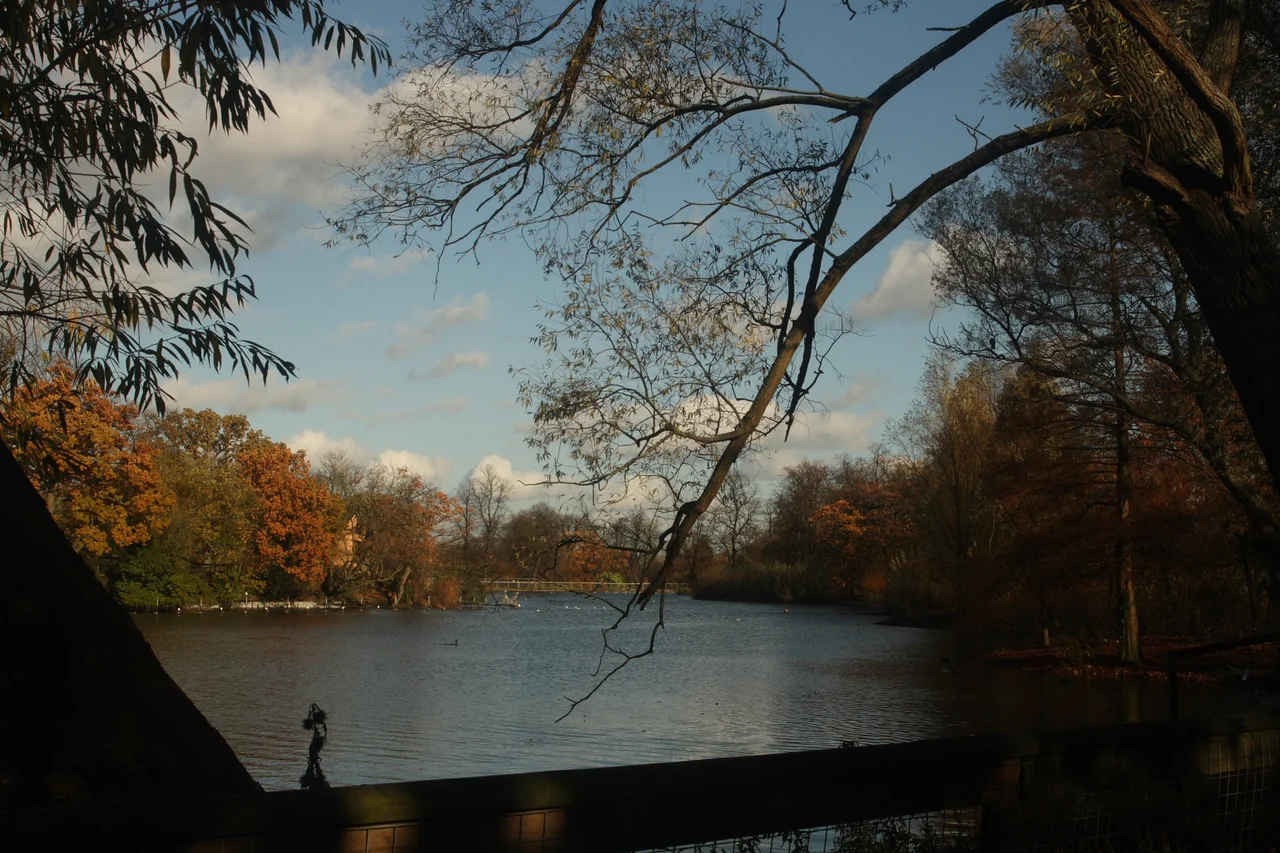

Crystal Palace Park
On the night of 30 November 1936, the largest glass building in the world burned to the ground in south London. The flames could be seen across most of southern England, and on the BBC the next morning Winston Churchill called it "the end of an age." Crystal Palace had been at the centre of this hilltop park for eighty-two years, the Victorian wonder rebuilt and enlarged here in 1854 after its first life as the centrepiece of the Great Exhibition. The Palace was gone by morning. The park was not. The fountains, the dinosaurs, the lake, the cricket ground, the long Italian terraces, all of it remained, and the park has been a curious kind of monument to absence ever since, the open space where a building used to be.
Paxton's Second Act
Sir Joseph Paxton had built the original Crystal Palace as a temporary pavilion in Hyde Park for the Great Exhibition of 1851. When the government decreed the structure had to come down, Paxton refused to let it die. He formed the Crystal Palace Company, bought the building for £70,000, and acquired a 389-acre site on Sydenham Hill straddling the old Kent and Surrey border. Between 1852 and 1854 he rebuilt it, larger this time, the total cost rising to £1.3 million. The landscape designer Edward Milner shaped the gardens, the Italian fountains, and a Great Maze (160 feet across, one of the largest in the country). Isambard Kingdom Brunel designed the two 284-foot water towers that powered the cascading fountains. Queen Victoria opened the rebuilt Palace in June 1854, and the suburb that grew up around it took the building's name.
Dinosaurs Before Anyone Knew
Walk down to the southeast corner of the park and you will find them: full-scale concrete sculptures of dinosaurs and extinct mammals, half-hidden in a deliberately designed "geological" landscape around the tidal lake. The sculptor Benjamin Waterhouse Hawkins finished thirty-three of them in 1854, working from the best science of his day, which was not yet very good. His iguanodon is built like a rhinoceros with a horn on its nose rather than the lithe biped paleontologists now know it to have been. Charles Darwin himself contributed a megatherium skull to the project. These were the first life-size attempts anyone had made to render the prehistoric world. Hawkins held a famous dinner inside the mould of his iguanodon on New Year's Eve 1853, before the concrete went on. The sculptures are now Grade I listed in their own right. Their anatomy is wrong. Their place in the history of science is irreplaceable.
The Wembley Before Wembley
After the cricket ground opened in 1857 (it became the home of London County Cricket Club from 1900 to 1908, with W.G. Grace involved in the club's founding), the park steadily filled up with sport. In 1894 the two largest fountains were grassed over. In 1895 the south basin was converted into a football stadium, which hosted every FA Cup Final from 1895 until 1914, the showpiece event of English football before Wembley existed. Crystal Palace F.C. itself was founded in 1905 to play home matches in the stadium. The First World War forced the club out, and they eventually settled at Selhurst Park in 1924, where they still play today as a Premier League side. The north water tower came down in 1941, perhaps to deny German bombers a navigation landmark. The south tower had already been demolished after fire damage. The football stadium itself was replaced in 1964 by the National Sports Centre.
Bob Marley's Last London Show
On 7 June 1980, Bob Marley played the Crystal Palace Bowl, a natural amphitheatre tucked into the park's northern corner. It was his last and largest concert in London. He was dying. A melanoma diagnosed in 1977 had spread, and within a year he would be gone, dead at thirty-six in May 1981. The Bowl had been a music venue for nearly sixty years by then, hosting Pink Floyd, Elton John, Eric Clapton, the Beach Boys, an open-air succession of summers. A blue plaque was finally affixed to the structure in October 2020 to mark Marley's appearance, the day forty years after his fans had stood on the grass and watched him sing. Ian Ritchie's permanent concert stage from 1996 was nominated for the RIBA Stirling Prize, then slowly fell into disrepair. Bromley Council and a local action group are working to bring it back.
A New Chapter
After the Greater London Council was abolished in 1986, the park passed to the London Borough of Bromley, which restored the dinosaurs and a third of the grounds between 2001 and 2003. The decades since have been a long argument about what the park is for. Proposals in 1989, 1997, 2003, 2007, and 2013 have tried to build hotels, multiplex cinemas, a new football stadium, even a Chinese-funded replica of the original Palace. Most of these were defeated by determined local campaigning. In 2023, after years of preparation, the newly formed Crystal Palace Park Trust took over much of the park's management. Their £40 million regeneration project, partly funded by selling two sites to Clarion Housing Association for social housing, began on the ground in May 2025 and is due to finish in 2027. The plan refurbishes the dinosaurs and terraces and adds new play areas. The Palace is not coming back. The park is becoming something new.
From the Air
Crystal Palace Park lies on Sydenham Hill at 51.4203 N, 0.0705 W in the London Borough of Bromley, about 7 miles southeast of Charing Cross. From the air, look for the two enormous transmission masts (Crystal Palace at 219 metres, Croydon nearby) on the ridge; the park is the green space surrounding them, with the National Sports Centre's curved stadium visible at the southern end. Nearest airports: Biggin Hill (EGKB) about 8 nm southeast, London City (EGLC) about 8 nm north, London Gatwick (EGKK) about 18 nm south. Best viewed at 2,500 to 5,000 feet on a clear day.
Nearby Stories
- Battle of Britain, Northfleet 1.1 km away
- Bayham Old Abbey 5.4 km away
- Catharine Macaulay 6.4 km away
- Hatfield rail crash 8.8 km away
- Chequers 8.9 km away
- Chelmsford Cathedral 10 km away
- Queen Victoria Hospital 13 km away
- Fishbourne Roman Palace 36 km away