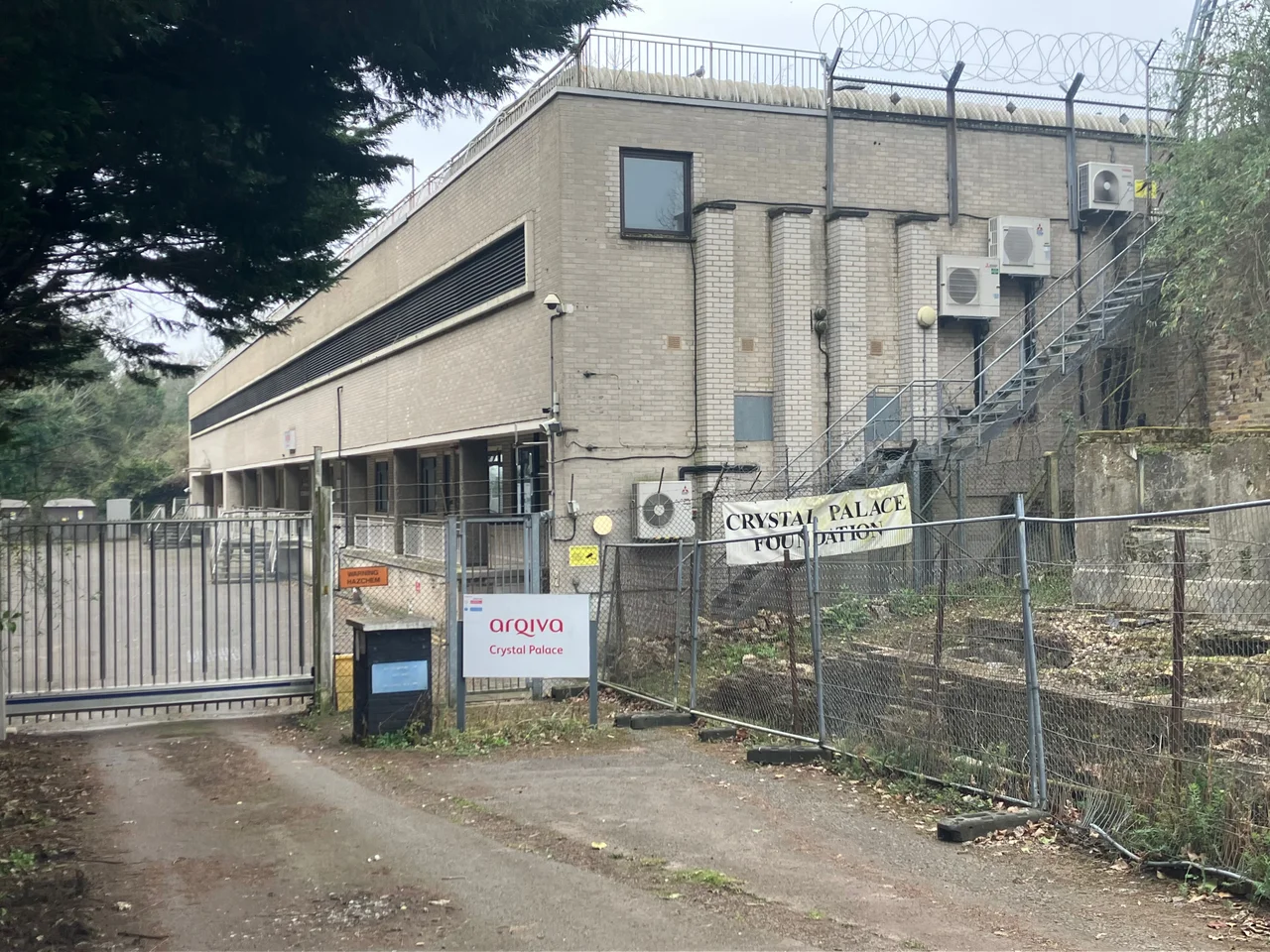

Crystal Palace transmitting station
The tower was nicknamed "the Phoenix" because it rose from a ruin. The Crystal Palace, the great glass building that had defined this hilltop since 1854, burned spectacularly in 1936. The Marine Aquarium on the same site collapsed in 1941 during the demolition of the Palace's blackened north water tower. By the mid-1950s the hilltop was a wasteland of Victorian masonry and waist-high weeds, until contractors arrived with two derricks (one 230 feet tall, one 125 feet) and a winch, and started building. By the time they finished, the new transmitter mast stood 219 metres above Sydenham Hill, which itself sits 109 metres above sea level. That made it the highest structure above sea level anywhere in London. It still is.
A Baird Original
Television had been broadcasting from this exact spot since 1933, when the Scottish inventor John Logie Baird set up an experimental transmitter and TV studio at the far end of the old Crystal Palace itself. Baird had been quietly inventing the future for years, demonstrating the first working television images in 1925 and the first public live TV broadcasts soon after. His studio at the Palace perished in the 1936 fire, but the precedent was set: this hilltop was for broadcasting. When the BBC and the Independent Television Authority began planning a permanent network in the 1950s, the Sydenham ridge was the obvious place. The Croydon transmitter went up two miles away first, taking ITV signals in 1955, and Crystal Palace followed in 1956 to broadcast the BBC.
Four Firsts
The transmitter has racked up an unusual number of historic firsts. It was the first transmitter in the UK to broadcast experimentally on the modern 625-line UHF system, between 1962 and 1964 on Channel 44, using a modified version of the SMPTE optical monochrome test card. On 18 July 1986, during the First Night of the Proms on BBC2, it became the first transmitter anywhere in the world to broadcast stereophonic television sound using the NICAM digital system. In May 2006 it carried the first terrestrial high-definition signals in the UK, broadcast to a trial group of 450 London homes. On 2 December 2009 it became one of the first DVB-T2 transmitters in the world, carrying a variant of the BBC's Multiplex B for HDTV. Each first was the kind of engineering bet that paid off, and each one then turned into ordinary technology that you stopped thinking about within a year.
Switching Off Analogue
For most of its life the tower has been the most important transmitter in the United Kingdom by population covered, carrying BBC One, BBC Two, ITV1, and Channel 4 in analogue, each beamed out at one megawatt of effective radiated power, all the way until April 2012. On 4 April that year, BBC2 analogue closed down on UHF Channel 33. Two weeks later, on 18 April 2012, the remaining analogue services followed. A public lighting display played out from the tower that night to mark the end of an era that had begun in 1936. From then on, the tower has carried only digital signals, six full multiplexes of Freeview, plus FM and DAB radio. The transmission powers actually dropped by 7 decibels because digital needs less power to reach the same audience, but the coverage area, about 60 miles in every direction across London and the Home Counties, stayed roughly the same.
Sound on the Air
Most of the radio frequencies you might pick up driving around south London come from this single tower. BBC Radio London, Radio X, Capital Xtra, Greatest Hits Radio London all transmit from here, along with low-powered relays of the four national BBC FM services (Radio 1, 2, 3, and 4) and Classic FM. The medium-wave transmitters carry Panjab Radio on 558 kHz and Lyca Gold on 1035 kHz; because the lattice tower itself is grounded, the MW signals come out of a separate wire aerial span close by. BBC Radio 4 used the tower for medium-wave broadcasting too, right up until 15 April 2024, when those frequencies were finally shut down in favour of digital and FM, ending decades of MW from Sydenham Hill. The tower also became one of the five original London transmitters for BBC DAB in 1995, joined by Digital One in 1999.
A Spare in the Wings
Look closely on a clear day and you can see Crystal Palace's slightly shorter sister tower, the Croydon transmitter, about two miles south. The towers look almost identical, but Crystal Palace is taller and sits on slightly higher ground, which adds up to the better location. Most of the time Croydon does its own job, broadcasting auxiliary signals. But because Crystal Palace is so important to so many viewers (along with the Winter Hill transmitter near Bolton, it is one of only two in the UK that singlehandedly provides ITV and BBC services for an entire region), the network has built in redundancy. If Crystal Palace ever went off the air, Croydon can duplicate its public service broadcasting multiplexes in an emergency. The Phoenix has a backup. So far, it has not needed one.
From the Air
The Crystal Palace transmitting station stands at 51.4242 N, 0.0749 W on Sydenham Hill in the London Borough of Bromley, the tower itself reaching 219 metres above ground level on a hill 109 metres above sea level (giving an absolute height around 1,075 feet AMSL). From the air it is almost impossible to miss, the eighth-tallest structure in London, with the slightly shorter Croydon transmitter visible nearby. Pilots in the London control zone treat both towers as significant obstacles. Nearest airports: Biggin Hill (EGKB) about 8 nm southeast, London City (EGLC) about 8 nm north, London Gatwick (EGKK) about 18 nm south. Always check current NOTAMs and tower lighting before transiting near the masts.
Nearby Stories
- Battle of Britain, Northfleet 1.1 km away
- Bayham Old Abbey 5.4 km away
- Catharine Macaulay 6.4 km away
- Hatfield rail crash 8.8 km away
- Chequers 8.9 km away
- Chelmsford Cathedral 10 km away
- Queen Victoria Hospital 13 km away
- Fishbourne Roman Palace 36 km away