
Cumbuco
Walk into a bar in Cumbuco on a January afternoon and you will hear Portuguese, Dutch, German, French, English, and - more and more - Korean. The village of about 25,000 sits thirty kilometers west of Fortaleza on a stretch of Ceará coastline where the trade winds blow steady and the Atlantic delivers a consistent cross-shore swell. Twenty years ago, this was a quiet fishing village. Now it is one of the great kitesurfing destinations on the planet, and somewhere between the jangadas still beached at sunrise and the bright nylon kites overhead, you can read the entire trajectory of how a coast changes.
Why the Wind Comes Here
The Ceará coast faces the equatorial Atlantic at an angle that catches the trade winds almost year-round. From August through January in particular, the wind blows clean and hard, often at 15 to 25 knots, almost every afternoon. The ocean floor drops gradually, which means flat water close to shore and surf farther out - a combination kitesurfers pay real money for. Add warm water, long stretches of empty sand, and lagoons that form behind the dunes, and Cumbuco became a word passed around the kite circuit in the 2000s. European operators arrived. Schools opened. Locals who had spent their lives fishing learned to rig kites and teach beginners. The village economy tilted.
The Korean Factor
Look west from Cumbuco beach and you can see the cranes and berths of the Port of Pecém and its industrial complex. The Companhia Siderúrgica do Pecém steel mill, originally a Brazilian-South Korean joint venture, brought hundreds of Korean engineers and workers to the region during construction, and many settled in Cumbuco because it was cheaper and cooler than the industrial zone. Korean hangul still appears on restaurant signs, grocery lists, and real estate boards. The plant was acquired by ArcelorMittal in 2023 but the Korean community it attracted remains. The village that used to orient itself entirely toward the fishing grounds offshore now pivots between three economies - kitesurfing tourism, the industrial port complex at Pecém, and a traditional jangada trade that still sends small sail-rigged rafts out at dawn to bring back lobsters and camurupim.
The Buggy, the Lagoon, the Dune
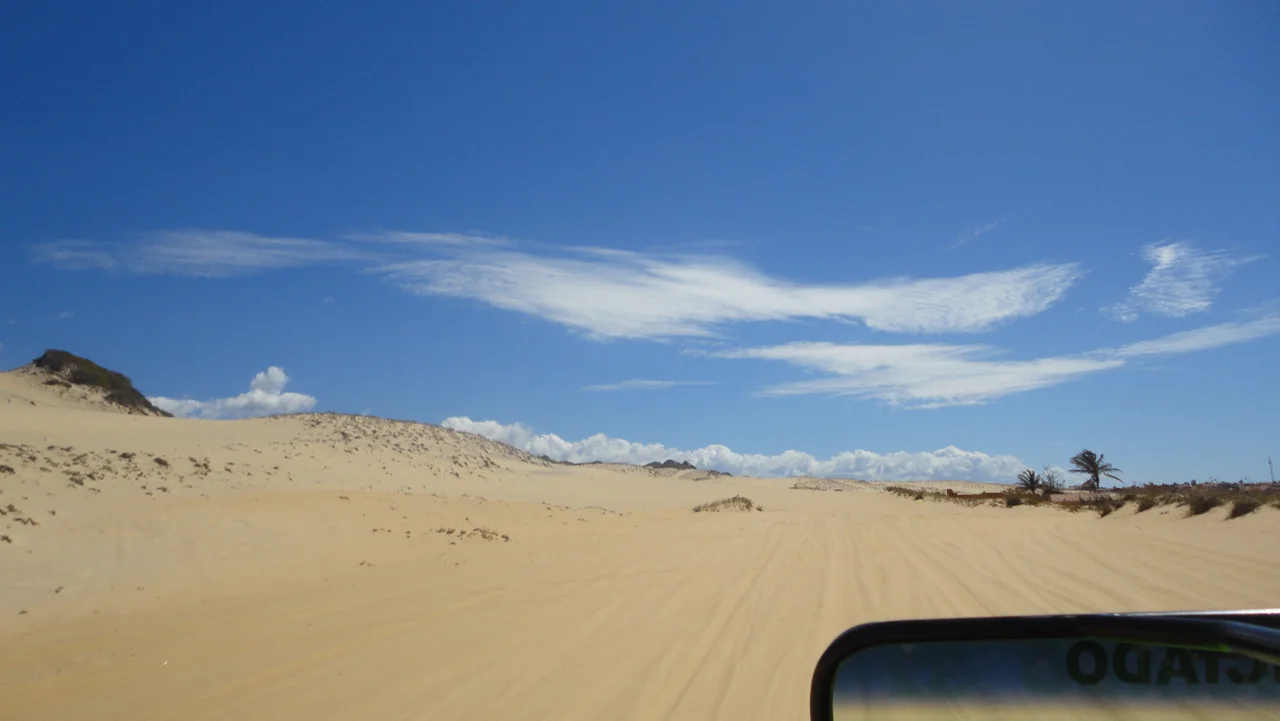
If you do not kite, you ride. For about R$150 a day, a driver will pick you up in a beach buggy and take you up the coast through the dunes, stopping at fresh-water lagoons hidden behind the sand - Lagoa de Cauípe, Lagoa do Banana - where you can swim in water warmer than the air. The drivers know every passable track, which matters because the dunes here move. The tallest shift meters in a single season with the wind. Horses cross the beach. Jangadas will take you a kilometer offshore for about R$10, a small price for the photograph of your village seen from the sea. It is technically illegal to drive on the beach, though that rule is rarely enforced. What is enforced, loosely, is the understanding that the ocean belongs to everyone - kitesurfers share the lineup with fishermen, and most days the system works.
The Rhythm of the Season
Cumbuco has two seasons: kiting and quiet. From August through February, the wind blows almost every day, every rental apartment fills, and the main square stays loud until midnight. From March through July the winds slacken, the Brazilian rainy season settles in, and the apartment owners drop their rates. Lunch can still be had for R$5 at the small restaurants off the main street. The ATM in the bakery at the east end of the village still closes at six in the evening. Bus service to Fortaleza still costs the same R$4.50 it did years ago. Off-season Cumbuco is what the village was before the kites - a fishing settlement where people walk everywhere, children kick soccer balls between tables at the beach bars, and the Atlantic just keeps rolling in, indifferent to whichever economy it happens to be feeding this year.
From the Air
Located at 3.63°S, 38.72°W on the Ceará coast, about 30 km west of Fortaleza in the municipality of Caucaia. The port of Pecém and its industrial complex sit another 30 km west. Coastline here faces northeast with consistent trade winds from east-southeast at 15-25 knots August through January. Best viewing altitude FL050-FL150 to see the dune fields, freshwater lagoons behind the beach, and the industrial cranes at Pecém. Nearest airport: Fortaleza Pinto Martins International (SBFZ), roughly 40 km by road.
Nearby Stories
- Batoque Extractive Reserve 17 km away
- Maracanaú 25 km away
- Guajiru 45 km away
- Beberibe Cliffs Natural Monument 66 km away
- Jijoca de Jericoacoara 140 km away
- Jericoacoara Beach 156 km away
- Crateús 205 km away
- Nadir Crater 2747 km away