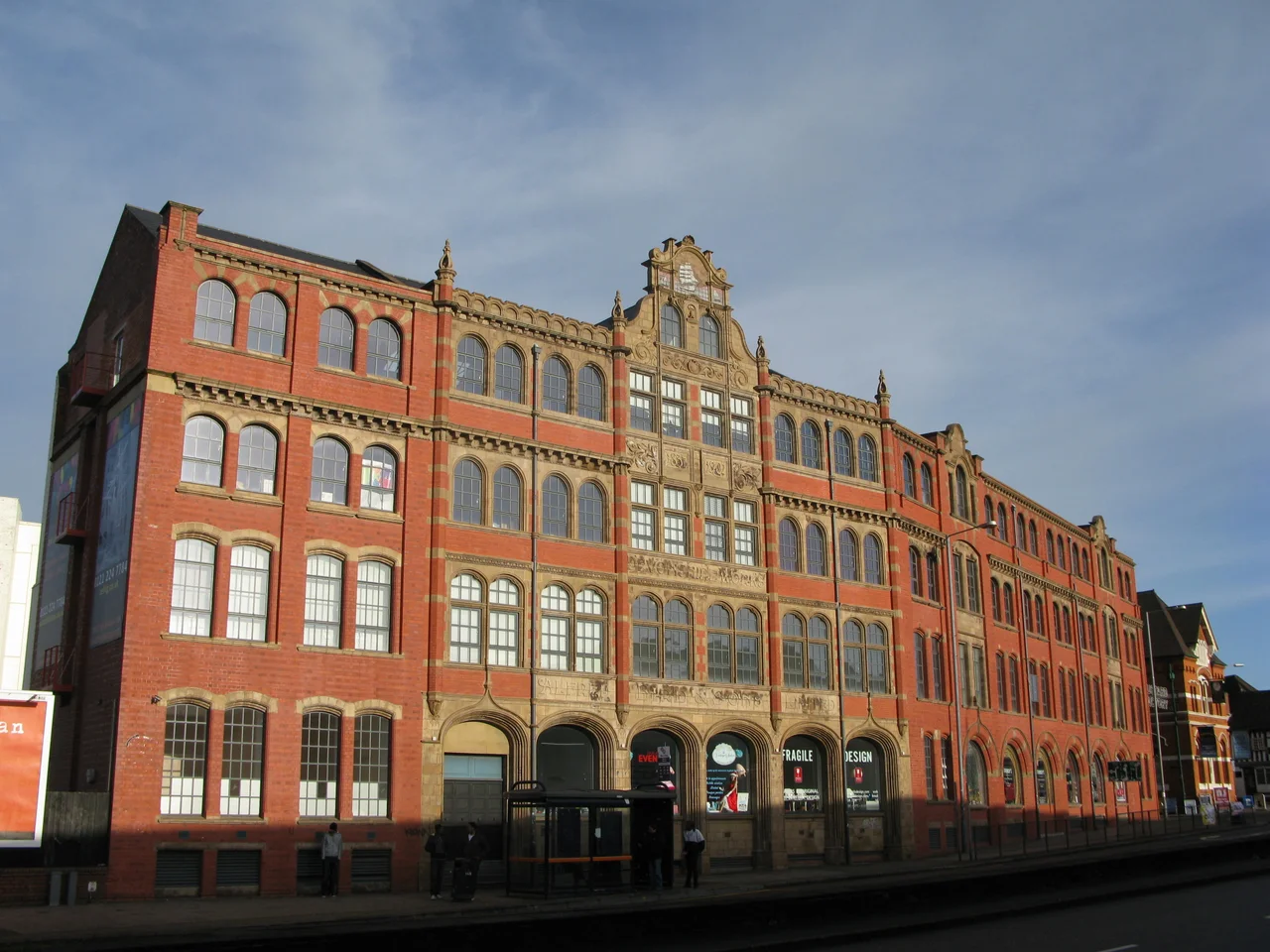

Custard Factory
Alfred Bird invented egg-free custard in 1837 because his wife was allergic to eggs. The recipe used cornflour instead, and Birmingham housewives bought it by the boxful. His son Sir Alfred Frederick Bird took over the company and built, between 1902 and the 1930s, an enormous works in Digbeth that employed a thousand people making yellow powder. The Bird company moved to Banbury in 1964. The factory sat derelict for twenty-eight years. Then a man named Bennie Gray put eight hundred thousand pounds of city grant money into the buildings in 1992 and turned them, with a chaotic kind of patience, into something Birmingham had not previously had: a workspace built for artists, musicians, and the creative trades. There is now a forty-foot Green Man made of vegetation and stone watching over the courtyard.
From Banbury to Bennie
Alfred Frederick Bird, who designed the factory, was the son of an inventor who had solved a domestic problem and built a national business on it. The factory architect was a firm called Hamblins. The buildings went up across fifteen acres - sixty thousand square metres - of red brick, blue brick, and steel-framed loading bays. When the Bird company moved its production to Banbury in 1964, the site lost its purpose. By the late 1980s it was the kind of post-industrial wreck that Birmingham had a great deal of: too big to demolish, too compromised to convert, slowly leaking value back into the ground. Bennie Gray bought it. His son Lucan Gray took over and ran the project until June 2017. A City Grant of £800,000 unlocked £1.6 million of private investment for the first phase - 100,000 square feet of buildings rebuilt as 145 units for artists, designers, and communicators. Glenn Howells Architects, a Birmingham firm, did the design work. The first phase created around 300 jobs.
The Lake in the Loading Bay
The first phase of the project, completed in the mid-1990s, included one of the most theatrical decisions in modern British adaptive reuse. The factory's main loading bay was flooded. Where lorries had once pulled in to be packed with custard powder, there was now a shallow lake, with two hundred studio workshops looking down on it from the upper floors. On the ground floor surrounding the water are meeting rooms, dance studios, holistic therapy rooms, a cafe, a record shop and clothes shop, an exhibition gallery, and a 220-seat theatre with stages for musicians, DJs, and rappers. An iron dragon - enormous, riveted, faintly menacing - clings to the rear elevation of the building from the outside. It became the most photographed object in Digbeth. Phase two, completed in 2002 and now called Gibb Square, added about a hundred more studio offices, plus galleries, restaurants, and shops set around a central pool with fountains. The pool drains for dance music events.
The Green Man Watches
Tawny Gray, no relation to Bennie or Lucan, built a forty-foot sculpture of the Green Man and installed it overlooking Gibb Street. It is made of vegetation grown into stone, a face composed of climbing plants and lichen and exposed mineral, the kind of work that takes its time. The Green Man is a figure from English folklore - the foliate head carved into cathedral roof bosses across the medieval country, a survival from pre-Christian woodland religion absorbed into church decoration. Putting one in a Birmingham creative quarter is a quiet act of cultural archaeology: this part of England has always built up its working myths from whatever is at hand, and the Custard Factory's myths are made from custard, code, and bracken. Toin Adams's later work, the Deluge, was installed in the restored Devonshire House building when it reopened as Zellig in May 2010 - a £9.6-million project supported by Advantage West Midlands, providing a hundred more office and workspace units in a Grade-II-listed shell.
Tenants and Trains
Some of the names that have rented space in the Custard Factory over the years: the Gadget Show. Ocean Colour Scene. ASOS, before it became one of the country's largest online retailers. Codemasters, the video-game publisher. Rare, the games studio. Maverick Television. North One Television. Fused Magazine. Punch Records. The cartoonist Alex Hughes. Huel, the meal-replacement-shake company. Across the road from the Custard Factory is Birmingham Coach Station, the National Express hub that has dispatched cheap long-distance buses across Britain since 1929. Three-quarters of a mile north is the Birmingham Institute of Art and Design, the country's largest university art and design centre outside London. The whole quarter feeds on a circuit of training, production, distribution, and pubs - the same circuit Birmingham has always run on, just rerouted through software companies instead of brass-foundries.
What Custard Built
Phase three has not formally finished. The Custard Factory now plays host to workspaces for some 400 small businesses, almost all of them in tech, digital, or creative fields. The complex also includes bars, restaurants, an arcade, the Mockingbird Cinema, a hair salon, a gallery, and a multi-purpose event space called the Old Library. Across Digbeth around it, the BBC is moving its regional operations into the former Typhoo Tea factory, Steven Knight's Digbeth Loc Studios is filming Peaky Blinders and MasterChef and This Town, and the West Midlands Metro is being extended down to the coach station. The Sunday Times rated Digbeth the coolest neighbourhood in Britain in 2018. The point is not that the survey is right - those surveys are mostly about journalists making themselves feel current - but that the area that produced egg-free custard for a hundred years has reinvented itself as the place that produces British screen drama for the next hundred. The yellow powder is still on supermarket shelves, made in Banbury. The factory it came from is now where people make television.
From the Air
The Custard Factory sits at 52.4752 degrees north, 1.8842 degrees west, in the Digbeth area of central Birmingham, just southeast of the city core. From cruising altitude in clear conditions, look for the red-brick industrial cluster around Gibb Street, with the silver-disc Selfridges of the Bull Ring shopping centre visible to the northwest. The Birmingham Coach Station forms a long building immediately east. Birmingham Airport (EGBB) lies about seven miles east-southeast; Coventry (EGBE) is about eighteen miles southeast. Best viewing altitudes are 1,500 to 3,000 feet.
Nearby Stories
- Shepshed 8.5 km away
- Battle of Evesham 11 km away
- Hixon rail crash 12 km away
- Battle of Cropredy Bridge 12 km away
- Wenlock Priory 15 km away
- RAF Shawbury 16 km away
- Market Bosworth 17 km away