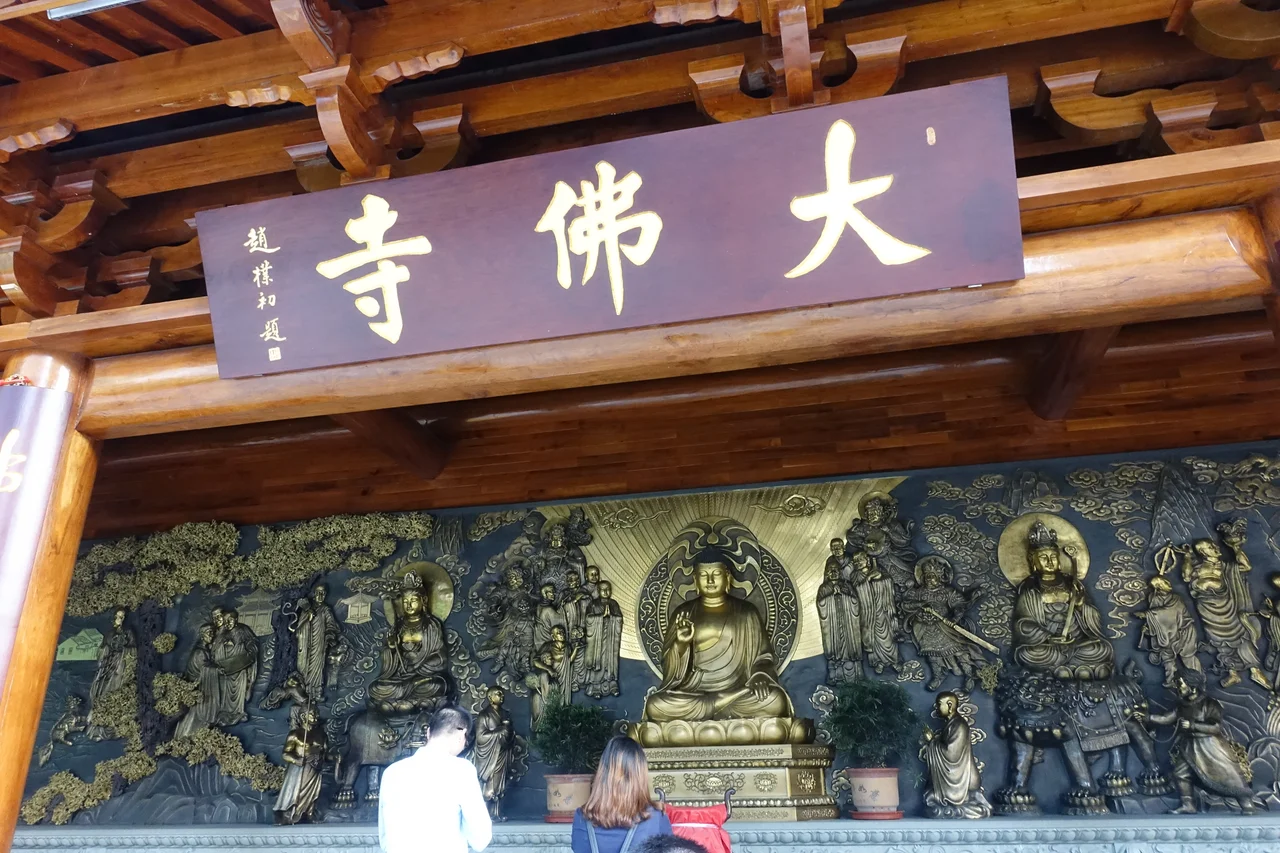

Dafo Temple (Guangzhou)
In 1663, a general turned benefactor gave Guangzhou a second chance at a temple. Shang Kexi had helped conquer the region for the Qing dynasty fourteen years earlier, and in that conquest the original building on this site had been demolished — reduced, as the records put it, to a pile of rubble. Now he donated property to rebuild it. He installed three copper statues of the Buddha in the new Mahavira Hall, each six metres tall and weighing ten tonnes, and they were the largest such figures in the Lingnan region. He gave the temple its current name: Dafo, meaning Grand Buddha. It was a gesture simultaneously of piety and power, and it is the foundation on which everything standing today rests.
Emperor Liu Yan's Twenty-Eight Temples
The story begins much earlier, in the Southern Han dynasty, when Emperor Liu Yan founded the temple in the years between 917 and 971 with the name Xinzang Temple. Liu Yan was a devout Buddhist who built 28 temples across his empire — the number corresponding to the 28 lunar mansions of Chinese astronomy, a cosmological gesture as much as a religious one. His temple here in what would become Guangzhou's Yuexiu District was the first of many incarnations. By the Song dynasty it had fallen into half-ruin. The Yuan dynasty rebuilt it under a new name, Futian'an. The Ming dynasty renamed it again, Longzang Temple, and extended it — until the Jiajing Emperor's preference for Taoism led him to suppress Buddhism and convert it into a government office. The cycle of construction, neglect, and repurposing was the condition of the temple's existence for centuries.
Conquest and Reconstruction
The most violent disruption came in 1649. When Shang Kexi and Geng Jimao led Qing forces into Guangdong province, the fighting left the temple demolished. What followed shows how recovery worked in this period: in 1661, a monk approached the visiting King of Vietnam, who was passing through Guangzhou en route to the Qing court, and asked for timber. The King agreed. By 1663, Shang Kexi's donation and the Vietnamese timber had produced a new building. Two years after that it was complete, and the temple — now named Dafo for its enormous copper statues — entered what the sources call an unprecedented heyday. The Yongzheng Emperor later added a formal imperial imprimatur in 1733, when the magistrate of Guangzhou chose Dafo Temple as the location to announce an imperial decree on Buddhist practice, adding a pavilion and several new halls.
The Opium Commissioner and the Pacify Bureau
The nineteenth century brought the temple into the orbit of larger historical forces. In 1839, Lin Zexu — the imperial commissioner sent by the Qing court to suppress the opium trade — used Dafo Temple as his headquarters for the collection of surrendered opium. This was the prelude to the First Opium War, and the temple's courtyard briefly became the administrative centre of a diplomatic and military confrontation with Britain. A decade later, during the Taiping Rebellion of 1850 to 1864, the government of Guangdong occupied the Monk's House and set up what was called the Pacify Bureau. By that point only three monks remained in residence. The institution of the temple continued, but the institution had been hollowed out.
Return to Practice
The Communist period saw Dafo Temple closed to religious use, as it was for Buddhist institutions across China. The turning point came in 1981, when the Guangzhou Municipal People's Government approved its restoration as an active Buddhist temple under the policy of free religious belief. The three copper statues were re-enshrined in the Mahavira Hall that year — each still six metres tall and ten tonnes, still the most prominent objects in a room built to honour them. Master Guangming, vice-president of the Guangzhou Buddhist Association, later became abbot and led the physical and religious revival of the temple through the 1990s. In 1993 the temple was formally listed as a Municipality Protected Historic Site. It now functions as a working temple open to Guangzhou's Buddhist community, with over a thousand years of interrupted history behind it.
From the Air
Dafo Temple is located at 23.125°N, 113.263°E in Yuexiu District, central Guangzhou, approximately 8 km south of Guangzhou Baiyun International Airport (ZGGG). The temple is embedded in the urban core and not individually identifiable from cruising altitude, but the dense roofscape of Yuexiu District — Guangzhou's historic administrative heart — is visible on clear approaches from the north. The Pearl River lies roughly 2 km to the south.
Nearby Stories
- Shunde 12 km away
- 2015 Shenzhen Landslide 15 km away
- Mount Luofu 23 km away
- Qingyuan Maglev Tourist Line 32 km away
- Kaiping 56 km away
- Heyuan 90 km away
- Chikan, Kaiping 92 km away
- Erlitou Site Museum of the Xia Capital 1257 km away