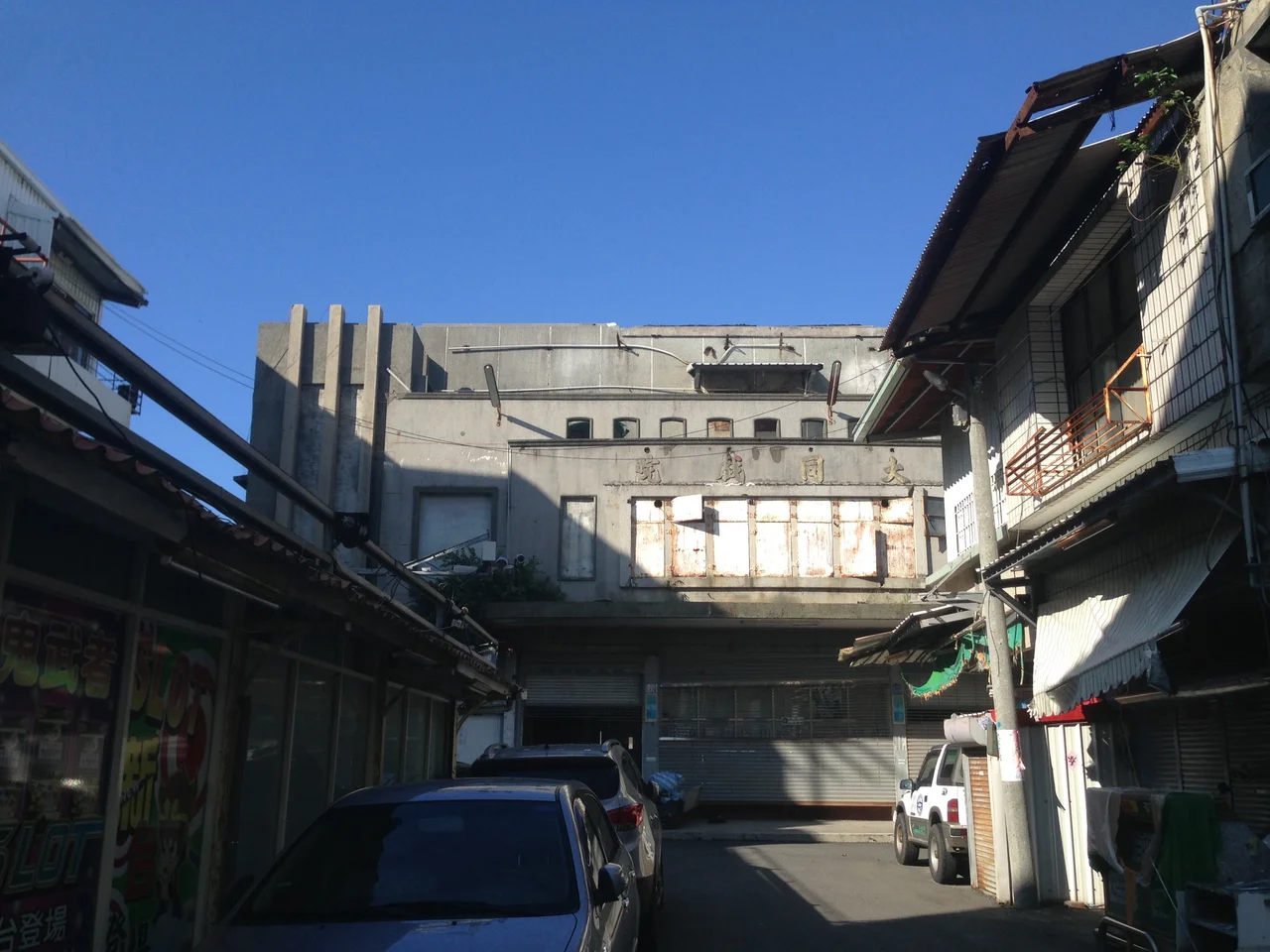

Datong Theater
It survived the arrival of television. That was no small thing. In the 1980s, when televisions moved into Taiwanese households and emptied cinema seats across the island, most of the neighborhood movie theaters that had anchored local life through the postwar decades simply closed. The Datong Theater in Taitung's Datong Borough kept its doors open. That stubbornness lasted another two decades before a fire on the night of 17 August 2009 settled the matter permanently.
A Neighborhood's Living Room
The Datong Theater opened in 1956, eleven years after Taiwan's handover from Japanese to Republic of China rule, in a city still rebuilding its sense of itself. Through the 1960s and 1970s it was the entertainment center for the residents of Datong Borough — the place where Taitung came to see the world projected large on a screen. In an era before home video and cable television, the cinema was not merely a leisure option; it was one of the few windows onto stories set beyond the Huatung Valley. The theater's seats held couples on dates, families on holidays, teenagers who walked over from school, and older residents who had watched the same building go up after the war. For two decades, it defined what a night out in this part of Taitung meant.
When the Screens Went Dark Around It
The 1980s changed the equation everywhere in Taiwan. Televisions multiplied in households across the island, and cinema attendance collapsed. One by one, the neighborhood theaters that had thrived in the postwar boom years shuttered, unable to compete with the convenience of watching at home. The Datong Theater held on. The reasons are not fully documented — perhaps a loyal local audience, perhaps management willing to adapt programming, perhaps simply the stubbornness of a building that had served its community well enough to earn some resilience. Whatever the cause, it remained in business while its counterparts across Taiwan went dark. By the time the twenty-first century arrived, it was one of the last traditional movie theaters in Taitung City, a category that carried a certain weight in a place that had once had many.
The Night of 17 August 2009
Fire destroyed the Datong Theater on 17 August 2009. The building that had outlasted the first great wave of cinema closures did not outlast the blaze. The theater closed. What remained was a burned structure in Datong Borough — a landmark in its absence as much as it had been in its presence. For years after the fire, the building stood as a ruin, its condition deteriorating and its future unresolved. In 2018, the Taitung County Government determined that the danger the structure posed outweighed its sentimental value and marked it for demolition. Some local residents objected, seeing in the ruins something worth preserving — a material trace of a particular era of Taitung's life. Their opposition delayed but did not prevent the outcome. Demolition work began on 2 December 2020.
What the Theater Leaves Behind
The Datong Theater's story is not exceptional in the arc of twentieth-century Taiwan. Neighborhood cinemas opened in the postwar years when the island was rebuilding, defined local life through the middle decades of the century, struggled against television's arrival, and eventually disappeared — some to fire, some to simple obsolescence, some to the wrecking ball. What gives the Datong Theater a specific gravity is that it lasted longer than most. It absorbed two decades of the television era that destroyed its peers. The fire came from outside, not from failure. And the community's opposition to demolition, however unsuccessful, speaks to the role such buildings play in the texture of a neighborhood — not just as entertainment venues, but as places where the ordinary life of a city coheres around a shared experience.
From the Air
The Datong Theater stood in Datong Borough, Taitung City, at approximately 22.754°N, 121.156°E — roughly central within the city grid. From the air, Taitung City is visible as the largest urban area at the southern end of the Huatung Valley, bounded to the east by low coastal hills and the Pacific shore. The nearest airport is RCFN (Taitung Airport), approximately 3 km to the northeast of the theater's former location. Recommended viewing altitude: 2,000–3,500 feet for city-level detail. The Beinan River runs south of the city center, and the mountains of the Central Range form a clear western backdrop.
Nearby Stories
- Jiadong 8.7 km away
- Bunun Cultural Museum 10 km away
- Liudui Hakka Cultural Park 12 km away
- Yujing District 16 km away
- Shouka Mountain Pass 40 km away
- 1951 East Rift Valley Earthquakes 97 km away
- Mavulis Island 157 km away
- 2021 Hualien Train Derailment 162 km away