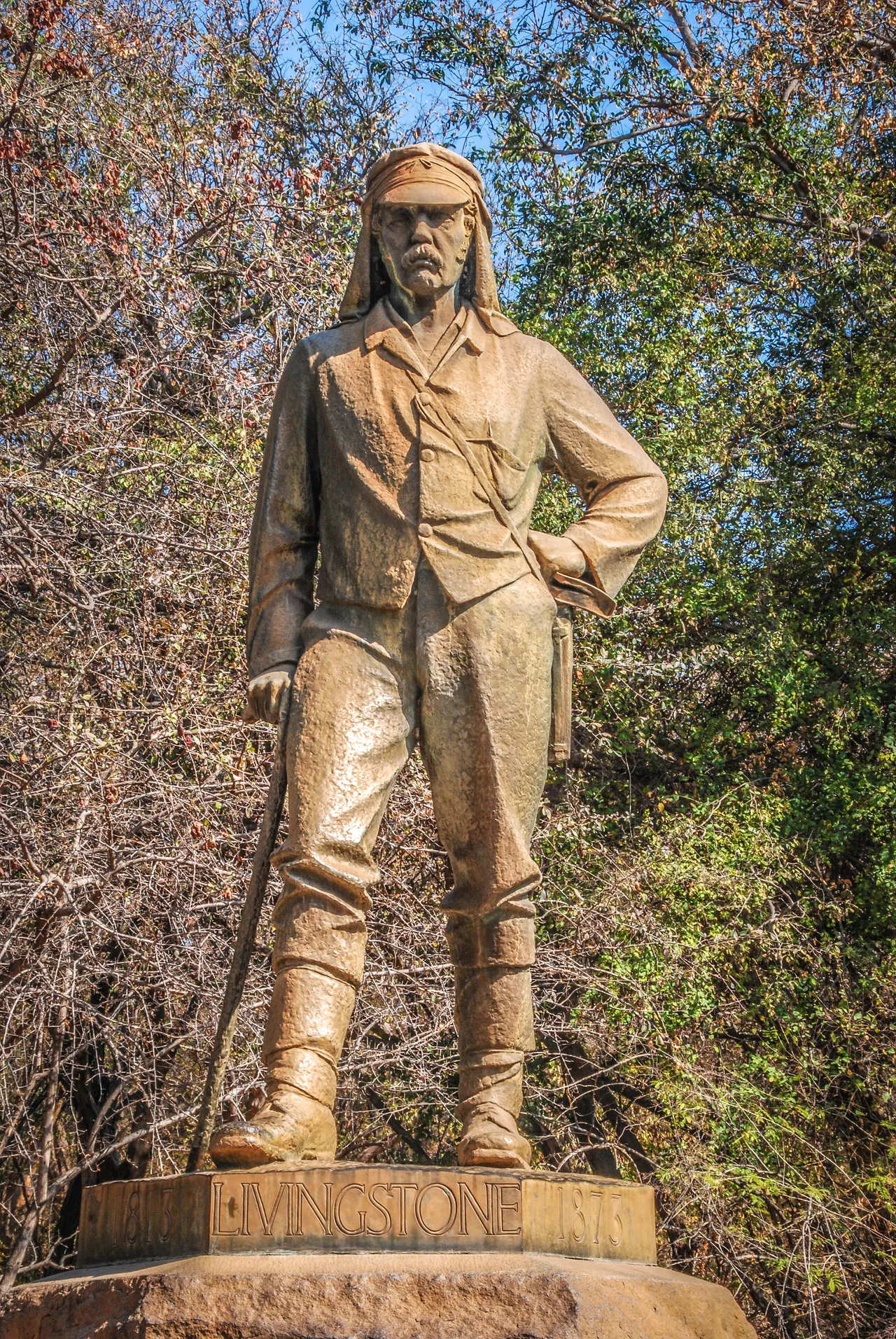

David Livingstone
When David Livingstone died on the morning of 1 May 1873, he was found kneeling at his cot in the village of Chitambo, in what is now Zambia. He had been praying. He was sixty years old, dysenteric and malarial, broken by years of overland travel through central Africa in search of the source of the Nile. What happened next is one of the strangest acts of devotion in the history of exploration. His two African servants - Chuma and Susi, both former enslaved people he had helped free - decided that the only proper thing to do was to take his body home. They removed and buried his heart under a mpundu tree in the village. They dried his body in the African sun, wrapped it in calico and bark, and then carried it more than 1,500 miles overland to the coast at Bagamoyo - a nine-month journey through hostile country - so that the man could be buried in his native Britain. He is interred today in Westminster Abbey, in the nave, beneath a slab of black marble inscribed with his last written words.
From the Mill to the Mission Field
David Livingstone was born on 19 March 1813 in a one-room flat at the top of a tenement called Shuttle Row, in the cotton-mill village of Blantyre on the River Clyde in South Lanarkshire, Scotland. The family was poor. His father Neil was a Sunday school teacher and door-to-door tea salesman; his mother Agnes was the daughter of farm labourers. There were seven children. At the age of ten, David started in the Henry Monteith cotton mill alongside his brother John, working fourteen-hour days as a piecer - the children whose job was to tie together broken cotton threads that whipped through the spinning mules. After his shift, he attended the company school. He propped a book on the spinning frame and read while the machines roared around him. He stayed in the mill for sixteen years, working his way up from piecer to spinner. He saved his wages, studied Latin and Greek, walked the limestone hills outside Blantyre collecting fossils, and at twenty-three he enrolled at Anderson's College in Glasgow to study medicine and theology. In 1840 he was ordained by the London Missionary Society and sailed for the Cape Colony in southern Africa, leaving the mills behind forever.
The African Years
Livingstone spent more than three decades in Africa. He married Mary Moffat, daughter of the Scottish missionary Robert Moffat, at the Kuruman mission station in 1845; their five children mostly grew up on the move and Mary herself died of malaria on the Zambezi in 1862. He crossed Africa coast to coast from Luanda to Quelimane between 1853 and 1856 - the first European known to have done so - and became the first European to see what the Kololo people called Mosi-oa-Tunya, the smoke that thunders, which he renamed Victoria Falls. His mapping of the Zambezi, the Shire highlands, and the watershed of the great lakes opened the geography of central Africa to British understanding for the first time. He was also, throughout his life, a passionate and tireless campaigner against the East African slave trade run by Arab and Swahili traders out of Zanzibar. He saw caravans of chained captives, witnessed massacres at Nyangwe in 1871, and wrote about them with anguish in dispatches that helped shape British public opinion against the trade. His humanitarian commitment was real. His travel notebooks are full of Bemba, Yao, and Tonga vocabulary, the names of his African companions, the histories of the people he met.
The Complicated Legacy
Livingstone was also, knowingly or not, a herald of empire. His mantra of "Christianity, Commerce, and Civilisation" became the manifesto of the late-Victorian missionary movement and was used to justify the European Scramble for Africa that followed his death. The missions he advocated for - the Universities' Mission to Central Africa, the Livingstonia Mission, the Blantyre Mission in Malawi - opened paths along which colonial administrators and traders soon followed. By 1900, most of Africa had fallen under European rule. Livingstone himself opposed many of these consequences - he hated the activities of Portuguese slave-traders, he believed African societies could be evangelised without being conquered - but his maps, his prestige, and the romantic British public image of "darkest Africa" awaiting redemption helped enable the imperial enterprise. Modern African and African-diaspora historians have rightly reframed him as a figure of contradiction: a working-class Scot of genuine humanitarian conviction whose work also accelerated the colonial machine. The town of Blantyre in Malawi is named after his birthplace. So are the Livingstone Mountains in Tanzania, Livingstone Falls in the Congo, the city of Livingstone in Zambia near the Falls, and dozens of streets, schools, and chapels across Africa and the diaspora.
Buried Twice
Henry Morton Stanley's famous 1871 greeting at Ujiji - "Dr Livingstone, I presume?" - made Livingstone perhaps the most famous Briton of his day, the lost explorer found by a young American newspaperman. By the time of his death two years later, he was a national figure. When Chuma and Susi's calico-wrapped body finally reached London, it was carried to Westminster Abbey on 18 April 1874 and laid in the nave beneath the slab where it lies today. The inscription reads: "Brought by faithful hands over land and sea, here rests David Livingstone, missionary, traveller, philanthropist." Below his name are the words: "All I can add in my solitude is, may Heaven's rich blessing come down on every one, American, English, or Turk, who will help to heal this open sore of the world." He was writing about the East African slave trade. The mpundu tree where his heart was buried in Chitambo became a national monument of Zambia. The slab in Westminster Abbey, in the nave, draws a constant procession of visitors. The Livingstone Centre in Blantyre, Scotland - opened in 1929 in the very tenement where he was born - tells the long version of the story, including the parts that the Victorians would have preferred not to hear.
From the Air
This article geolocates to Westminster Abbey at 51.499 degrees north, 0.128 degrees west, in the City of Westminster, central London, where David Livingstone is buried. The Abbey sits beside the Houses of Parliament and Big Ben, on the north bank of the Thames opposite the London Eye - one of the most recognisable urban skylines on Earth. London Heliport (Battersea) is about three miles southwest. London City Airport (EGLC) lies about eight nautical miles east, London Heathrow (EGLL) about thirteen nautical miles west. The London Helicopter Lanes follow the river beside the Abbey. Recommended viewing altitude 1,500 to 2,000 feet, although central London is restricted airspace and most overflights happen on prescribed corridors only. Livingstone's actual birthplace is in Blantyre, South Lanarkshire, Scotland, about 320 nautical miles northwest; his place of death is at Chitambo, Zambia, about 4,500 nautical miles south-southeast across Africa.
Nearby Stories
- Battle of Britain, Northfleet 1.1 km away
- Bayham Old Abbey 5.4 km away
- Catharine Macaulay 6.4 km away
- Hatfield rail crash 8.8 km away
- Chequers 8.9 km away
- Chelmsford Cathedral 10 km away
- Queen Victoria Hospital 13 km away
- Fishbourne Roman Palace 36 km away