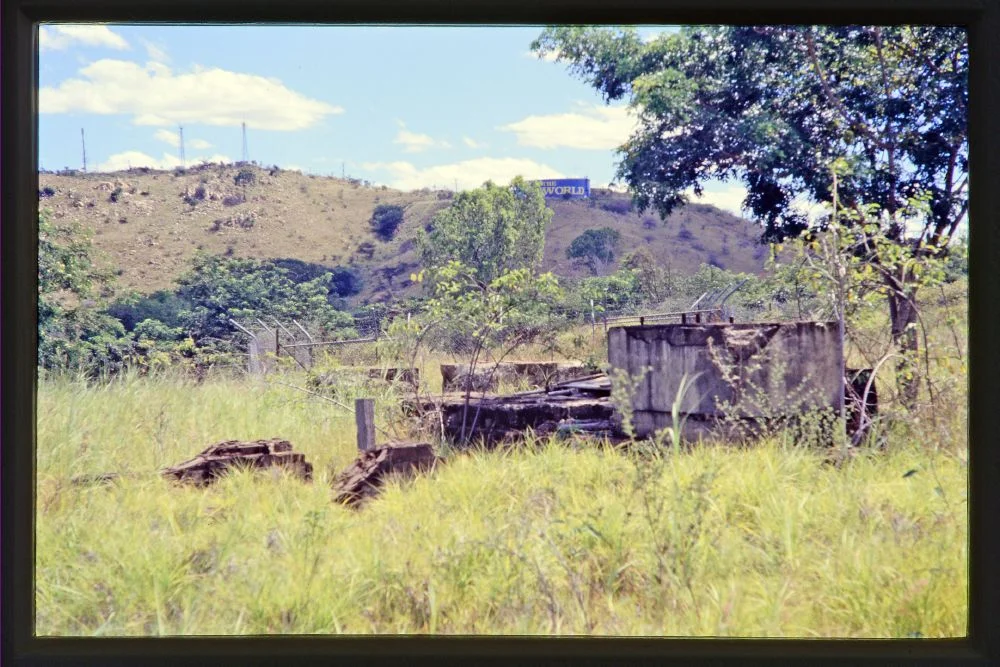

Day Dawn Mine Remains
It begins with a group of German miners and a streak of bad luck. For years the ground they had taken up on a ridge east of Charters Towers gave them only a 'stringer' - a thin, teasing thread of gold that promised much and paid little. Then, in 1878, at a depth of two hundred feet, the rock changed all at once. The reef came in four feet thick of rich stone, widened to twenty, and in places ran to five ounces of gold to the ton. The claim was called the Day Dawn, and the name proved apt: it was the dawn of serious money on the Towers. A century and a half later, a single fenced shaft and the grassed-over foundations of vanished machinery are nearly all that remain of the reef that started it all.
The Reef That Came in Thick
The original Day Dawn Prospecting Claim was first worked in 1874 and was, for its early years, a disappointment - a stringer that never quite delivered. Its fortunes turned in the hands of Frederick Pfeiffer and his partners Christian and Levers, who in 1878 cut the rich body of the Day Dawn Reef. The strike made the field's reputation: this was the first consistently large gold producer at Charters Towers, the mine that proved the district's deep reefs could pay on a grand scale. Pfeiffer grew wealthy enough to build a fine villa nearby on Paull Street, and by the time he died in 1903 the Day Dawn had yielded gold worth well over a million pounds. Across its working life from 1881 to its closure in 1913, the claim ranked as the fifth-largest producer on the entire Charters Towers goldfield, returning some 379,859 ounces of gold.
Sinking the Number Three
Success drew capital. In June 1887 the mine was sold to an English company, the Day Dawn P.C. Gold Mining Company, and the claim swelled from twenty-four acres to more than fifty-five. Around 1891 the new owners sank a fresh vertical shaft - the Day Dawn PC No. 3 - to work the eastern ground, cut the Eastward Ho reef, and prospect beneath the Rainbow Flat. It was a serious piece of engineering. By 1898 the shaft dropped 868 feet straight down, with two underlie shafts angling off to the northeast and northwest, reaching a total depth of 1,078 feet. The 1897 trade press catalogued the surface plant: a 430-ton ore hopper, a stone breaker, a 28-horsepower engine, two air compressors, two Robey boilers, six rock drills, and an underground air machine. Above it all rose a distinctive forty-foot brace and an open timber headframe, with a long raised walkway running to the east.
What the Ground Keeps
From 1902 the returns began to fall, and in 1913 the Day Dawn closed for good. Then the slow erasure began. The original Day Dawn shaft and the No. 2 beside it were destroyed outright. What survives clusters around the No. 3: the open, intact shaft itself, fenced behind chain wire first strung by the Charters Towers City Council in the late 1960s; the substantial machine foundations to the north; a brick powder magazine fifty metres to the southwest; and a water tank. The neighbouring No. 4 shaft stands to the east behind its own fencing. It is little to look at - a grassed reserve, some concrete footings, a hole in the ground behind a fence. But these are among the only tangible relics of an entire era of mining.
Reading a Vanished Industry
To make sense of the Day Dawn you have to read the wider landscape, because the mine itself is mostly gone. Pfeiffer's villa still stands intact on Paull Street, a fragment of the wealth this reef created. The line of the old tramway that once carried Day Dawn ore to the Excelsior Mill can still be traced across the ground. Together with the shaft, the magazine, and the machine mounts, these scraps sketch the shape of something enormous: an industry that, between 1872 and 1918, shaped nearly every aspect of life in Charters Towers. The Day Dawn ridge was one node in a goldfield so productive that its people called their town 'The World.' Heritage listing in 2003 recognised what the casual visitor might miss - that this quiet, fenced reserve marks the spot where the Towers first learned how rich it truly was, and that the ground here still holds answers about how that wealth was won.
From the Air
The Day Dawn mine remains lie at 20.084 degrees south, 146.258 degrees east, on the Day Dawn ridge in the Charters Towers City area, just east-southeast of the town centre off Paull Street. From the air this is an urban-edge site - a grassed reserve amid suburban streets - so use the town grid and the unmistakable bulk of Towers Hill (421 m) immediately to the southwest as your reference rather than the remains themselves. Charters Towers Airport (ICAO YCHT) sits just to the southwest of town; Townsville (YBTL) is the nearest major airport, roughly 130 km northeast. Best appreciated at low level, below 3,000 ft AGL. The dry inland air gives long, clear winter visibility.
Nearby Stories
- Bindal People 44 km away
- Herveys Range Heritage Tea Rooms 57 km away
- Bowen River Hotel 65 km away
- Radar Station, Charlie's Hill 71 km away
- Strathmore Homestead 126 km away
- Porcupine Gorge 153 km away
- Undara Volcanic National Park 230 km away
- Lake Dunn 276 km away