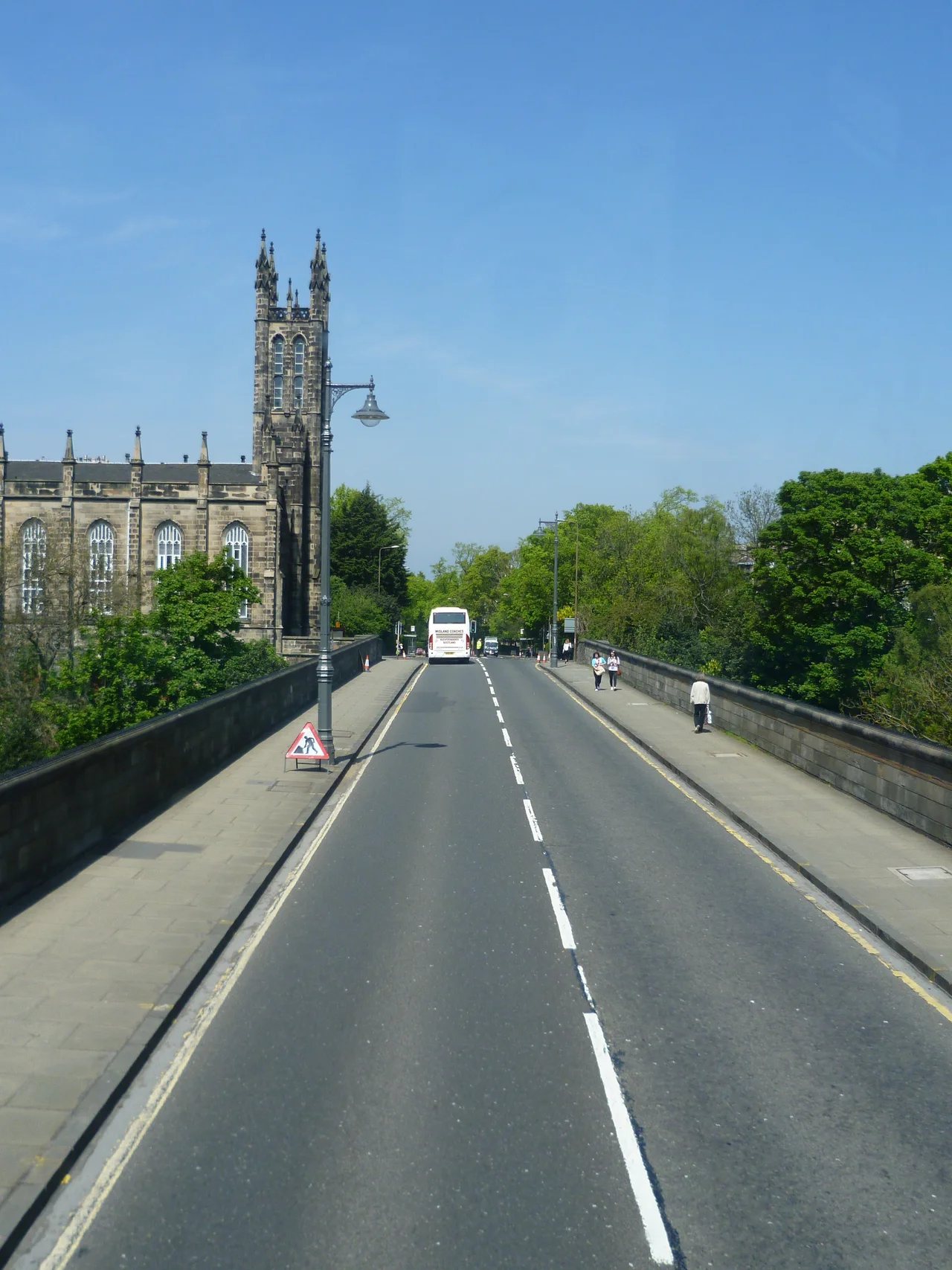

Dean Bridge
Thomas Telford was seventy-three years old when he finished the Dean Bridge in 1831. He had built canals across Wales, harbours at Aberdeen, the Menai Suspension Bridge across the strait to Anglesey, and roads through the Highlands. The Dean was one of his last major works, and he saved a small piece of pride for it. The bridge does not just cross the Water of Leith. It vaults the entire gorge, 447 feet of stone roadway sailing 106 feet above the river bed, on four arches that look almost too thin to hold themselves up.
The Problem of the Gorge
Before 1831, anyone heading north from Edinburgh's West End toward Queensferry had to dip down into the Dean Village, ford or cross the Water of Leith at a single-arch stone bridge, then climb the steep Path Brae on the other side. It was a bottleneck for the new wealth of the Georgian city. John Learmonth, a former Lord Provost who owned the Dean estate on the north bank, wanted to feu his land for an extension of the New Town, but he needed a bridge that did not condescend to the village floor. He was willing to pay the entire estimated cost of £18,556 himself. In 1828 the Cramond Road Trustees agreed to part-fund the bridge on two conditions: that it be designed by the finest engineer in Britain, and that it be toll-free.
Telford's Design
Telford originally proposed three arches. When test pits revealed poor ground conditions on the south bank, he amended the design to four smaller spans of 90 feet each. The piers were built hollow to save weight and cost, with external walls three feet thick and four internal voids separated by two-foot inner walls. On either side of the main deck, a five-foot-wide external soffit carries a slightly larger 96-foot arch that springs higher above the riverbed. These outer arches, he wrote, "are the distinguishing features of this bridge." The footways are carried on these segmental arches like delicate balconies. The stone came from Craigleith quarry near Blackhall. The Aberdeen builder John Gibb, who had worked with Telford on Aberdeen harbour, took the contract. Work began in 1829 and finished by the end of 1831.
Pennies for a View
Between the bridge's completion and its formal hand-over to the trustees, the contractor John Gibb noticed that people were already eager to walk across his new structure. He erected toll-gates at each end and charged pedestrians one penny a head to come up and look. The official opening came in early 1832, though horses and carts had to wait until May 1834 to use it. In 1957 the Institution of Civil Engineers, of which Telford had been the first President, installed a bronze plaque on the east parapet to commemorate his bicentenary. The plaque was stolen, then replaced in 1982. In 1912 the parapet was raised in height. Suicides from the bridge had become tragically frequent in the Victorian period, a problem the village below referred to with a grim local euphemism. The taller parapet was meant as a deterrent.
Still Carrying the Road
Almost two centuries after it was built, the Dean Bridge still carries the A90, the main road from Edinburgh's West End to Queensferry and the Forth crossings beyond. In 1965 it was listed Category A, the highest protection in Scotland. In 2025 the City of Edinburgh Council opened public consultation on extending the Edinburgh Trams network to Granton, and one of the proposed routes would run trams over Telford's bridge, asking the 1831 structure to take on a job he could never have imagined. From the Water of Leith Walkway below, you can see the bridge the way Telford intended: a thin pale ribbon spanning the gorge, the village clustered beneath it, the river running on as if the bridge were not even there.
From the Air
Located at 55.9531°N, 3.2143°W, spanning the Water of Leith gorge about 0.8 nautical miles northwest of Princes Street in Edinburgh's West End. The bridge is 447 feet long, 39 feet wide, and rises 106 feet above the river. From the air, look for the distinctive thin white line of the bridge crossing a deep wooded gorge, with the densely packed buildings of Dean Village visible directly below. The bridge carries the A90 road toward the Forth crossings. Edinburgh Airport (EGPH) is about 5 nautical miles west. Best viewed from 1,500-2,500 feet AGL in clear weather.
Nearby Stories
- Ardoch Roman Fort 2.2 km away
- Craignethan Castle 3.1 km away
- Haddington 3.8 km away
- Balvaird Castle 4.3 km away
- Battle of Kilsyth 9.4 km away
- Siege of St Andrews Castle 9.9 km away
- Neidpath Castle 11 km away
- Melrose Abbey 15 km away