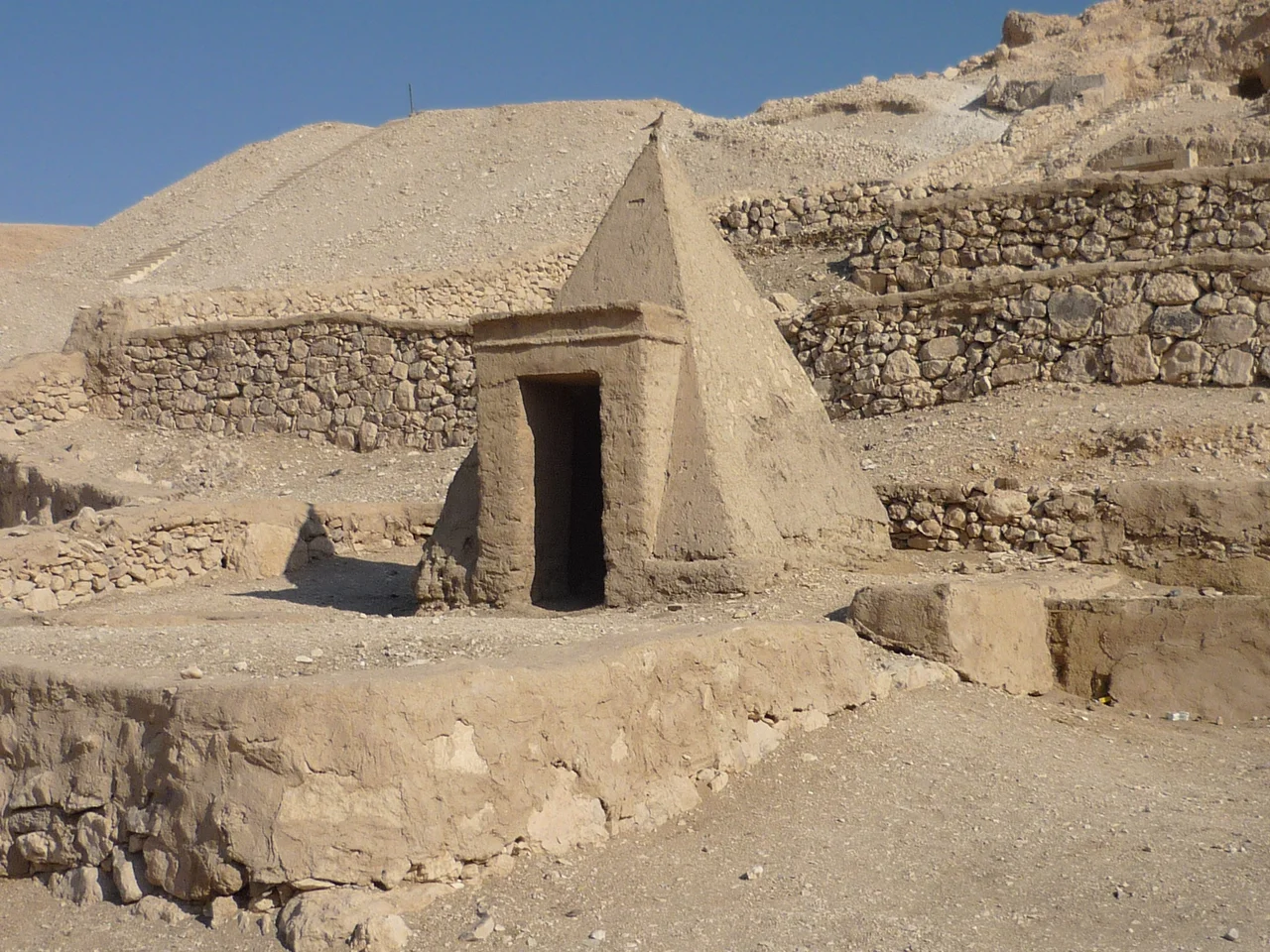

Deir el-Medina
More than three thousand years ago, a tomb-painter named Kenherkhepeshef kept a book of dreams in his library, and it was already old when he owned it. The men and women who lived in this small desert village left behind something far rarer than gold: their own words. Shopping lists and love poems, sick-day notes and lawsuits, complaints about a neighbor and prayers for a dead child — scratched onto flakes of limestone and broken pottery, thousands of them survive. This was Set Maat, the Place of Truth, home to the skilled crews who carved and painted the royal tombs in the Valley of the Kings. Because they could read and write, and because the dry sand kept their rubbish for millennia, we know them as we know almost no other community of the ancient world.
The Place of Truth
The village sits in a parched fold of the Theban hills, a short walk over the ridge from the royal tombs its people built. Founded around the time of Thutmose I in the early eighteenth dynasty, it housed perhaps sixty to seventy families at its height, packed into narrow stone-and-mudbrick houses along a single walled lane. These were not slaves. They were craftsmen of the highest skill — draughtsmen, sculptors, plasterers, and painters — who called themselves the Servants in the Place of Truth. They worked an eight-day week with the ninth and tenth days off, walking out to the tombs each morning and lodging in huts on the mountainside between shifts. There was no well; every drop of water had to be carried in. That a community could thrive here at all is a measure of how much the state valued the hands that made eternity for its kings.
Wages in Grain
Nobody at Deir el-Medina was paid in coins, because coins did not yet exist. The crews were paid in grain — emmer wheat that became bread and barley that became beer — delivered as monthly rations from the royal granaries, along with fish, vegetables, oil, and firewood. This was not charity. To the Egyptians, paying a fair wage on time was part of Maat, the cosmic order of truth and balance that the king himself was sworn to uphold. When the grain arrived, the village ate. When it did not, families went hungry within days, because almost no one had a private store to fall back on. The ration lists, scribbled and corrected on potsherds, let us watch the household economy of working people in extraordinary close-up — who was owed what, who was short, and who had to buy wheat at the market to survive.
When the Bread Stopped Coming
In the twenty-ninth year of Ramesses III, around 1158 BC, the grain stopped coming. Eighteen days into the month, the rations still had not arrived, and the crews had reached the end of their patience. They downed their tools and marched off the job — walking out and sitting down at the funerary temples until someone listened. It is the earliest recorded strike in human history. "We are hungry," they told the officials who came to reason with them; eighteen days had passed and still no rations, and they had been forced to buy their own wheat. The village elders urged them back to work. They refused, swearing great oaths, and demanded the matter be carried to the vizier or the pharaoh himself. The authorities heard them out, released the grain, and the men returned the next day. But the trust was broken. More strikes followed over the years, and when the elders kept siding with the state, the workers stopped trusting them and chose their own representatives instead — laborers speaking for themselves, across thirty-two centuries, in words we can still read.
The Robbers and the Records
Late in the twentieth dynasty, the world the village depended on began to fray. Grain deliveries grew unreliable, work dried up amid fears of unrest, and some of the very men who knew the tombs best turned to robbing them. Thieves tunneled in through the back walls to avoid breaking the official seals, and a whole shadow economy grew up around the loot — fences who moved the goods and officials who took bribes to look away. The trials that followed are preserved in documents like the Abbott Papyrus, which records investigators torturing a confession out of a repeat offender, only for a suspicious vizier to march him to the tomb he claimed to have plundered and find it untouched. These are uncomfortable stories, but they are human ones: people under economic strain, making hard and sometimes ugly choices, all set down in ink and stone. The village was eventually abandoned, but its archive remains the richest window we have onto how ordinary Egyptians actually lived, argued, worshipped, and grieved.
From the Air
Deir el-Medina lies on the Theban west bank at 25.73 degrees N, 32.60 degrees E, tucked into a dry valley between the Valley of the Kings to the north and the Valley of the Queens to the south. From the air the site reads as a compact rectangular grid of low stone foundations against tan hillside, with the larger Medinet Habu temple visible a short distance to the southeast and the green ribbon of the Nile floodplain to the east. Recommended viewing altitude is 2,000 to 4,000 feet AGL; the surrounding desert offers excellent visibility most of the year, though afternoon haze and blowing dust can reduce contrast. The nearest airport is Luxor International (ICAO HELX), roughly 7 km east across the river; Aswan International (HESN) lies about 200 km south.
Nearby Stories
- Temple of Seti I (Abydos) 20 km away
- Dendera Temple complex 21 km away
- Esna 22 km away
- Abydos, Egypt 49 km away
- Mersa Gawasis 116 km away
- Kharga Oasis 147 km away
- Hurghada 184 km away
- Wadi El Gemal National Park 238 km away