.jpg)
Deptford Dockyard
On 30 May 1593, in a respectable house in Deptford owned by a widow named Eleanor Bull, four men spent the day in a private room: Christopher Marlowe, the playwright; Ingram Frizer, a financial agent for the Walsinghams; and two intelligence operatives, Nicholas Skeres and Robert Poley. According to the coroner's report, they argued over the bill. Marlowe snatched Frizer's dagger. In the struggle the blade went into Marlowe's forehead above the right eye and killed him instantly. He was twenty-nine, and the foremost dramatist in England before Shakespeare took the title. He was buried the next day in an unmarked grave in the churchyard of St Nicholas, fifty yards from the gates of the dockyard that had brought all the relevant men to the relevant town.
Henry VIII's First Yard
In 1513 Henry VIII founded a dockyard on the south bank of the Thames at Deptford Strand, eight miles below the city walls. Its 'Great Store-house' went up the same year — a brick rectangle 50 metres long and two storeys high, parallel to the river, marked with the royal cypher and the date. The store-house outlasted the dockyard. The dockyard outlasted three hundred and fifty years of English maritime history. From the keels laid here came the ships of Drake, Cook, Vancouver, Bligh and Nelson. The site grew through the sixteenth and seventeenth centuries into a complex of slipways, dry docks, mast ponds, rope walks, smithies and storehouses covering 35 acres of riverbank. For decades it was the most important of all the royal dockyards, and the headquarters of naval administration.
The Knighting of Drake
In April 1581 Elizabeth I came to Deptford to knight Francis Drake aboard the Golden Hind, the 100-ton galleon in which he had just completed the first English circumnavigation of the globe. The Queen ordered the ship preserved at Deptford Creek as a public exhibition — possibly the world's first museum ship — and there it stayed, slowly rotting, until what was left of it was broken up in the 1660s. The Walter Raleigh cloak-on-the-puddle story, almost certainly invented later, is also said to have happened here. What is undoubtedly true is that the dockyard called itself the Cradle of the Navy and was not exaggerating: every English naval expansion for the next two centuries depended on what came off these slips.
Peter the Great in Sayes Court
In January 1698 a 26-year-old Russian tsar arrived at Deptford with a delegation calling itself the Grand Embassy, officially incognito under the obvious pseudonym Pyotr Mikhailov. Peter the Great wanted to learn shipbuilding from the world's best practitioners, and the Royal Navy's premier yard was the obvious place. The diarist John Evelyn rented him Sayes Court, a fine house next to the dockyard. The Tsar and his retinue proceeded to wreck it. Evelyn's servant wrote to him in alarm: 'There is a house full of people and right nasty. The Tsar lies next your library, and dines in the parlour next your study.' Peter dined at ten in the morning and six at night, was rarely at home, and amused himself by being pushed through the prized hedge in a wheelbarrow. He left after three months. Evelyn's beautiful garden was destroyed. But the Tsar had spent his days at the dockyard learning, in person, how the English built warships, knowledge he carried back to Russia and used to build the navy that defeated Sweden at Poltava in 1709. The City of London later put up a plaque: 'Here worked as a ship-carpenter Peter, Czar of all the Russias, afterwards Peter the Great, 1698.'
Cook, Vancouver, Bligh, Nelson
Through the eighteenth century, Deptford specialised in smaller warships and in experimental work — copper sheathing trials against the ship-eating teredo worm, sea-water distillation, coal-pitch extraction. Several of the ships James Cook used on his Pacific voyages were refitted here, as were the ships of George Vancouver's 1791-95 expedition mapping the northwest coast of America. Bligh's vessel for the second breadfruit voyage came through Deptford. Warships built on these slips fought under Nelson at Trafalgar. In 1822 the yard launched HMS Comet, the Royal Navy's first steam-powered vessel, even as the Napoleonic peace was draining demand for warships. The Admiralty ordered work scaled back in 1821, and from then on Deptford was a slowly contracting yard, doing experimental and small-vessel work while the front-line dockyards at Portsmouth and Plymouth took the heavy fleet maintenance.
The End and the Cattle Market
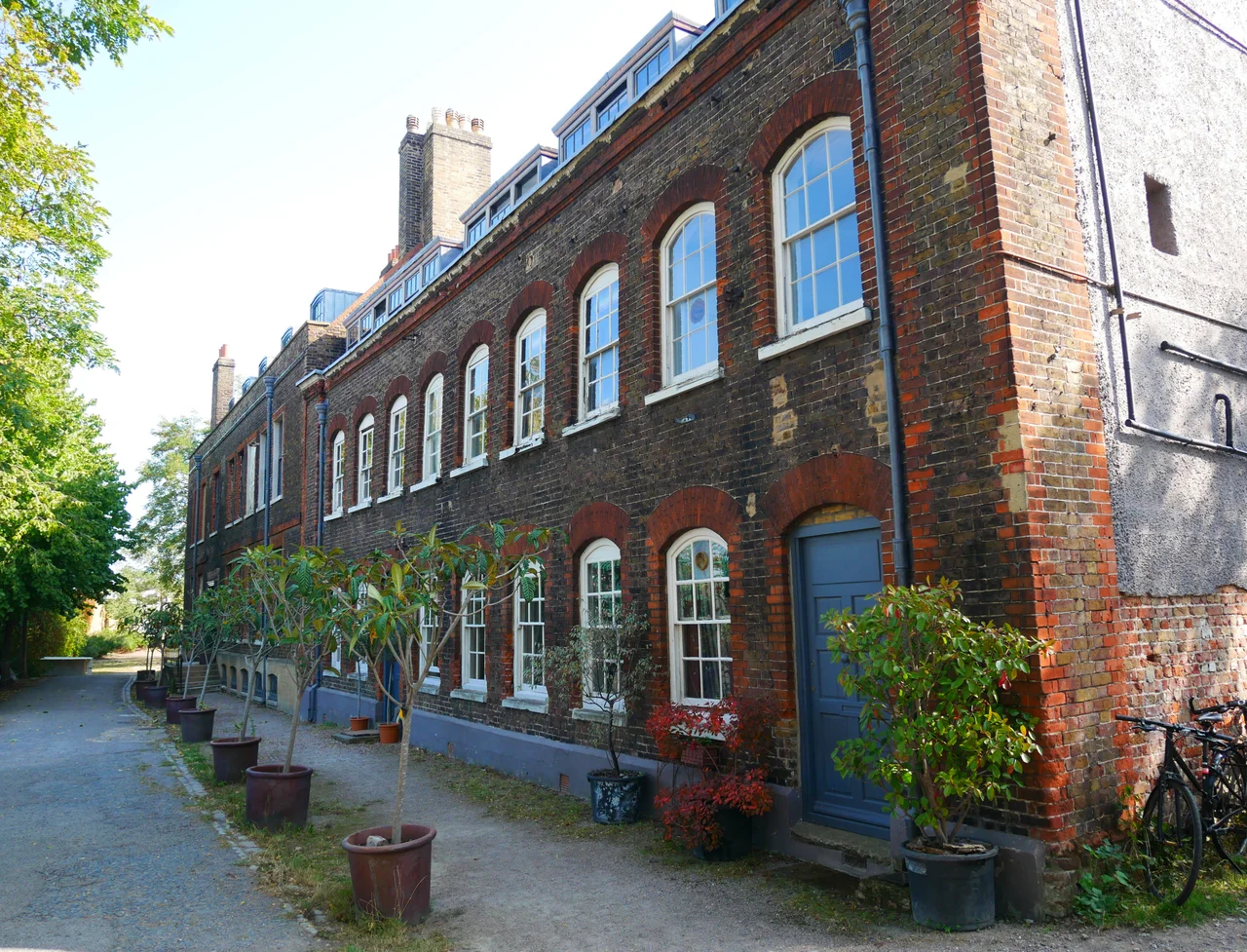
Ironclads finished Deptford. The new iron-hulled warships needed deeper water and bigger machinery than the shallow Thames bend could offer. A parliamentary committee recommended closure in 1865 and the yard shut on 31 March 1869. The final ship built there, the screw corvette HMS Druid, had been launched eighteen days earlier. The land was sold. About thirty acres went almost immediately to the City of London Corporation and became the Foreign Cattle Market, a quarantine slaughterhouse for imported livestock. Henry VIII's Great Storehouse, with its 1513 date stone, was still standing in 1954 — and was then demolished. Its bricks were used for repairs to Hampton Court Palace, a fittingly Tudor afterlife. The clock and cupola from the early 18th-century storehouse now stand in Thamesmead. The Master Shipwright's House of 1708 survives, as does the 1720 Office Building and the 1846 iron-roofed Olympia Warehouse.
Convoys Wharf
Today the dockyard site is Convoys Wharf, owned for decades by News International for the storage of newsprint, now slowly being redeveloped for housing and commercial use. Archaeological digs in 2010-12 uncovered the slipways, the dry docks, the basin and the foundations of buildings demolished centuries ago. The Lenox Project, formally proposed in 2013, aims to build a full-size sailing replica of HMS Lenox — a 70-gun ship of the line originally built at Deptford in 1678 — on the dockyard site, as the centrepiece of a museum that would anchor the new development. If it happens, it would be the first naval ship built at Deptford in 156 years. Marlowe's grave is unmarked, but his church still stands, and the river still bends past the slipways where so many of the ships that defined British history first met the water.
From the Air
Deptford Dockyard, now Convoys Wharf, lies at 51.49N, 0.03W on the south bank of the Thames at the foot of Limehouse Reach, immediately west of the Greenwich peninsula. Greenwich and the National Maritime Museum lie about a mile downstream. London City Airport (EGLC) is two nautical miles north across the river; Biggin Hill (EGKB) is to the south. The Convoys Wharf site is recognisable from the air as a large quayside parcel along a sharp bend in the Thames, with the surviving Master Shipwright's House and Olympia Warehouse near the eastern edge. Recommended viewing altitude 1,500-2,500 ft AGL for the river and dockyard footprint.
Nearby Stories
- Battle of Britain, Northfleet 1.1 km away
- Bayham Old Abbey 5.4 km away
- Catharine Macaulay 6.4 km away
- Hatfield rail crash 8.8 km away
- Chequers 8.9 km away
- Chelmsford Cathedral 10 km away
- Queen Victoria Hospital 13 km away
- Fishbourne Roman Palace 36 km away