
The Gate That Outlasted Its Kingdom
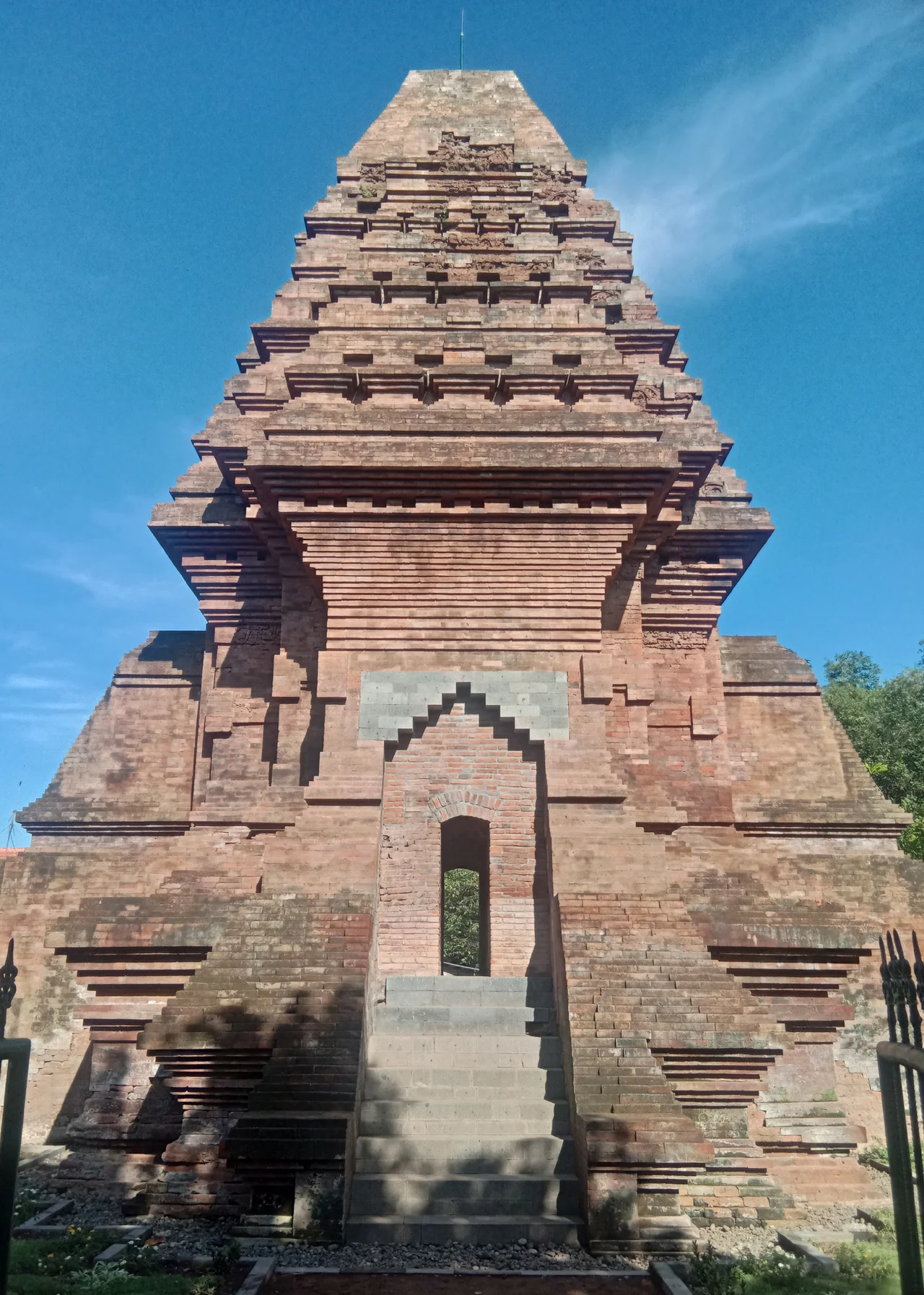
In the village of Candinegoro, wedged between a prayer room and the back walls of family homes, a 13.5-meter tower of red brick rises above the rooftops. It is not a mosque, not a water tower, not a relic of Dutch colonialism. It is a paduraksa -- a roofed ceremonial gateway -- built during the Majapahit Empire in what experts estimate was the 14th century. Dermo Temple has no founding inscription, no recorded architect, no date carved into its brickwork. What it has is presence: six and a half centuries of standing in place while the kingdom that built it collapsed, the religion it served receded, and the village around it grew so close that its eastern wall nearly touches a neighbor's fence.
A Gate Without a Date
No one knows precisely when Dermo Temple was built, or by whom. The absence of written sources or year numbers has left archaeologists to work from architecture alone. Based on the building's style and construction techniques, experts place it in the 14th century, during the height of the Majapahit Empire, the last great Hindu-Buddhist kingdom of Java. The temple takes the form of a paduraksa gate -- a style also called candi bentar when split, but here presented as a unified arch whose two sides meet at the top, crowned by a single roof. The design closely resembles the Bajang Ratu Gate at Trowulan, the Majapahit capital some 40 kilometers to the southwest, suggesting the same architectural tradition and possibly the same era of construction. Relief carvings and scattered stone blocks surround the structure, hinting that Dermo was once part of a larger sacred compound whose other buildings have not survived.
The Port at the Doorstep
Just north of the temple lies the Terung area, a name that appears in the Canggu inscription of 1358 CE as one of the ports and river crossings along the Bengawan Brantas, the great river that served as the Majapahit Empire's commercial artery. The inscription, dated to 1280 in the Saka calendar, records Terung among a network of toll stations and ferry points that regulated trade flowing between the interior and the coast. The relationship between Dermo Temple and the port of Terung remains unresolved -- no inscription links the two directly -- but the proximity is suggestive. A ceremonial gateway standing within sight of a major trading port raises obvious questions: was Dermo the entrance to a temple complex that served the merchants and travelers passing through? Was it a spiritual threshold marking the boundary between commercial and sacred space? The evidence does not answer. It only invites the question.
Centuries of Silence, Then Scaffolding
The first European records of Dermo Temple appear in Dutch colonial reports from 1905 to 1915, by which time the structure had already been standing for roughly five centuries. What happened in between is largely undocumented. The Majapahit Empire declined through the 15th century, Islam spread across Java, and the temple's original religious function faded. The village of Candinegoro grew around it -- the name itself, meaning "temple place," preserving in everyday Javanese what the historical record does not. Restoration was discussed for decades but did not begin until 2015. Five years of careful work followed, dismantling bamboo supports that had been propping up the structure, stabilizing the red-brick walls, and restoring the gateway's profile. In December 2020, the East Java Cultural Heritage Conservation Board declared the restoration complete, removed the last scaffolding, and opened the temple to public visits. After 662 years, Dermo had its grand reopening.
Standing Among Neighbors
What makes Dermo unusual among Java's candi is not its age or its architecture but its setting. This is not a ruin in a forest clearing or a monument in a manicured park. It stands in a kampung, a village neighborhood, bordered on three sides by residential houses and on the fourth by a prayer room. Children walk past it on their way to school. Laundry dries on lines within its shadow. The temple exists not as a destination but as a neighbor, absorbed so thoroughly into daily life that its extraordinariness has become ordinary. Sidoarjo Regency contains several other Majapahit-era temples, including the better-known Candi Pari, but Dermo's domestic context gives it a quality the others lack: the sense that history here is not preserved behind a fence but lived alongside, brick wall to garden wall, century after century.
From the Air
Located at 7.41S, 112.62E in Sidoarjo Regency, approximately 25 km south-southwest of Surabaya. Nearest major airport is Juanda International (WARR/SUB), located roughly 15 km to the east in Sidoarjo district. The temple is embedded in a dense residential area and not visible from altitude, but the surrounding Sidoarjo lowlands and the Brantas River floodplain are distinctive features. The Trowulan archaeological zone, site of the former Majapahit capital, lies approximately 40 km to the southwest. Best approached at low altitude from the east, following the Brantas delta landscape.
Nearby Stories
- The Kedopok War: When Probolinggo Rose Against Its Buyer 5.5 km away
- The Floating Colossus of Surabaya 6 km away
- Purwodadi Botanical Garden 9.7 km away
- Madura: Salt, Bulls, and the Island That Emptied Itself 21 km away
- Where Teak Meets Oil 30 km away
- The Train Builders of Madiun 71 km away
- The School That Gave Itself Away 75 km away
- Where Three Worlds Meet: The Great Mosque of Sumenep 89 km away