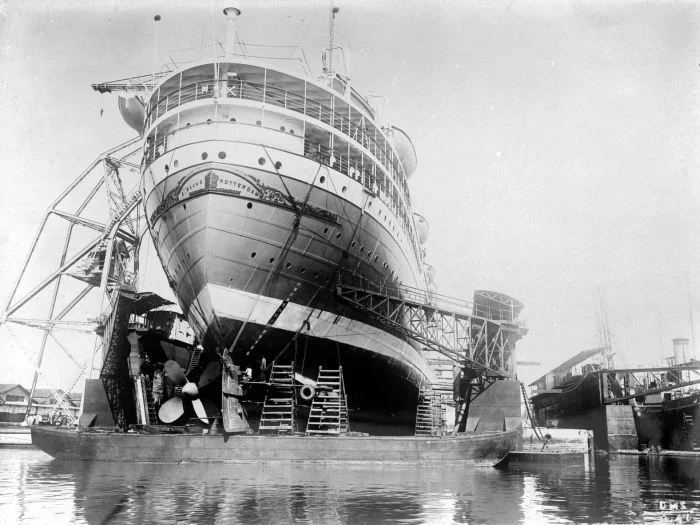

The Floating Colossus of Surabaya
In the summer of 1913, three tugboats hauled a steel structure the length of a city block out of Amsterdam harbor, across the Zuiderzee, and into the open Atlantic. Their cargo was a floating dry dock capable of lifting 14,000 tons -- one of the largest movable objects of its era. Its destination was Surabaya, Java, more than 10,000 nautical miles away through the English Channel, past Gibraltar, across the Mediterranean, through the Suez Canal, and across the Indian Ocean. The journey would take months. A sandstorm in the Red Sea nearly ended it. But the dock arrived, and for the next four decades it would become the backbone of ship repair in the Dutch East Indies, lifting warships, merchantmen, and even other dry docks onto its steel pontoons.
An Empire That Outgrew Its Tools
By 1900, the Dutch East Indies had three floating dry docks, and all of them were becoming inadequate. The largest, the Onrust Dock of 5,000 tons stationed at Surabaya, had been handling Dutch warships since the 1880s. It had once managed to lift vessels exceeding its rated capacity, including Russian armored cruisers calling at the port. But when the new Dutch cruiser De Ruyter arrived in 1903 at 5,002 tons displacement, the aging dock could not lift her. Its actual capacity had quietly declined from 4,800 to 4,500 tons. The Dutch navy was building bigger ships, and the colonial dockyard infrastructure was falling behind. Plans for a 7,000-ton replacement were debated, but by the time the colonial legislature acted, ambition had swelled the requirement to 14,000 tons -- a dock large enough to handle any warship the Netherlands might send east.
Built on the IJ, Bound for Java
The Nederlandsche Scheepsbouw Maatschappij in Amsterdam won the contract in 1911. The shipyard had just proven its dry dock expertise by building the 12,000-ton Juliana Drydock, and its engineers under W. Fenenga designed a self-docking dock of the bolted sectional type: three sections that joined along their full profile, 140 meters long, 25 meters wide inside, powered by electricity. It could lift a 14,000-ton ship with 7.5-meter draft in four hours. Construction proceeded on a site along the IJ waterfront, and by June 1913 the dock was ready for its maiden journey. On Saturday the 21st, tugboats began hauling it across the Zuiderzee toward the North Sea. The ocean-going tug Atlas, at 519 tons with 1,500 horsepower, led the convoy, followed by Titan at 352 tons. Atlas carried wireless telegraphy -- cutting-edge technology for a towing operation. They passed Gibraltar on July 11, transited the Suez Canal in August, and weathered a sandstorm in the Red Sea before waiting in Aden for the monsoon season to pass.
The Workhorse of the Strait
The dock reached Surabaya and entered the new harbor in March 1916. Once operational, it became extraordinarily busy. In 1917 alone it handled 96 ships across 283 docking days. By 1920 the pace had climbed to 121 ships in 329 days -- the dock was occupied nearly every day of the year. Its operator, the Droogdok Maatschappij Soerabaja, took on work ranging from naval vessels to merchant ships, and even converted old sailing ships to make tobacco runs around the Cape of Good Hope to Europe during World War I. In one memorable operation in 1918, the 14,000-ton dock lifted the smaller Surabaya Dock of 3,500 tons onto its own pontoons for repairs -- a dry dock docking a dry dock, the maritime equivalent of a surgeon operating on herself.
Depression, War, and a Second Life
The Great Depression hit the dock company hard. From 1931 to 1935, shareholders received no dividend. But the dock's strategic importance never wavered. In 1937, the Dutch navy commissioned the light cruiser De Ruyter at 170.9 meters -- longer than the dock itself. Two additional pontoon sections were built at the Surabaya shipyard, stretching the dock and increasing capacity to 15,500 tons. When World War II reached the East Indies, the dock was central to desperate efforts to repair and refit the Dutch fleet. In March 1942, as Japanese forces closed in on Surabaya, the Dutch attempted to destroy the naval facilities rather than let them fall intact. After the war, the dock returned to service in 1947, continuing operations through the turbulent years of Indonesian independence. By the late 1950s, the Indonesian military had taken control of the dock company, and in September 1959 it was officially nationalized, becoming PT Dok dan Perkapalan Surabaya.
Steel Memory on the Madura Strait
The story of the 14,000-ton dock is the story of colonial infrastructure outlasting the empire that built it. Designed in Amsterdam, assembled on the IJ, towed through the maritime chokepoints of the old world, and stationed on the Madura Strait, it served Dutch colonial ambitions, survived Japanese occupation, and passed into Indonesian hands. The dock company's successor, PT Dok dan Perkapalan Surabaya, continues shipbuilding and repair at the same Surabaya waterfront where the dock first arrived in 1916. The massive steel pontoons are gone, but the industrial tradition they anchored persists -- a century-old link between Amsterdam's shipyards and Java's busiest port.
From the Air
Located at approximately 7.20°S, 112.73°E on the Surabaya waterfront along the Madura Strait, East Java. The former dock site is near the modern Port of Tanjung Perak. Best viewed at 2,000-4,000 ft when approaching from the strait. The harbor area and industrial waterfront are clearly visible from the air. Nearest major airport: Juanda International (WARR), approximately 10 nm south of the city center. The Madura Strait and Suramadu Bridge provide prominent visual references.
Nearby Stories
- The Gate That Outlasted Its Kingdom 6.7 km away
- Bengawan Solo: Java's River of Deep Time 11 km away
- Madura: Salt, Bulls, and the Island That Emptied Itself 14 km away
- Where Teak Meets Oil 30 km away
- HNLMS Kortenaer: A Destroyer's Last Two Minutes 42 km away
- The Kedopok War: When Probolinggo Rose Against Its Buyer 45 km away
- The Train Builders of Madiun 74 km away
- Forty Hours in the Masalembo Sea 209 km away