
Despotate of the Morea
The word despotes carried no dishonor in Byzantine usage — it was a court title, a mark of imperial family rank, not a synonym for tyranny. The rulers of the Despotate of the Morea were, for most of its existence from 1349 to 1460, sons or brothers of Byzantine emperors, governing the Peloponnese from the walled hilltop city of Mystras while the empire they represented contracted year by year around them. What makes the Despotate remarkable is not that it fell, but what it produced while falling.
The Territory Won by Ransom
The Despotate did not begin as a planned institution. It began with a defeated Frankish prince and a ransom negotiation. The Peloponnese — known throughout the medieval period as the Morea, perhaps from its resemblance to a mulberry leaf — had been organized as the Principality of Achaea by French crusaders after they participated in the sack of Constantinople in 1204. In 1259, the Principality's ruler William II Villehardouin was captured at the Battle of Pelagonia by the forces of Byzantine Emperor Michael VIII Palaeologus. To buy his freedom, William surrendered a large part of the eastern Morea, including his newly built strongholds — among them the fortress-city of Mystras, perched above the ancient site of Sparta.
This ransomed territory became the nucleus of Byzantine power in the Peloponnese. For nearly a century it grew slowly. In 1349, Emperor John VI Kantakouzenos reorganized the territory as a formal appanage for his son Manuel Kantakouzenos, giving the Despotate its institutional shape. Manuel ruled with considerable skill, maintaining peace with his Latin neighbors and managing — in cooperation with those same Latins — the raids of Murad I into the Morea in the 1360s.
The Palaiologos Century
After Manuel Kantakouzenos died in 1380, the rival Palaiologos dynasty — the family that had ruled Constantinople since 1261 — seized the Morea. Theodore I Palaiologos became despot in 1383 and ruled until 1407, consolidating Byzantine administration and making a realistic peace with the Ottoman Empire, acknowledging Ottoman suzerainty in exchange for stability. He also resettled Albanian populations into the territory to replenish depopulated land; these communities became the Arvanites, a distinct cultural presence in the Peloponnese that persisted for centuries.
Through the first half of the fifteenth century, the sons of Emperor Manuel II Palaiologos governed the Morea: Theodore II, Constantine, Demetrios, and Thomas. Constantine — who would become the last Byzantine emperor, dying at Constantinople in 1453 — expanded the Despotate significantly, conquering Patras in 1430 and extending Byzantine control across most of the peninsula. By 1430, the Despotate of the Morea encompassed virtually the entire Peloponnese.
But expansion did not mean security. In 1446, Ottoman Sultan Murad II swept down and destroyed the Hexamilion wall at the Isthmus of Corinth — the defensive barrier protecting the Peloponnese from the north — and raided across the peninsula at will. Murad died before he could consolidate the conquest, but the vulnerability was now exposed.
Mystras and the Last Flowering
The capital Mystras is where the Despotate's cultural legacy is most visible. Built on a rocky spur of the Taygetos mountains, about six kilometers northwest of ancient Sparta, Mystras was both a fortress and a court. Through the first half of the fifteenth century, it became a center of the movement historians call the Palaiologan Renaissance — a late Byzantine revival of classical Greek learning, art, and theology.
The philosopher George Gemistos Plethon lived and worked in Mystras during this period. His lectures on Plato, which he delivered to audiences that included Italian humanists, helped carry Platonic philosophy to Florence. Some scholars argue his influence helped spark the Italian Renaissance's deeper engagement with Greek thought. Whether or not that claim is too large, Plethon was a real figure doing real intellectual work in a city that the world largely ignored — a philosopher writing about the ideal state in a state that was running out of time.
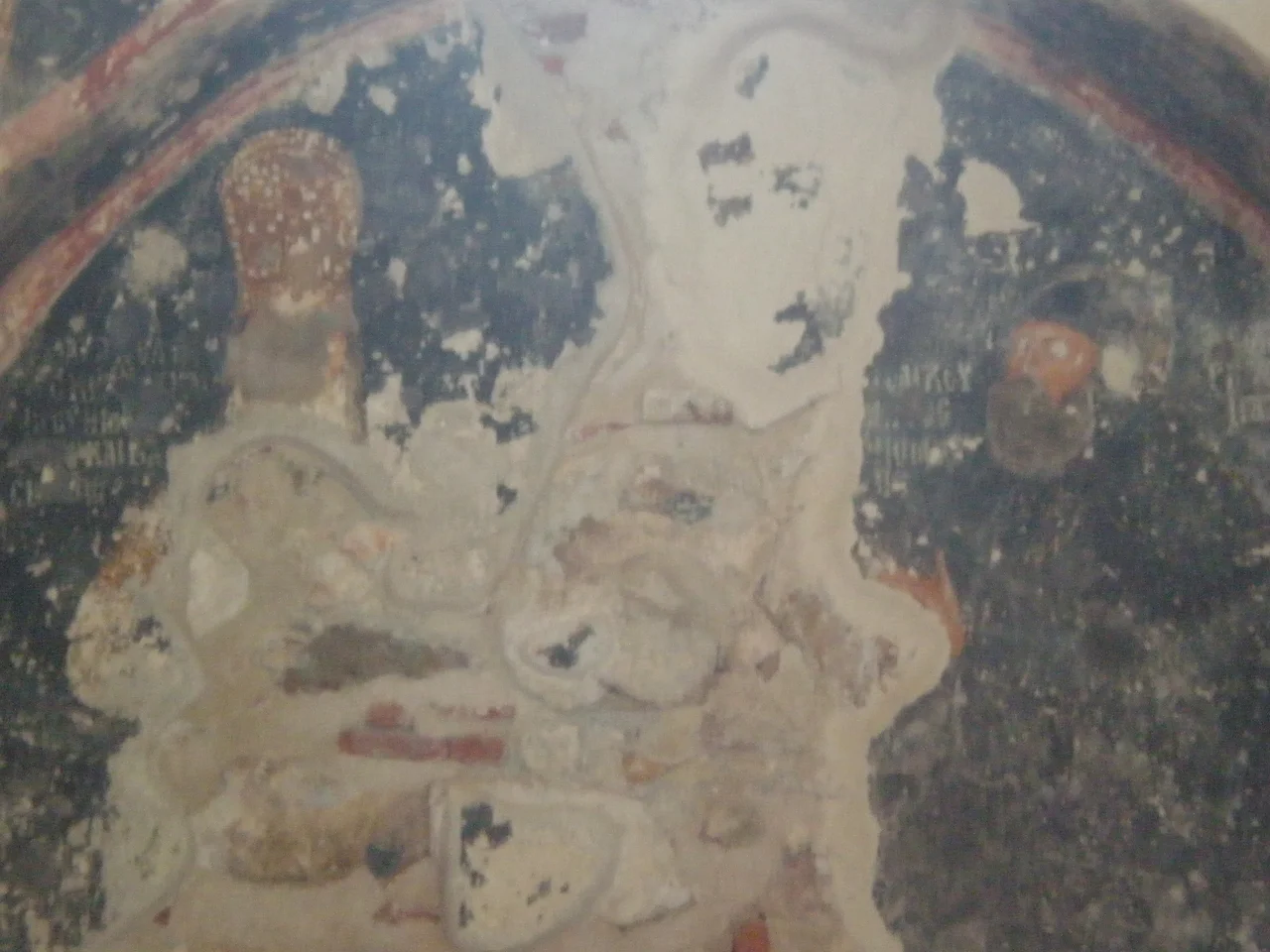
The churches of Mystras still stand, their frescoes among the finest surviving examples of late Byzantine art: rich colors, elongated figures, faces painted with the kind of psychological intensity that distinguishes late Byzantine iconography from earlier, more hieratic styles.
The Slow End
Constantinople fell to Mehmed II in May 1453. The last emperor, Constantine XI Palaiologos, died fighting in the city's breach. His brothers Demetrios and Thomas, who governed the Morea, had sent him no aid; the Despotate was recovering from yet another Ottoman attack. Their rule was by then deeply unpopular. An Albanian-Greek revolt against them led the brothers, in a catastrophic decision, to invite Ottoman troops into the Morea to help them suppress it.
The tribute they owed the Sultan went unpaid. They then revolted against Ottoman authority — a revolt they lacked the power to sustain. In May 1460, Mehmed II entered the Morea in person. Demetrios surrendered and became an Ottoman captive. Thomas fled to the West. By the end of the summer of 1460, virtually every city in the Peloponnese had submitted. A few holdouts remained: Monemvasia, the rocky sea-fortress, briefly fell under the rule of a Catalan corsair before its population expelled him and placed themselves under papal protection. The Mani Peninsula, at the far southern tip of the Peloponnese, resisted under a coalition of local clans and eventually came under Venetian rule. The last Byzantine position of all was Salmeniko Castle in the northwest, where Graitzas Palaiologos held out until July 1461, then slipped away to Venetian territory.
Thus the Despotate of the Morea ended: not in a single catastrophic battle but in a summer-long dissolution, one city at a time.
Mystras from the Air
The site of Mystras lies at approximately 37.07°N, 22.37°E, on the western slopes of the Taygetos range, southwest of modern Sparta in Laconia. The ruins of the medieval city — churches, palaces, monasteries — cascade down the hillside, and the hilltop fortress remains largely intact. It is a UNESCO World Heritage Site. From the air, Mystras's position is striking: the grey-brown crags of Taygetos rise sharply behind it, and the flat valley of the Eurotas River opens before it — the same valley where ancient Sparta stood. The Despotate's territory extended north across the mountains to the Arcadian plateau. Its geography, rugged and defensible but ultimately indefensible, mirrors its history.
From the Air
The Despotate's capital, Mystras, lies at approximately 37.07°N, 22.37°E on the Taygetos foothills, southwest of Sparta in Laconia. The Arcadian plateau, the northern extent of the Despotate's territory, sits around 37.50°N, 22.50°E. From cruising altitude, the Taygetos massif is one of the most distinctive landforms in southern Greece — a long, narrow ridge rising to over 2,400 meters, separating the Eurotas valley (Sparta's plain) from Messenia to the west. Nearest major airport: LGKL (Kalamata International), approximately 50 km west of Mystras. The ruins of Mystras are visible on approach from the north as a tiered stone settlement on the lower slope of the mountain.
Nearby Stories
- Araklovon Castle 4.8 km away
- Pellana 6.6 km away
- Arkadiko Bridge 10 km away
- Siege of Corinth (1463) 11 km away
- Leonidio 11 km away
- Kyparissia 11 km away
- Pheneus 14 km away
- Santameri Castle 29 km away