
Docklands Light Railway
When the Docklands Light Railway opened on 31 August 1987, the trains had no drivers, the stations had no staff, and the area it served was mostly derelict. The London docks, which had handled the trade of the British Empire from 1802 through to 1981, had closed one by one as cargo containerised. Warehouses stood empty. Cranes rusted. The cheapest possible rail solution had been the only one the Thatcher government would fund: a £77 million budget, a stretch of disused railway viaduct, a single-articulated lightweight train running on automated control. Forty years later that toy railway carries 97.8 million passenger journeys a year, runs 38 kilometres of track, links the City of London to Canary Wharf and London City Airport, and is still driverless.
The Cheap Option
In 1972, when the docks were still functioning but already in trouble, the London Docklands Study team commissioned a report that proposed a 'minitram' people-mover to connect Docklands to the Fleet line, which would become the Jubilee line. By the time the Thatcher government took office in 1979 the docks had gone dark and the Jubilee extension was off the table. The London Docklands Development Corporation, set up in 1981, hired London Transport to look at light-rail options. The Jubilee line extension would have cost around £450 million; the lightweight automated railway would cost £77 million. The choice was made on price. The original plan included some stretches of street running with manual operation, but the LDDC pushed for full automation. The two enabling Acts of Parliament went through in 1984 and 1985, construction started immediately, and the first trains rolled on 31 August 1987. The opening ceremony was performed by the Queen on 30 July, a month earlier.
Building It Bigger as It Filled Up
The original system had 12.1 kilometres of track, 15 stations, and trains made of single articulated cars supplied by Linke-Hofmann-Busch. It was, by intent, modest. Then Canary Wharf happened. The Olympia and York development at the centre of the Isle of Dogs began rising in 1988 and changed every assumption about Docklands traffic. The single-car trains became inadequate within months. The DLR's history since 1990 has been one continuous expansion: extension to Bank in 1991, requiring a new fleet of trains because the original ones did not meet underground fire safety regulations; extension to Beckton in 1994; extension under the Thames to Greenwich and Lewisham in 1999 via a private finance initiative that brought the line in ahead of schedule. By the time London was awarded the 2012 Olympics, the DLR was carrying tens of millions of passengers a year and could not run more trains because the signalling was at capacity, so the entire system was upgraded to three-car operation between 2007 and 2011 instead. Platforms were extended. Viaducts were strengthened. Selective door operation was introduced at the four stations that could not be lengthened.
The Airport in the Docks
London City Airport opened in 1987 in the basin of the King George V Dock, the same year the DLR began running. For almost twenty years passengers reached the airport by bus from Canning Town. In December 2005 an eastward branch of the DLR opened along the route of the old Eastern Counties and Thames Junction Railway, putting the airport on the network at last. In January 2009, with construction starting in June 2005, the Woolwich Arsenal extension opened, taking the railway under the Thames to a brand-new station on the south bank. Boris Johnson, then Mayor of London, formally opened it on 12 January 2009. The Stratford International extension came in August 2011, in time for the Olympics, taking over the old North London Line tracks from Canning Town through new stations at Star Lane, Abbey Road, and Stratford High Street.
How Driverless Trains Actually Work
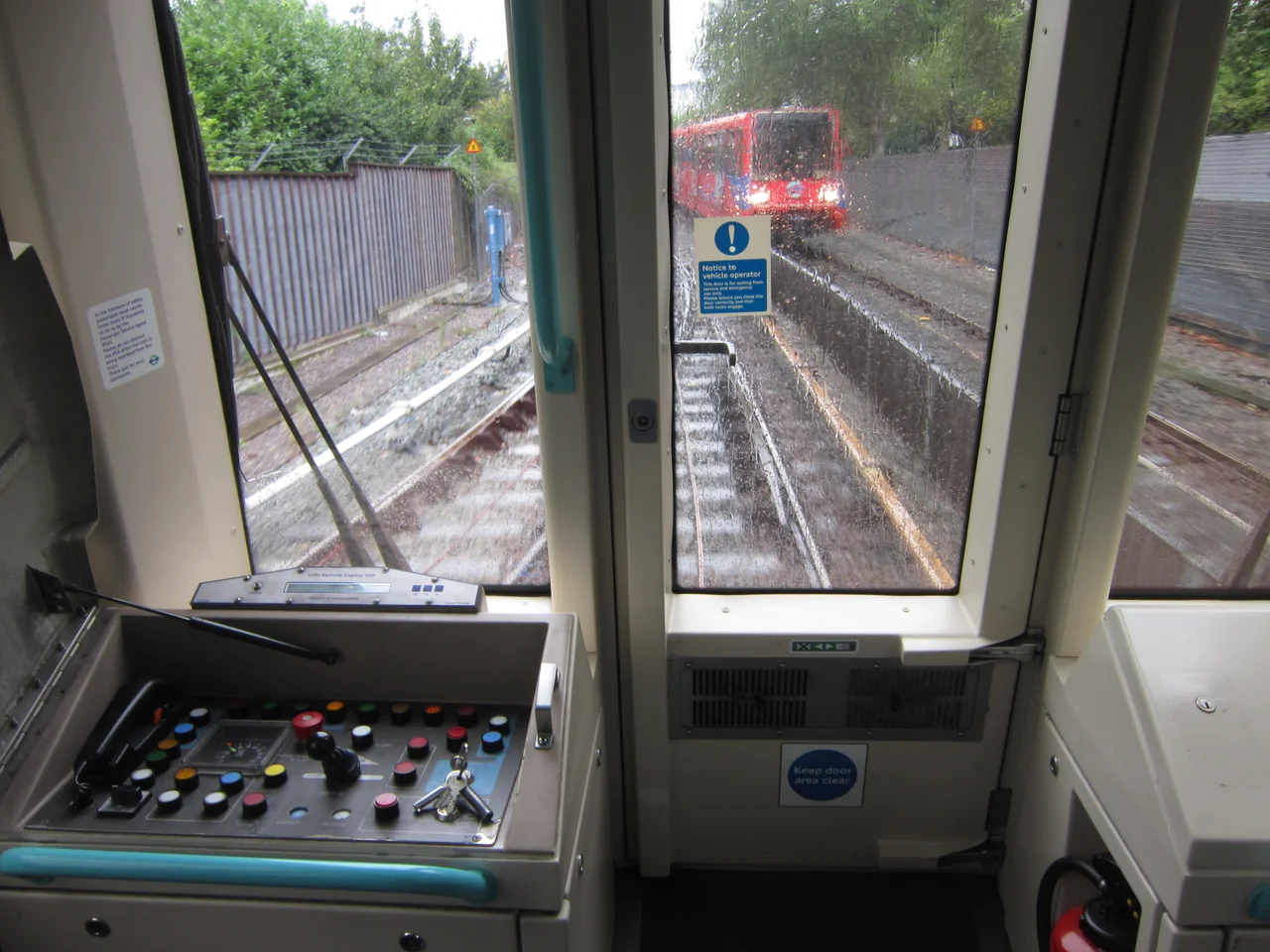
There are 149 trains on the DLR, and none of them has a driving cab. Operations are run by a central control room and an automated train protection system. There are still humans on board, called Passenger Service Agents, who handle ticket inspections, station announcements, and the very occasional manual takeover during disruption. The four below-ground stations (Bank, Tower Gateway, Cutty Sark, and Woolwich Arsenal among them) are staffed for fire safety reasons. Everywhere else is gates, sensors, and CCTV. From the front window of a DLR train (the best seat in London transport, especially with children) you can watch the points throw themselves and the signals change as the train glides through. The line was one of the first major rail projects anywhere to be designed for full wheelchair access from the start, with level platform boarding and lifts at every station.
The Network Today
The DLR now reaches west to Bank and Tower Gateway in the City of London, north to Stratford and Stratford International, south under the Thames to Lewisham, and east to Beckton, London City Airport, and Woolwich Arsenal. A proposed Thamesmead extension is being studied. The 1996 Docklands bombing destroyed part of the original South Quay station; it was rebuilt and the platform was eventually relocated 200 metres east in 2009. The franchise is currently held by KeolisAmey Docklands, a joint venture operating on behalf of Transport for London. Stand on a DLR platform now at South Quay or West India Quay, look up at the glass towers of Canary Wharf, and you can see the reason the cheapest railway in London's history became one of its most important. The empty docks are not empty anymore.
From the Air
The DLR network winds through east and south-east London on a mix of viaducts and short tunnels. The most photogenic stretches are along the Isle of Dogs, where the line threads between the towers of Canary Wharf, and across the Thames at Cutty Sark and Woolwich. London City Airport sits in the middle of the network, on the basin of King George V Dock; aircraft on final approach pass right over Pontoon Dock station. The Royal Docks, the O2 Arena, and the Thames Barrier are all visible along the route.
From the Air
Located at approximately 51.50 N, 0.02 E across east London. The DLR network runs from the City of London east to Beckton, Woolwich Arsenal, and London City Airport, and south to Lewisham. London City Airport (EGLC) is the closest airfield and sits in the centre of the network; its single 1,508-metre runway runs east-west between the Royal Docks. View from commercial overflights at 4,000 to 7,000 feet. The Canary Wharf cluster, the Thames Barrier, and the O2 Arena are the most visible visual markers.
Nearby Stories
- Battle of Britain, Northfleet 1.1 km away
- Bayham Old Abbey 5.4 km away
- Catharine Macaulay 6.4 km away
- Hatfield rail crash 8.8 km away
- Chequers 8.9 km away
- Chelmsford Cathedral 10 km away
- Queen Victoria Hospital 13 km away
- Fishbourne Roman Palace 36 km away