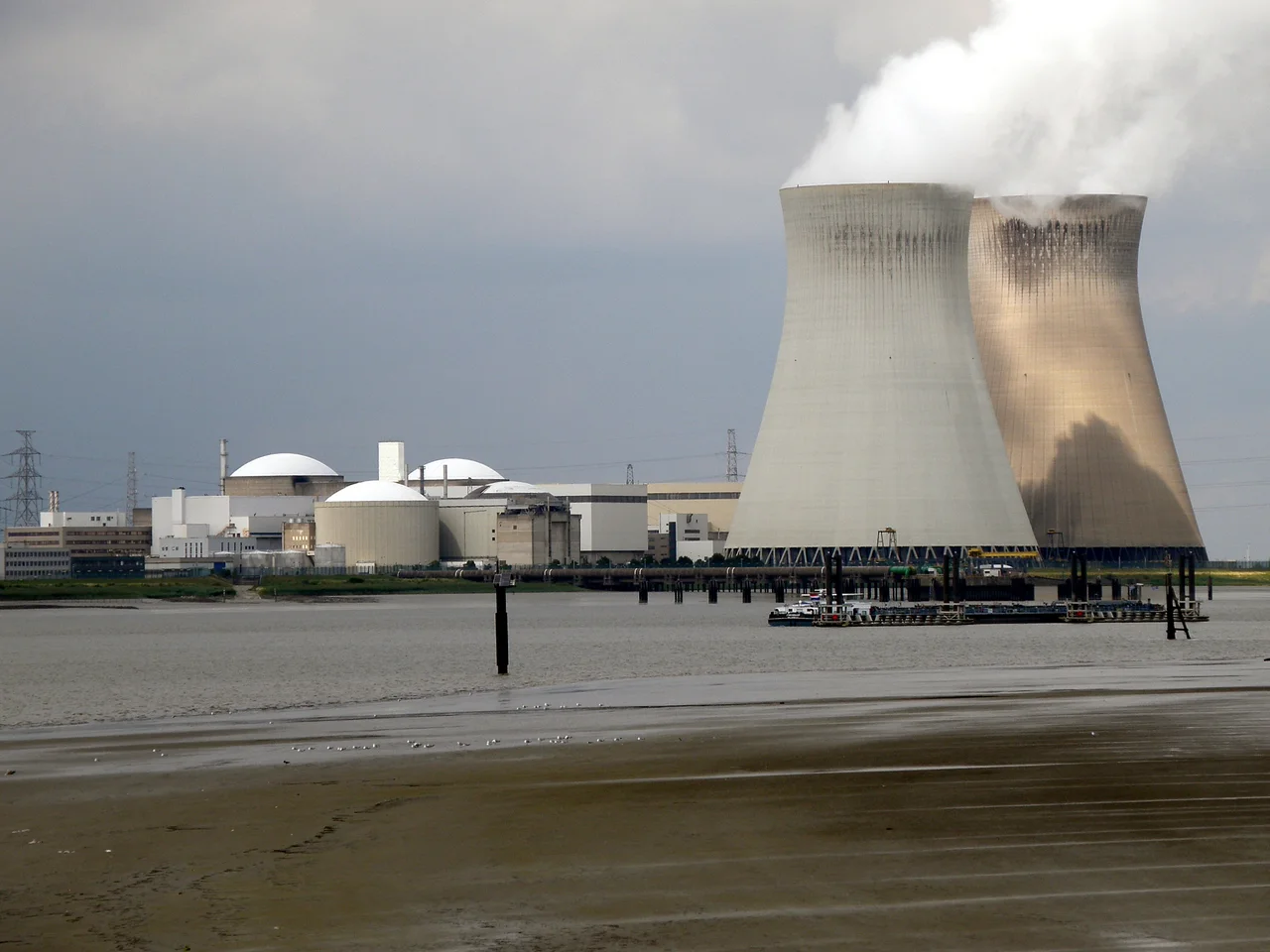

Doel Nuclear Power Station
Nine million people live within seventy-five kilometres of the cooling towers. That figure, recorded in a 2011 Nature commentary on European reactor siting, made Doel the most densely encircled nuclear power station in Europe and probably the world. The towers themselves rise 169 metres above the left bank of the Scheldt, big enough to be visible from the Dutch provinces of Zeeland and western North Brabant, big enough to host a nesting pair of peregrine falcons that have returned every spring since 1996. Beside them sits the village of Doel, which gives the plant its name, and which has been slowly torn down around the people who refused to leave.
Four Reactors on a Crowded Bank
Doel 1 and Doel 2 came online in 1975, twin pressurised-water units built by the ACEC-Cockerill-Westinghouse consortium that anchored Belgian heavy industry in the postwar decades. Doel 3 followed in 1982, Doel 4 in 1985, and earthworks for a fifth, larger reactor were halted in 1988 when the political appetite for new nuclear construction collapsed. The four operating reactors together produce 2,925 megawatts, roughly fifteen percent of Belgium's installed capacity and, in good years, thirty percent of the electricity actually generated. Nuclear power has long been the country's cheapest source of electrons, and Belgium's grid has been built around that assumption. The Belgian engineering firm Tractebel designed the plant; the public utility EBES built it; the French giant Engie, through its Belgian subsidiary Electrabel, owns and runs it today. EDF Luminus holds a minority stake in the two newest units.
The Village That Was Supposed to Disappear
Doel the village is older than Doel the power station by several centuries, a polder settlement of brick houses and dykes and a single church spire. In 1999 the Flemish government decided that the Port of Antwerp needed to expand westward across the Scheldt, and that the village stood in the way. Compulsory purchases began; demolitions followed. Roughly half the houses have been pulled down. The official population, which once numbered nearly a thousand, fell into the low double digits. But a stubborn core of residents and a steady rotation of squatters, artists and activists refused to leave. Murals appeared on the boarded windows of empty houses. The bakery closed; a cafe stayed open. Court rulings have flipped back and forth on whether the demolitions can continue. The peregrine falcons on the cooling tower have outlasted several rounds of policy.
Cracks, Sabotage, and the Politics of Aging
Doel has had its share of difficult years. In 2012, ultrasound inspections of Doel 3 revealed thousands of tiny cracks in the lowest forged ring of the reactor pressure vessel, traced to a manufacturing defect from the 1970s. The reactor sat dark for a year while regulators debated whether such defects compromised safety. They concluded that they did not, and Doel 3 restarted in June 2013. The following August, the main turbine of Doel 4 was deliberately destroyed when someone opened a fire-safety valve and drained sixty-five thousand litres of lubricating oil into an underground tank. The turbine seized while spinning at full speed. Repairs cost more than a hundred million euros, the plant was offline through the worst of winter, and the perpetrator was never identified. In 2016, after the Brussels bombings, the Belgian government dispatched 140 soldiers to guard the nuclear sites permanently. The reactors had long been listed in Europe's threat assessments; that March, both Doel and the Tihange plant were briefly evacuated.
The Long Goodbye, Postponed
Belgium legislated a nuclear phase-out in 2003 and has been rearranging the deadlines ever since. Doel 1 and Doel 2 were supposed to close in 2015; they ran for another decade and finally shut down on 14 February 2025. Doel 3 had already gone dark in 2022. That leaves Doel 4, licensed until 2035, and a politically tense conversation about whether to keep it, or perhaps even some of the others, running longer. In March 2025 the Belgian government finalised a deal to restart at least some shuttered units in November of that year, an extraordinary reversal driven by European energy anxiety and the realisation that wind and solar alone could not yet carry the load. Spent fuel waits on site in dry casks while researchers at the HADES laboratory, 225 metres down in the Boom Clay, study whether deep geological burial can work. The MYRRHA project explores nuclear transmutation, a way to make the waste decay faster. Above all of it, the towers keep steaming into the wide Scheldt sky.
From the Air
Located at 51.33N, 4.26E on the left bank of the Scheldt River, 15km northwest of Antwerp city centre. The two 169-metre cooling towers and their steam plumes are dominant landmarks for any flight near the Belgian-Dutch border, visible from much of Zeeland and western North Brabant. Antwerp International Airport (EBAW) is 18km southeast; Rotterdam The Hague Airport (EHRD) is 50km north. The Dutch border lies less than 3km north of the plant.
Nearby Stories
- Roosendaal 5 km away
- Sabbinge Castle 5.7 km away
- Bouchout Castle 7.1 km away
- Campine 8.5 km away
- North Brabant 12 km away
- Egmont Castle 12 km away
- Battle of Halen 14 km away
- Reginald Warneford 22 km away