
Donaghadee Lifeboat Station
On January 31, 1953, the British Railways car ferry MV Princess Victoria sailed from Stranraer toward Larne in a force-ten gale. 176 people were on board. The seas hammered the ship's stern car-deck doors until they gave way, and the vehicle deck flooded. By late afternoon she had foundered seven miles east of Belfast Lough. 135 people drowned. The lifeboat from Donaghadee, under Coxswain Hugh Nelson, was one of three RNLI crews launched in response. By the time the Donaghadee boat returned to harbour, it had picked up survivors from life rafts and scattered wreckage - 33 of the 44 people who survived that day. Hugh Nelson received the RNLI Bronze Medal. He later received the Medal of the Order of the British Empire.
A 7,500-Pound Bequest
The station's origin lies with a single donor. In 1907, the RNLI received a bequest of 7,571 pounds, 18 shillings and seven pence from the estate of the late Mrs A. W. Clarke Hall, who had specified that a lifeboat be provided for the north coast of Ireland and named William and Laura, after her husband and herself. The committee chose Donaghadee. At the time, most RNLI stations still operated 'Pulling and Sailing' lifeboats - boats with oars and a single mast, the last of which would only be retired in 1957. Donaghadee was different from the start. The 43-foot Watson-class lifeboat built for the new station was one of the earliest motor-powered RNLI boats, fitted with a 40-horsepower Blake petrol engine. Thames Ironworks at Blackwall in London built her. She departed Harwich under her own power on July 1, 1910, travelled up the east coast of England, crossed Scotland via the Forth and Clyde Canal, and arrived at Donaghadee 11 days later. At the dedication ceremony in September, Charles Dunbar Butler, the station's president, and Miss Slade, representing the donor's family, formally handed her over.
The Coxswain Who Drowned Fishing
Lifeboat coxswains spent their working lives at sea, and Donaghadee's records carry a quietly devastating note from 1917: Coxswain William G. Nelson drowned in a fishing accident. He had survived years of lifeboat callouts in the worst weather the Irish Sea could produce, only to lose his life in routine work. The detail does not appear in many maritime histories, but it sits in the station's records and is the kind of fact that explains why lifeboat communities are often tight-knit across multiple generations. Two surnames - Nelson and McNamara - recur through the Donaghadee station's award lists across more than a century, suggesting fathers, sons and grandsons who all answered the same pagers.
The Sir Samuel Kelly and the MV Douglas
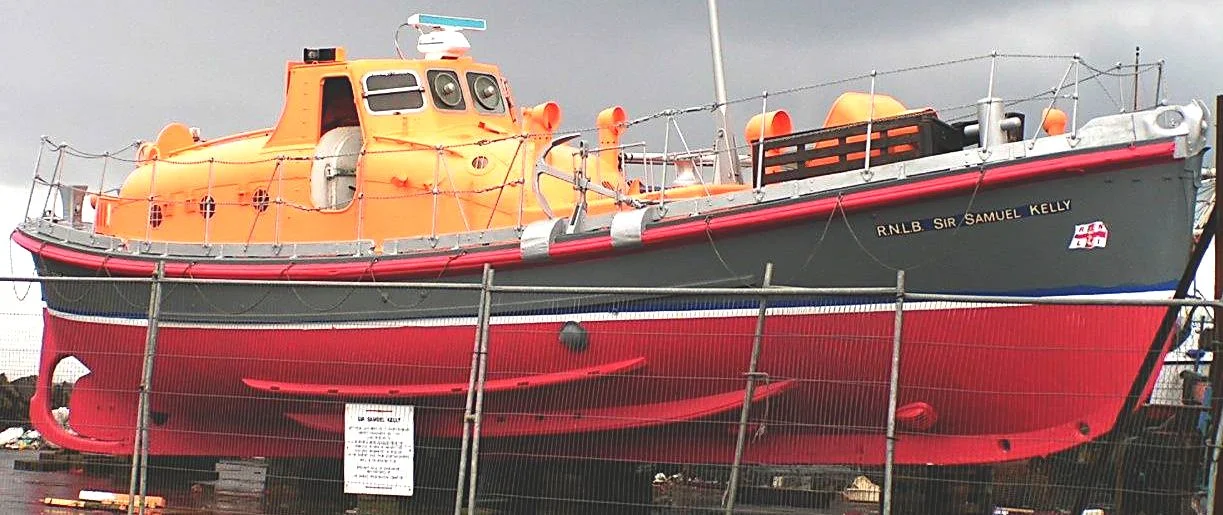
On August 17, 1950, Donaghadee's third lifeboat was named in a ceremony at the harbour. The Sir Samuel Kelly (ON 885) was the gift of Lady Mary Kelly of Crawfordsburn, County Down, in memory of her husband, a coal merchant and philanthropist. Six years later, on July 17, 1956, the Norwegian cargo ship MV Douglas of Bergen ran aground north of Larne, near the Maidens lighthouses off County Antrim. The ship was holed and taking on water but in no immediate danger. The Sir Samuel Kelly was requested to stand by. A tug tried to tow Douglas off the rocks the next day and failed. The lifeboat eventually landed four of the cargo ship's crew at Larne and turned for home. The Sir Samuel Kelly had been on station alongside Douglas for 53 hours - more than two days of continuous duty for a crew who had originally been told to expect a short callout.
Seven Minutes from Pager to Sea
At 02:15 on September 13, 2009, the crew of the lifeboat Saxon (ON 1267) were woken by their pagers. A yacht called Bentim Buoys with three elderly crew members aboard had run aground on the rocks near Ballywalter. The Saxon was launched in seven minutes from pager to slipway - an extraordinary response time for a volunteer crew at two in the morning. In force five-to-six conditions, getting a reliable tow line onto the yacht took repeated attempts, but eventually the Saxon pulled Bentim Buoys off the rocks. The yacht was found to be watertight and was towed to harbour, arriving at five in the morning. Coxswain Philip McNamara received the Thanks of the Institution inscribed on vellum for that service. The Saxon herself was withdrawn from the station in 2023 for repair work, and the relief lifeboat 14-21 MacQuarie (ON 1225) became Donaghadee's permanent boat. She is still on station, still answering pagers in the dark.
From the Air
Donaghadee Lifeboat Station sits at 54.64N, 5.53W on the Parade in Donaghadee, on the northern east coast of the Ards Peninsula in County Down. From altitude, look for the distinctive harbour with its two long stone piers projecting into the Irish Sea, and the lighthouse at the harbour mouth - the same harbour designed by John Rennie and completed in the 1820s. Nearest airport is Belfast City (EGAC), about 15 nautical miles west. Recommended viewing altitude 2,000-3,500 feet. The Princess Victoria sank approximately seven miles east of the entrance to Belfast Lough, roughly between Donaghadee and the Galloway coast.
Nearby Stories
- Pasages (steam trawler) 0.5 km away
- Edward Harland 1.1 km away
- SS Georgetown Victory 4.7 km away
- St Patrick's Isle 18 km away
- Ballymena 19 km away
- Silent Valley Reservoir 20 km away
- Larne 23 km away
- Battle of Glen Trool 39 km away