
Dorrigo National Park
Step onto the Skywalk and the floor of the world simply ends. The boardwalk runs out over the lip of the escarpment, and below your feet the rainforest canopy rolls away toward the coastal plain, green giving way to blue haze and, on a clear day, the distant glint of the Pacific. This is the edge of the Dorrigo plateau, where the tablelands of New England crack open and fall away to the sea. The forest clinging to that drop is not ordinary bushland. It is a surviving piece of Gondwana, the ancient supercontinent, and the people who knew it first, the Gumbaynggirr, walked these slopes long before any track was cut.
A Surviving Fragment of Gondwana
The rainforest here is old in a way that is hard to grasp. Its plant lineages descend from the forests that once blanketed Gondwana, the southern supercontinent that began breaking apart more than 150 million years ago. As Australia drifted north and dried out, those forests retreated to a handful of wet refuges along the eastern escarpment. Dorrigo is one of them. In 1986 the park was inscribed as part of the World Heritage Gondwana Rainforests of Australia, the most extensive stretch of this kind of forest left on Earth, and in 2007 it was added to the Australian National Heritage List. To walk the Wonga Walk beneath trees six centuries old is to move through a landscape that remembers a different planet.
Gumbaynggirr Country
Long before the park existed, this was, and remains, Gumbaynggirr country, a place of deep significance to the people whose land it is. They knew the escarpment forests intimately, the seasons of fruit and bird, the ways through the wet slopes. The name Dorrigo itself comes from their language. When you stand on the plateau and look down the same drop the Gumbaynggirr have looked down for thousands of generations, the forest stops being scenery and becomes something held in trust, a country with custodians, not simply a park with visitors.
Water Everywhere
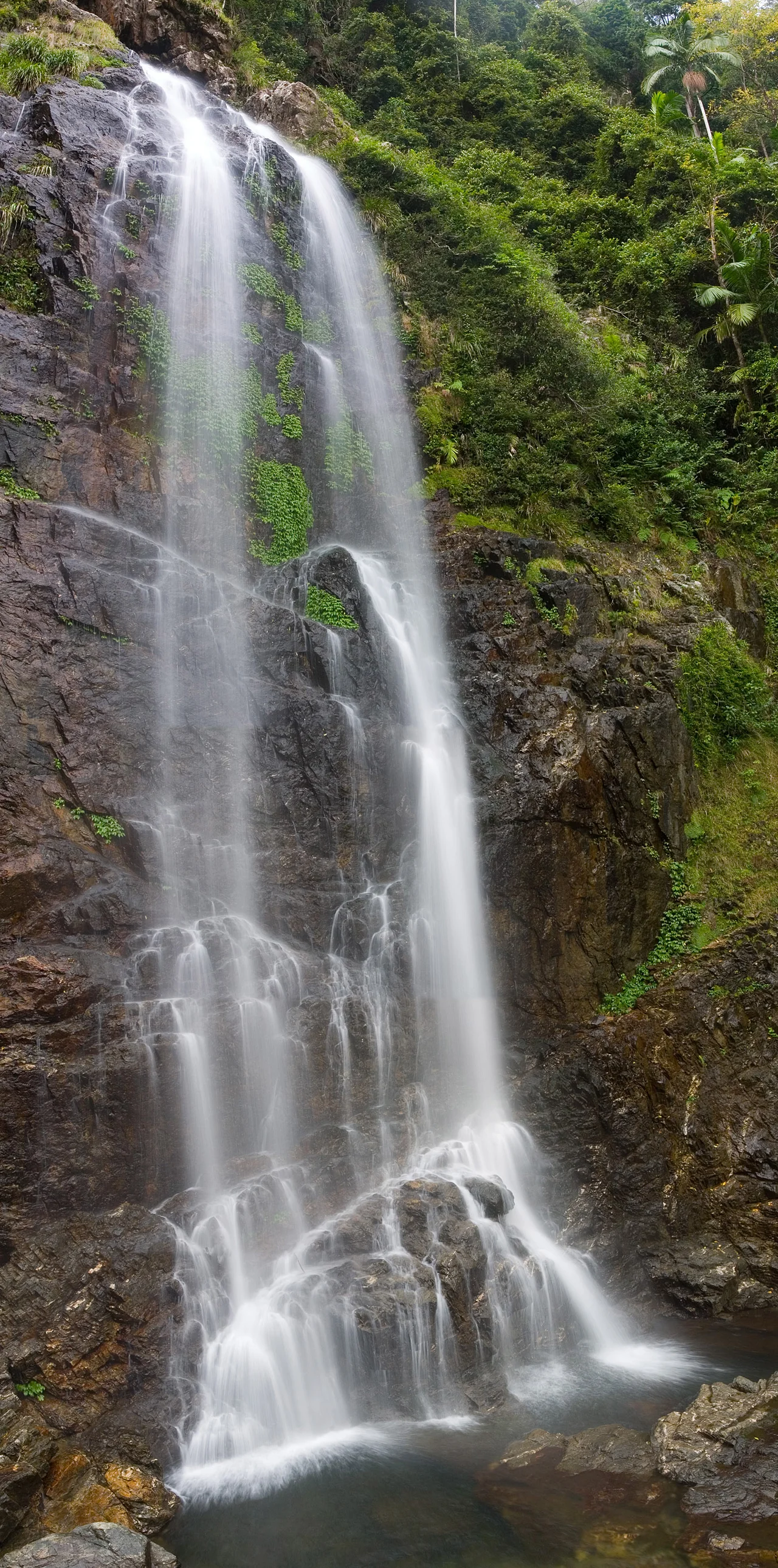
A plateau soaked by some of the heaviest rainfall in New South Wales has to shed its water somewhere, and at Dorrigo it does so spectacularly. Creeks gather on the tableland and pour over the escarpment edge in a chain of falls. The Wonga Walk threads past Crystal Shower Falls, where the track ducks behind the curtain of water, and Tristania Falls, where the cascade slides over dark rock between tree ferns. After rain the whole forest drips and runs, and the air turns cool and green and faintly mineral. The waterfalls gave the road that climbs to the plateau, the Waterfall Way, its name.
The Loudest Quiet Forest
Stand still on a track and the rainforest fills with sound. Around 128 bird species live here, and Dorrigo is one of the great birdwatching forests of eastern Australia. The superb lyrebird performs from the leaf litter, mimicking every other call in the forest and a few sounds that were never meant to be birdsong. Overhead the wompoo fruit dove gives its deep, bottle-blowing wom-poo, and the male regent bowerbird flashes black and gold through the canopy. Among the ferns a red-necked pademelon, a small forest wallaby, freezes, watches, and bounds away. The Skywalk and the canopy tracks were built to put you among all this, at the height where the forest actually lives.
From the Air
Dorrigo National Park sits at 30.38 degrees south, 152.75 degrees east, on the eastern edge of the Dorrigo plateau roughly 731 metres above sea level where the New England escarpment falls away toward the coast. From the air the sharp line between cleared tableland farmland and dense dark-green escarpment rainforest marks the park boundary, with the coastal plain and the Pacific beyond to the east. Recommended viewing altitude is 3,000 to 5,000 feet AGL for the escarpment edge; the plateau is often capped by cloud and the area is among the wettest in New South Wales, so expect mist and reduced visibility after rain. Nearest airport is Coffs Harbour (YSCH) about 50 km east on the coast; Armidale (YARM) lies west across the tablelands.
Nearby Stories
- Wollomombi Falls 29 km away
- South West Rocks Pilot Station Complex 43 km away
- Guy Fawkes River National Park 44 km away
- Glen Innes Showground 58 km away
- Angourie, New South Wales 65 km away
- Apsley Falls 68 km away
- Yamba, New South Wales 98 km away
- SS Elingamite: Gold, Fog, and a Captain Wrongly Blamed 1803 km away