.jpg)
Drumcliff Monastery
Cast a cold eye on life, on death. Horseman, pass by. The words are carved on a slab of limestone in a small churchyard at the base of Benbulben, five miles north of Sligo town. William Butler Yeats wrote them as his own epitaph, and they mark a grave he asked for here, in the shadow of a mountain he loved, beside the ruins of a monastery founded in 574 AD by Saint Colmcille. The Drumcliff site has been holy ground for fifteen hundred years. Yeats simply added another layer.
Colmcille's Westernmost Heart
'Beloved to my heart also in the West,' the saint is said to have declared in a later fragment, 'Drumcliffe at Culcinne's strand.' Colmcille founded the monastery in the territory of Cairbre Drom Cliabh, ruled by the descendants of Cairbre Mac Neill, son of Niall of the Nine Hostages. The land was probably donated by a relative, the High King Aed Ainmire. Drumcliff joined the paruchia Columbae, the great federation of Columban monasteries headquartered at Iona. For the next two centuries, this network flourished under the patronage of Colmcille's own dynasty, the Cenel Conaill, ecclesiastical and political power braided together. The monastery sat on the south bank of the river Codhnach, near the site of the Battle of Cul Dreimhne, fought around 560. Colmcille himself had taken part in that fight, fifteen years before he turned the ground beside it into a place of prayer.
The High Cross
A great sandstone cross still stands at Drumcliff, and it carries the only known representation of the Virgin Mary and Child on any high cross in Ireland. Carve into the west face: scenes from the New Testament. The arrest and mocking of Jesus, with two soldiers flanking him. The Return from Egypt, paired with the infant John the Baptist between Zechariah and Elisabeth. The Crucifixion itself, with Stephaton offering vinegar and Longinus lifting his spear. The east face turns to the Old Testament: Adam and Eve in the garden, David killing Goliath, Daniel in the lion's den. A high-relief lion or camel walks across each shaft, depending on which face you read. John the Baptist was a particular focus of Columban devotion, and the cross gives his infancy unusual prominence. After more than a millennium of weather, the interpretations remain debated. The figures remain.
Burned in His Own House
The monastery's annals read like a chronicle of survival. In 871, Dunadhach son of Raghallach, Lord of Cinel Cairbre-Mor, 'Protector of the roaring shore, pious warrior of the sons of Conn,' was interred under hazel crosses at Drumcliff. In 1029, the erenagh Angus O Hennesy was burned to death. In 1315, the daughter of Manus O Conor attacked the churches here, plundering several clerics. In 1416, the coarb Muirgius O Coineoil was burned in his own house by robbers. In 1252, the death notice for Maelmoedoc O Beollain called him 'the richest and most prosperous man of his time in Ireland and the most esteemed, most charitable and most generous.' Lightning hit the round tower in 1396. Vikings, infighting, dissolution under Henry VIII, the slow eclipse by the Dominican Friary at Sligo, all left their marks. The last monks are mentioned in 1503.
Round Tower, Round Mountain
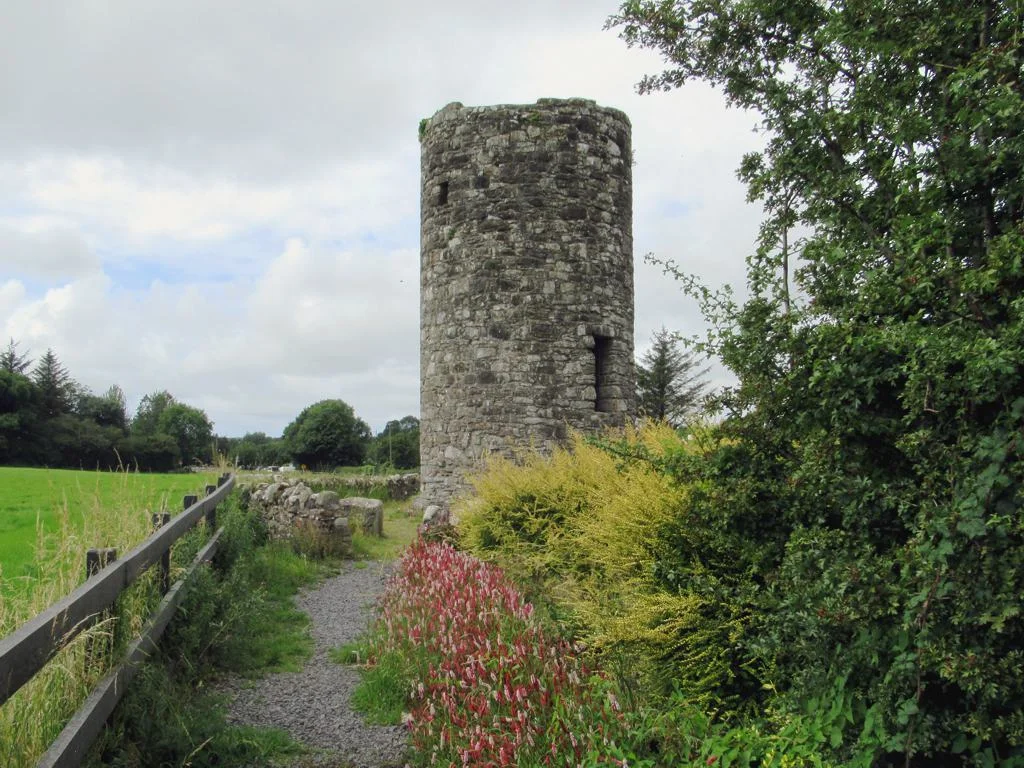
The round tower at Drumcliff is shorter than most, rising only about nine meters from ground level. Its diameter is just under five. The east-southeast doorway stands a meter and three-quarters above the ground, the standard defensive raise. Excavations in the early 1980s pulled up the debris of a working monastery: bronze and iron waste from metalworking, pins and needles and buckles, glass and paste beads, iron knives, antler and bone combs, animal bones, shellfish, seeds and grain. A single fragment of gold leaf. Remote sensing has since identified the buried lines of mill-races. Saint Mothorian was the first abbot. A later abbot, Saint Torannon, who died in 921, became the regional patron. He believed the top of Benbulben was the closest point to heaven in Ireland.
Yeats Came Home
Yeats died in 1939 in Roquebrune-Cap-Martin on the French Riviera, and the war delayed his return. In 1948 his remains were brought back to Drumcliff and buried in the Church of Ireland graveyard beside the monastery he had grown up beneath. His great-grandfather had been rector here. The epitaph he composed for himself looks across the road at Benbulben rising bare and gray-white against the Atlantic sky. The poet who had spent a lifetime writing about Sligo, about the Gore-Booths at nearby Lissadell, about the old gods and the new Ireland, asked to be put back into this specific ground. He could have chosen anywhere. He chose the place Saint Colmcille loved, in the West.
From the Air
Located at 54.33°N, 8.49°W at the base of Benbulben, five miles north of Sligo town on the N15. Best viewed at 1,500-3,000 feet for the dramatic contrast of the mountain's vertical limestone walls against the small churchyard at its foot. Nearest airport is Sligo (EISG) just to the south; Donegal (EIDL) is 45 km north. The round tower is small, look for the high cross and church spire. Atlantic weather can mask Benbulben within minutes.
Nearby Stories
- Roman Catholic Diocese of Killala 3.2 km away
- County Leitrim 6.2 km away
- Glencolmcille 8.3 km away
- Ballymote 8.5 km away
- Caves of the Tullybrack and Belmore Hills 15 km away
- Ballycastle, County Mayo 20 km away
- Castlederg 32 km away
- RMS Empress of Britain (1930) 80 km away