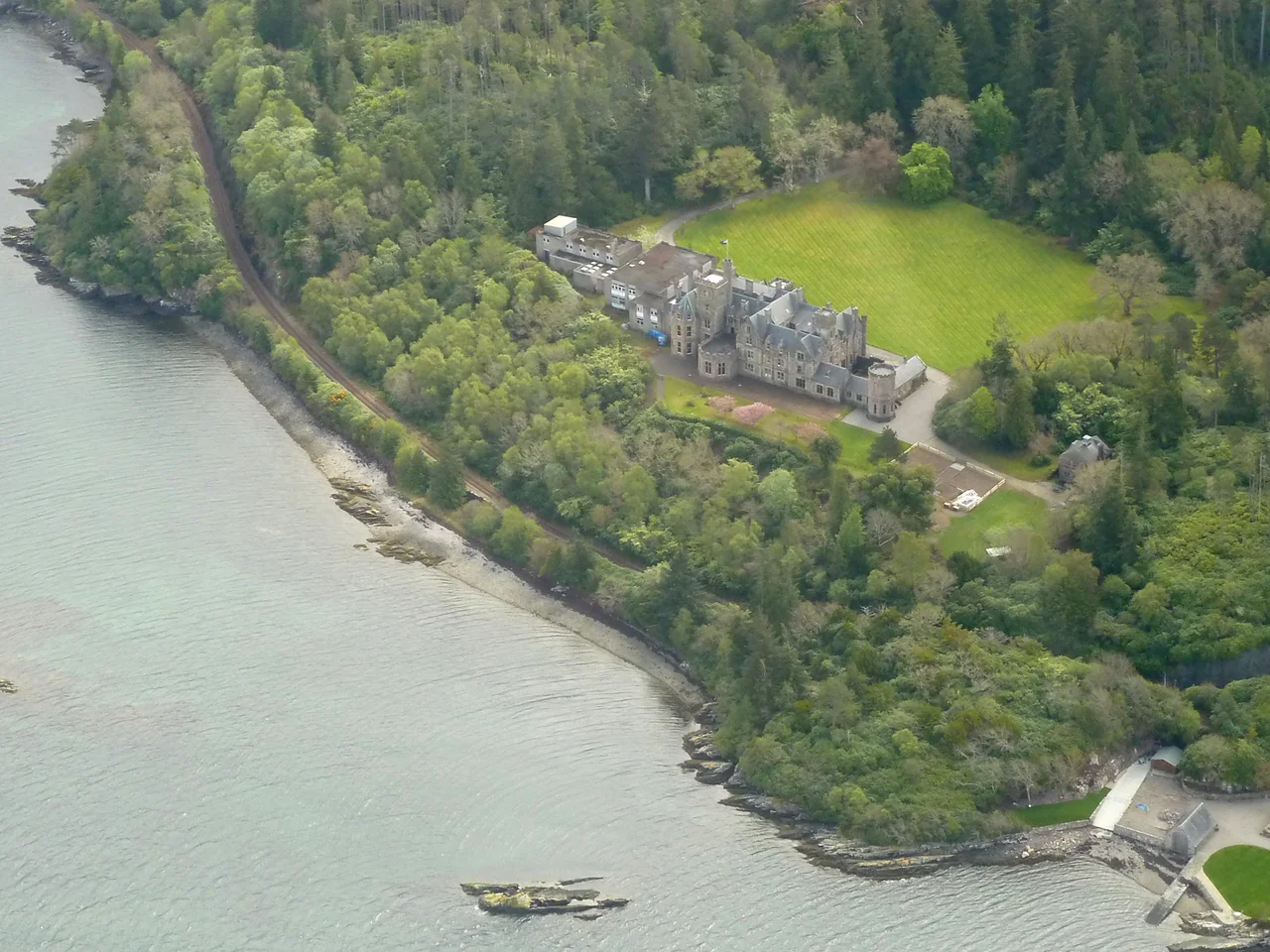
.jpg)
Duncraig Castle
Seventeen people - one extended English family - moved into Duncraig Castle in the summer of 2003 and let a BBC camera crew follow them. The castle had been derelict for thirteen years. None of the bathrooms worked. Several ceilings had collapsed. The five-part BBC1 series that followed was the kind of thing British television does very well: hopeful people, a beautiful ruin, money running out, families coming apart. By 2008 only one branch of the Dobson family was still in residence. By 2009 the castle was on the market again. Duncraig has been on this loop of grand ambition and quiet retreat almost since it was built. The man who built it was a Scottish MP who had made a fortune in the opium trade.
Matheson's Money
Sir Alexander Matheson, first Baronet of Lochalsh, returned to Britain in the 1860s with a fortune earned in China. He had been a partner in Jardine, Matheson & Co., the trading house his uncle James Matheson co-founded in 1832 - and the dominant British firm in the nineteenth-century Chinese opium trade. The British government had fought two wars to keep that trade open; the partners of Jardine, Matheson became wealthy beyond ordinary imagining. Alexander Matheson brought his share home and built a country seat. Duncraig Castle, completed in 1866 on the south shore of Loch Carron, was designed by Alexander Ross, an Inverness architect who specialised in the Scottish Baronial style - three storeys of asymmetrical bays, with crenellations and gabled wings. Matheson died in 1886. His family kept the castle as a hosting venue, renting it to wealthy summer tenants for grand parties and shooting weekends. In 1897, when the Highland Railway extended its line from Stromeferry to Kyle of Lochalsh, the family arranged for a private station of their own. Duncraig Station, originally built for the convenience of the Mathesons and their guests, is still open as a public stop on the Kyle of Lochalsh line - a single concrete platform and an unusual hexagonal shelter with a pyramid roof.
Hamilton's Plan
In the 1920s the castle passed to Sir Daniel Hamilton and his wife Margaret, who owned the neighbouring estate. The Hamiltons were social reformers, prominent in cooperative and educational movements, and they intended to use Duncraig as a community resource - some kind of school or institute serving the rural Highlands. The plan never quite materialised. When the Second World War came, the Admiralty took over the castle and used it as a naval hospital. By the time peace returned, Sir Daniel had died. Margaret Hamilton bequeathed the castle to Ross-shire County Council, with the wish that it become a technical school for the Highlands. The council adapted the building as a residential college for girls studying home economics. For more than four decades, Duncraig taught domestic science and cookery to generations of young women from across the north of Scotland. A modernist wing was added in 1969. Fireplaces were removed; central heating was installed throughout. The home economics college closed in 1989, and the council put the castle on the market.
Empty, Then Crowded
Duncraig stood derelict through the 1990s, apart from a stretch in the mid-1990s when the BBC used it as a base for the production crew of Hamish Macbeth, the comedy-drama set in fictional Lochdubh and shot largely in nearby Plockton. In 2002 the castle was bought by Sam and Perlin Dobson, a couple from Nottingham who ran a family business. In the summer of 2003 seventeen members of the extended Dobson family - couples, children, in-laws - moved in together. The BBC filmed it for a five-part series that aired on BBC1 in October 2004. The series did what these series do. The cousins quarrelled. The renovation costs spiralled. The legal disputes started. By 2008 only Sam and Perlin's immediate family remained, after the other siblings had left or been court-ordered out. In 2009 the Dobsons sold the castle to Suzanne Hazeldine, who reopened it as a bed and breakfast in the existing rough condition for two years before closing again in 2010 for a more thorough renovation. The reopening kept slipping. In 2016 she told The Press and Journal she had given the building a "complete overhaul." The B&B was open for some of 2021 and 2022. It was sold into private ownership at the end of 2022, and the bed and breakfast has not reopened since.
Above the Loch
Duncraig today sits on its forty-acre property above Loch Carron, between the village of Plockton and the Kyle of Lochalsh, with its own private island, jetty and boathouse. From the south windows you can see the Skye Bridge in the distance, and on a still summer evening the loch can be flat enough to mirror the castle's gables. Plockton, a mile west along the shore, is one of the most photographed villages on the west coast - white-painted houses, palm trees grown in the warmth of the North Atlantic Drift, fishing boats on the bay. Duncraig railway station, half a mile up the hill from the castle, was given a category-B listing in 1997 for its hexagonal shelter. The Kyle line runs four trains a day each way from Inverness, which is one of the most spectacular rail journeys in Britain. Duncraig Castle is not currently open to the public. But the loch and the railway and the village beneath it remain, and a private island still sits offshore in the bay.
From the Air
Duncraig Castle stands at 57.34N, 5.63W on the south shore of Loch Carron in Wester Ross, just east of Plockton village and about 2 nm northeast of the Kyle of Lochalsh. Visual landmarks: Loch Carron itself stretches east-west; Plockton with its sheltered bay and palm trees is 1 nm west; the Skye Bridge crosses the strait 4 nm southwest; Plockton airstrip (EGEC) is 1 nm west of the castle. Nearest ICAO airports: Plockton airstrip (EGEC) immediately to the west (grass strip, daylight VFR only), Inverness (EGPE) 55 nm east, Stornoway (EGPO) 80 nm northwest. Recommended viewing altitude 1500-2500 ft AGL to keep the castle and Loch Carron in frame. The Kyle of Lochalsh line runs along the shore directly below the castle.
Nearby Stories
- Duntulm Castle 3.3 km away
- Sabhal Mòr Ostaig 6.3 km away
- Fairy Lochs 7.6 km away
- Talisker distillery 10 km away
- Rùm 14 km away
- An Teallach 17 km away
- Glen Affric 22 km away
- Stand-off at the Fords of Arkaig 26 km away