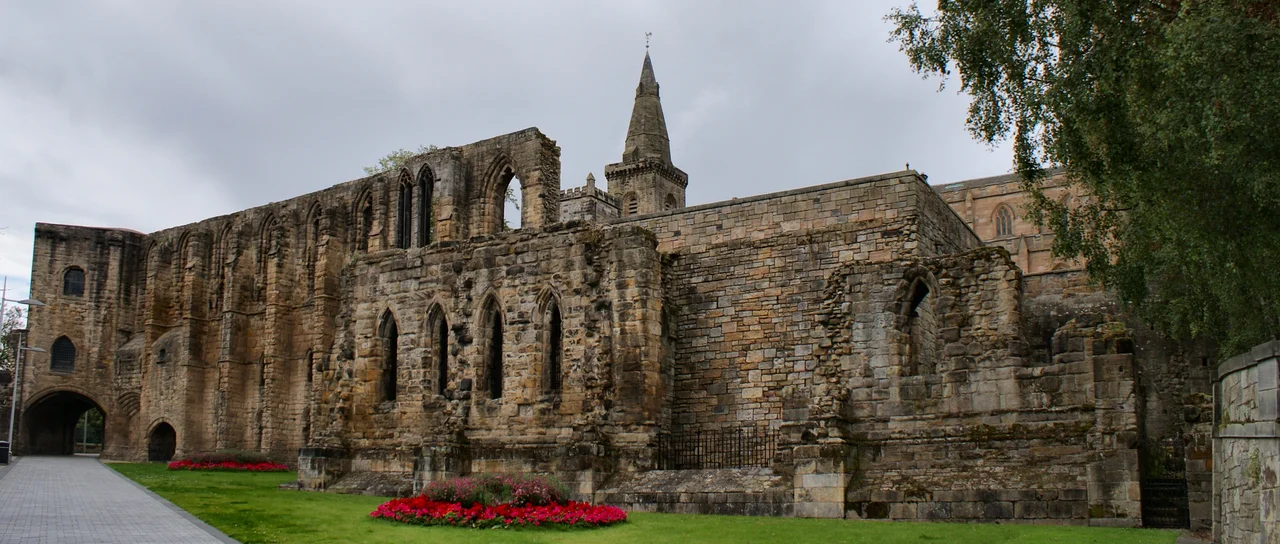

Dunfermline Palace
On a wet November day in 1600, Anne of Denmark gave birth to a small, sickly boy at Dunfermline Palace. A new bed of green velvet and taffeta had been built for the occasion in one of the palace's upper rooms. The child was slow to learn to walk and had to be trained with an oak stool fitted with wheels, described in Scots as a "tymber stule with rynand quheillis to gang in." When he finally walked the length of the great chamber unaided, his physician wrote proudly that he managed it "like a gallant soldier all alone." That sickly child was Charles I, and he was the last reigning monarch to be born in Scotland.
From Guest House to Palace
Dunfermline Palace stands on the southern slope of a hill in Fife, attached to Dunfermline Abbey by a covered gatehouse called a pend. The building was originally the guest house of the abbey, the place where wealthy travellers, royalty among them, were lodged when they came to pray at the shrine of St Margaret. Scottish kings had favoured Dunfermline since the 11th century, when Malcolm III made it his capital and married Margaret of Wessex. David II and James I were both born here. Timber was bought for royal lodgings in 1429. Around 1500, James IV converted the monastic guest house into a proper palace; he came to inspect the work himself in 1507 and handed out drinksilver, tips, to the masons. William Schaw, the king's master of works, remodelled the building again in 1590 to prepare it for the new queen, Anne of Denmark.
Anne of Denmark's Palace
In 1589, when James VI married Anne of Denmark, he gave her Dunfermline Palace as a wedding present. He had to compensate the Master of Gray, who held the title of Commendator of Dunfermline, with 12,000 merks. Anne loved the place. She gave birth to three of her children here: Elizabeth in 1596, Charles in 1600, and Robert in 1602. She travelled between Dunfermline and Edinburgh by boat, sometimes stopping to eat at South Queensferry. Her household at Dunfermline included her English musician John Norlie, her fool Tom Durie (who according to one persistent story walked in on the queen celebrating a secret Catholic Mass), the gardener John Lowrie, and her German physician Martin Schöner. In 1600 she completed a new building at the palace, the cruciform "Queen's House," with a driveway running through its basement level, modelled on the Queen's House at Greenwich. It was demolished in 1797.
Prince Charles
After the Union of the Crowns in 1603, when James VI became James I of England and moved his court to London, Dunfermline Palace fell quiet. The new Prince Charles, too frail to travel south with his parents, was left at Dunfermline for a year in the care of Alexander Seton and his wife Grissal Leslie. Marion Hepburn, who had previously rocked the cradles of his older sisters, was put in charge of his. The English courtier Robert Carey came to see him and wrote that the prince was "a very weak child." The physician Henry Atkins wrote to Anne that Charles could now walk the great chamber several times a day without support, "not so bold as Ajax but as wary as Ulysses." In July 1604 the prince finally crossed the Forth to begin his journey south. His old Dunfermline servants went with him: his seamstress Joan Drummond, the laundress Agnes Fortune, the cook John Lyle. Most were given pensions for the rest of their lives.
Abandonment
Charles I returned to his birthplace only once after that, briefly, for his Scottish coronation in 1633. The last monarch to use the palace was his son Charles II, who stayed here in 1650 just before the Battle of Pitreavie. Soon afterward, during Cromwell's occupation of Scotland, the building was abandoned. By 1708 it had been unroofed. The Queen's House was demolished in 1797. What remains today is the kitchen, its cellars, and the long, high south wall, almost intact, looking out over the deep wooded gorge of the Lyne burn and beyond to the Firth of Forth. From below, the wall still rises like the side of a cliff, its empty window openings ranked one above the other, the way they must have seemed to a small Stuart prince looking out at the Scotland he was about to leave behind.
From the Air
Located at 56.0695°N, 3.4646°W in central Dunfermline, Fife, adjoining Dunfermline Abbey on the south side. The palace ruins occupy the top of a steep gorge overlooking the Pittencrieff Glen. From the air, look for the long south wall of the palace, the abbey church and tower immediately to the north, and the green expanse of Pittencrieff Park to the west. The Firth of Forth lies about 3 nautical miles south. Edinburgh Airport (EGPH) is about 11 nautical miles south. Best viewed from 1,500-2,500 feet AGL in clear weather.
Nearby Stories
- Ardoch Roman Fort 2.2 km away
- Craignethan Castle 3.1 km away
- Haddington 3.8 km away
- Balvaird Castle 4.3 km away
- Battle of Kilsyth 9.4 km away
- Siege of St Andrews Castle 9.9 km away
- Neidpath Castle 11 km away
- Melrose Abbey 15 km away