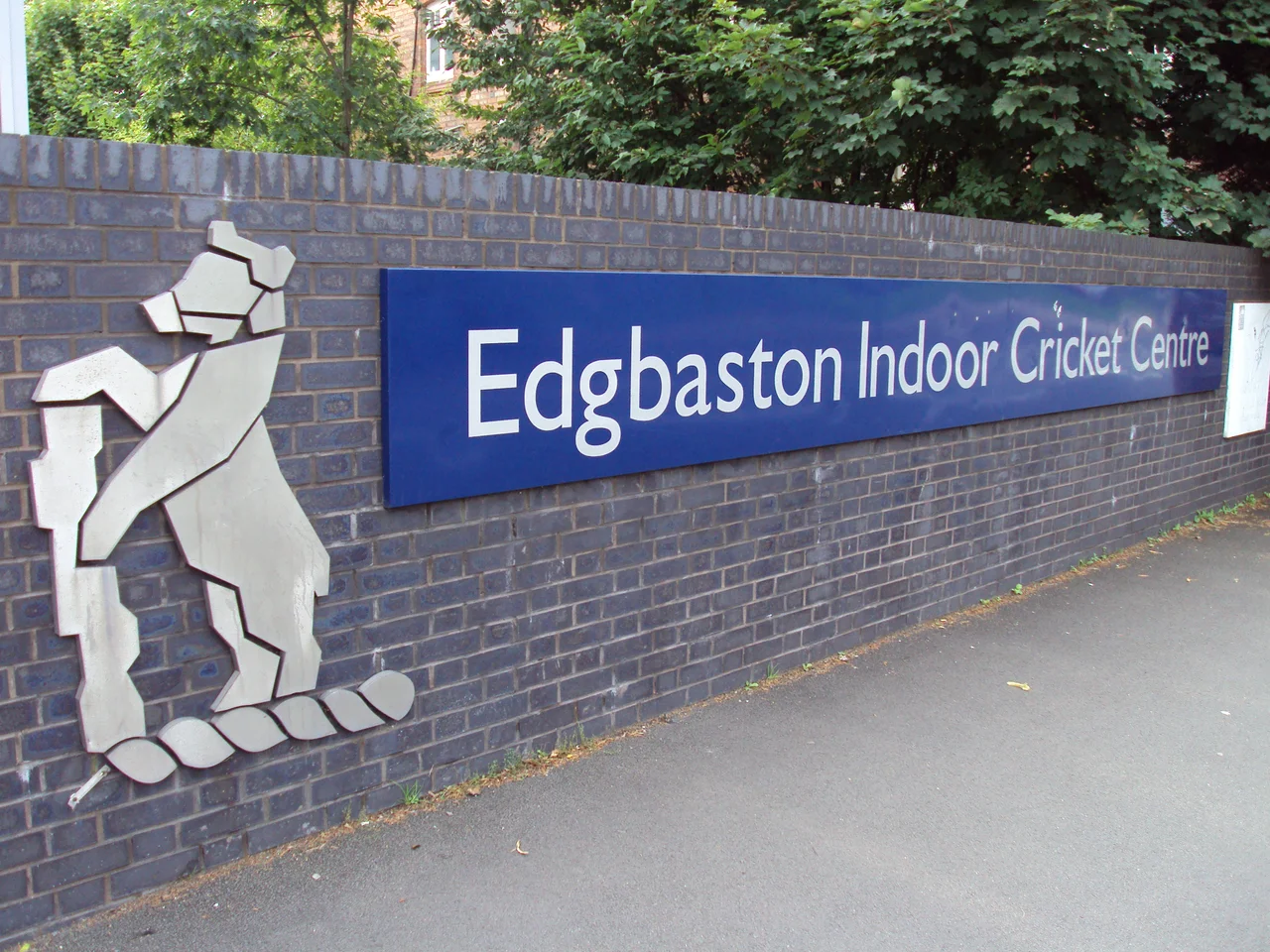

Edgbaston Cricket Ground
In 1885, Calthorpe Estates offered Warwickshire County Cricket Club twelve acres of what they frankly described as a meadow of rough grazing land beside the River Rea. It was not the parcel the club had wanted. The Wycliffe Ground on Pershore Road would have been more elegant, but the Calthorpes had reasoned that the less attractive plot would gain more from association with a cricket ground than the other way around. Warwickshire agreed to lease the meadow for five pounds an acre, spent another twelve hundred and fifty pounds draining it and putting up a wooden pavilion, and on 7 June 1886 played their first match against the MCC. Three thousand people came over two days. Two months later, six thousand turned out to watch them play Australia. The rough grazing had become Edgbaston.
From meadow to Test ground
The man who pushed for Birmingham was William Ansell, the club secretary, who had argued against Rugby and Leamington Spa on grounds of railway connections and city size. He envisioned first-class status for the county and Test status for the ground, and he was right on both counts. Edgbaston's first Test match arrived in 1902, the opening fixture of an Ashes series against Australia. The club hurriedly built a permanent stand, two temporary ones, and press facilities for ninety reporters. The whole effort cost fifteen hundred pounds, of which Warwickshire's share of tour income covered only half. The match ended in a draw because of rain, but not before England bowled Australia out for thirty-six in the first innings, with Wilfred Rhodes taking seven wickets for seventeen runs. The young ground had announced itself.
The crowd that became a player
Edgbaston earned a reputation that other Test grounds in England did not quite share: a partisan, noisy, sometimes raucous home that rattled visiting teams. The Eric Hollies Stand, named after the Warwickshire leg-spinner who once bowled Don Bradman for a duck, sits where the old Rea Bank used to be and remains the loudest corner. Ian Botham, after taking five wickets in twenty-eight balls to win the 1981 Ashes Test, said the crowd had inspired him. Alec Stewart later compared the atmosphere to Eden Gardens in Kolkata and called it like having another man in your side. In 2005, England beat Australia here by two runs, the narrowest Ashes Test ever played. In 2019, every match of the Cricket World Cup at Edgbaston sold out months in advance, including the semifinal where England put Australia away by eight wickets on the way to lifting the trophy for the first time.
Records etched into the outfield
Some grounds collect minor records. Edgbaston collects the kind that get reprinted in every almanac. In 1957, Peter May and Colin Cowdrey put on 411 against the West Indies, still England's highest Test partnership. In 1994, Brian Lara walked out for Warwickshire and scored 501 not out against Durham, the highest individual score in first-class cricket history. In 2015, England made 408 against New Zealand for their highest one-day total at the time. In 2016, Jason Roy and Alex Hales chased down 256 against Sri Lanka without losing a wicket, still the highest opening partnership in a successful ODI run chase. In 2017, the ground hosted England's first day-night Test, complete with the debut of the pink Dukes ball. The numbers add up to a stadium that has been present at hinge moments rather than peripheral ones.
Brumbrella and the redevelopment years
For decades, one of Edgbaston's quirks was the Brumbrella, a motorised rain cover the size of the pitch that rolled across the square on tracks. It retired in 2000, but the ground kept changing. Between 2010 and 2011, the entire south side came down. The old pavilion, parts of which dated to the 1890s, the Leslie Deakins Stand, the R. V. Ryder Stand, and the William Ansell Stand were demolished in January 2010, and a new South Stand and West Stand were built in sixty-six weeks at a cost of thirty-two million pounds. Five permanent floodlight pylons went up at the same time. The first Test on the rebuilt ground saw England beat India by an innings and 242 runs and climb to the top of the ICC Test rankings for the first time. In 2025, work began on the next phase, a forty-six million pound redevelopment that will demolish the Priory and Raglan Stands and replace them with a 146-room Radisson RED hotel and a new 3,200-seat stand, intended to be ready for the 2027 Ashes.
From the Air
Edgbaston Cricket Ground sits at 52.456 degrees north, 1.902 degrees west, about two kilometres south-west of central Birmingham. Approach from the north at 2,500 to 3,500 feet AGL for the cleanest view. The bright blue Edgbaston Suite cladding on the West Stand and the South Stand's tiered structure mark the venue from above; the River Rea curls along the eastern boundary. Birmingham International Airport (EGBB) lies twelve kilometres to the east; Coventry Airport (EGBE) is twenty-five kilometres south-east; Wolverhampton Halfpenny Green (EGBO) is roughly thirty kilometres west. Expect typical English Midlands haze in summer and frequent low cloud in winter.
Nearby Stories
- Shepshed 8.5 km away
- Battle of Evesham 11 km away
- Hixon rail crash 12 km away
- Battle of Cropredy Bridge 12 km away
- Wenlock Priory 15 km away
- RAF Shawbury 16 km away
- Market Bosworth 17 km away