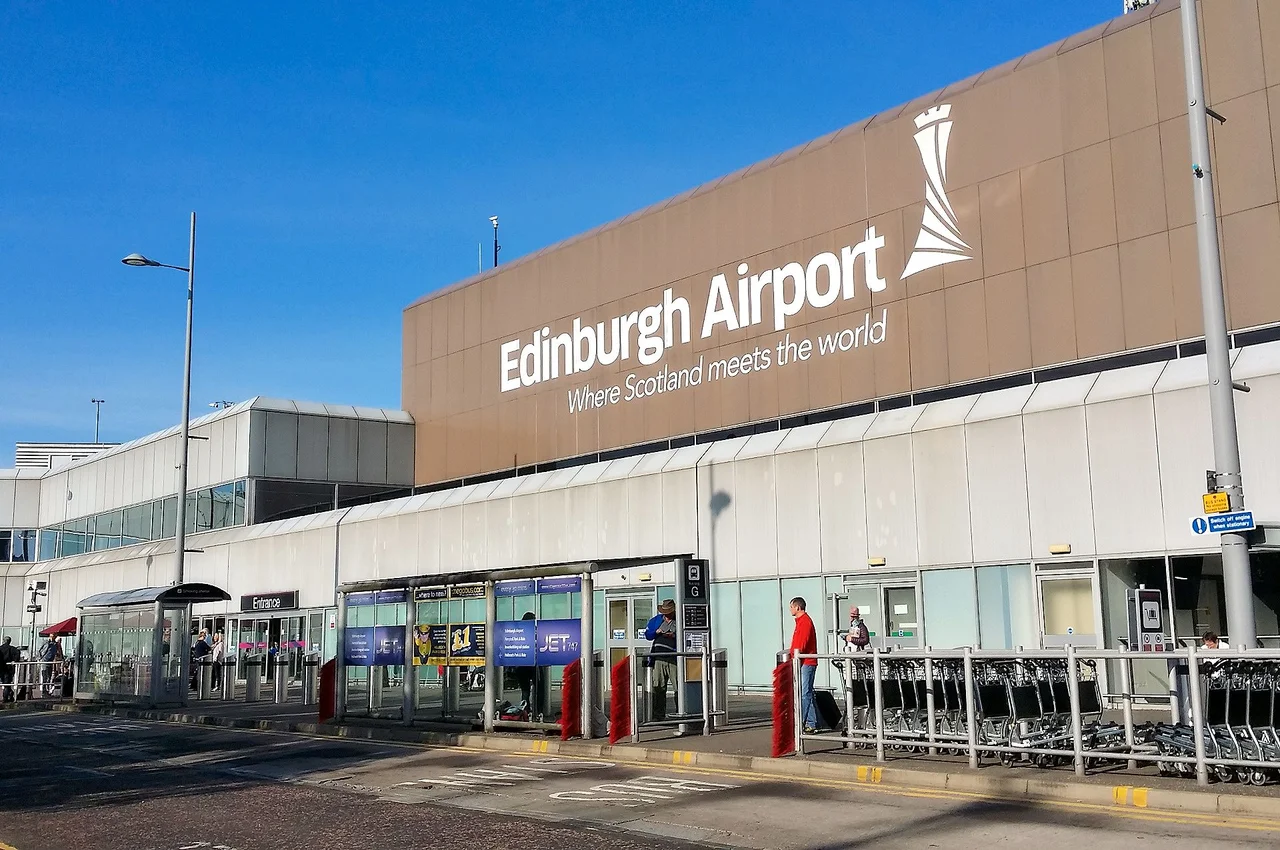

Edinburgh Airport
In 1916, the Royal Flying Corps cleared a field at Turnhouse on the western edge of Edinburgh and started flying biplanes from it. It was the northernmost British air defence base of the First World War, charged with watching the Forth estuary for Zeppelins. A century later, the grass strip the RFC laid down has grown into Scotland's busiest airport, handling over 15 million passengers and 109,000 aircraft movements in a single year. Almost nothing remains of the original aerodrome except the runway alignment and the name. The control tower, the terminal, the tram station, the cargo apron, all of it was built on top of a story that began with a war.
Turnhouse
Turnhouse Aerodrome opened in 1916 with a handful of Royal Flying Corps biplanes assigned to defend Scotland's industrial belt from Zeppelin raids. In 1918, when the Royal Flying Corps and the Royal Naval Air Service were merged to form the Royal Air Force, the base became RAF Turnhouse. From 1925 it housed 603 (City of Edinburgh) Squadron of the Royal Auxiliary Air Force, flying Westland Wapitis, Hawker Harts, and Hawker Hinds from the grass. When the Second World War broke out in 1939, RAF Fighter Command took over and paved a 3,900-foot runway capable of handling Supermarine Spitfires. Squadrons 3, 65, and 141 served from Turnhouse during the Battle of Britain. The base remained under military control after the war until civil flights began on 19 May 1947, when a British European Airways Douglas C-47 made a scheduled stop at Edinburgh on its way from London Northolt to Shetland.
From Charter to Continental
International scheduled service began in 1962 with a direct route to Dublin. For most of the next decade, international flights from Edinburgh were chartered or private. The first true scheduled route to continental Europe was Amsterdam in 1975, followed during the 1980s by Paris, Düsseldorf, Brussels, Frankfurt, and Copenhagen. Transatlantic flights were not possible from Edinburgh under the US-UK Bermuda II Agreement, which designated only Glasgow-Prestwick as Scotland's gateway to North America. The British Airports Authority took ownership in 1971, by which point the original terminal was handling about eight times its design capacity. A completely new terminal designed by Sir Robert Matthew opened on 27 May 1977 with the Queen herself cutting the ribbon. The original RAF Turnhouse station closed in 1997, ending eighty-one years of military aviation at the site.
Growth and the Tram
Privatisation of BAA in 1987 marked the beginning of Edinburgh Airport's modern expansion. Passenger numbers grew from 681,000 in 1971 to 1.8 million in 1987 to 11.1 million by 2015. In May 2014, Edinburgh Trams opened, giving the airport its first rail-style connection to the city centre. The line runs east from the airport stop through Murrayfield, Haymarket, and Princes Street before continuing north to Leith and eventually Newhaven. In 2018 the old crosswind Runway 12/30 was permanently closed as part of the expansion works. By December 2024, Edinburgh became the first airport in Scotland to record over 15 million passengers in a calendar year. It now serves 35 airlines flying to over 152 international destinations, the busiest airport in Scotland and the sixth busiest in the United Kingdom.
Approaches and Memory
Edinburgh Airport's single active runway, 06/24, is 8,400 feet long and aligned almost exactly east-northeast to west-southwest. Aircraft on approach pass over the Pentland Hills to the south or the Firth of Forth to the north. Loganair flight 670A, a Royal Mail Shorts 360 with two crew on board, took off from Edinburgh on 27 February 2001 at 1730 GMT and crashed into the Firth of Forth minutes later. Both pilots died. A subsequent inquiry found that slush had built up in the aircraft's engine intakes during several hours on the snowy ramp. Protective covers had not been fitted. The accident remains the worst in the airport's history. In 2024, the French infrastructure group Vinci SA took a majority stake in the airport, paying £1.27 billion for 50.01 percent. The grass strip the Royal Flying Corps cleared in 1916 had, after 108 years, become a piece of internationally traded infrastructure.
From the Air
Edinburgh Airport (ICAO: EGPH, IATA: EDI) is located at 55.9500°N, 3.3725°W in the Ingliston area, 5 nautical miles west-northwest of Edinburgh city centre. Field elevation is 136 feet. Single runway 06/24 is 8,400 feet long. The airport is served by Edinburgh Trams. From the air, look for the long east-southeast/west-northwest runway alignment, the parallel A8 road running close to the southern boundary, and the Royal Highland Showground at Ingliston immediately south. The Firth of Forth lies about 3 nautical miles north, with the three Forth bridges 6 nautical miles to the north-northwest. Approach charts: standard ILS approaches both ends of 06/24.
Nearby Stories
- Ardoch Roman Fort 2.2 km away
- Craignethan Castle 3.1 km away
- Haddington 3.8 km away
- Balvaird Castle 4.3 km away
- Battle of Kilsyth 9.4 km away
- Siege of St Andrews Castle 9.9 km away
- Neidpath Castle 11 km away
- Melrose Abbey 15 km away