
Edinburgh College of Art
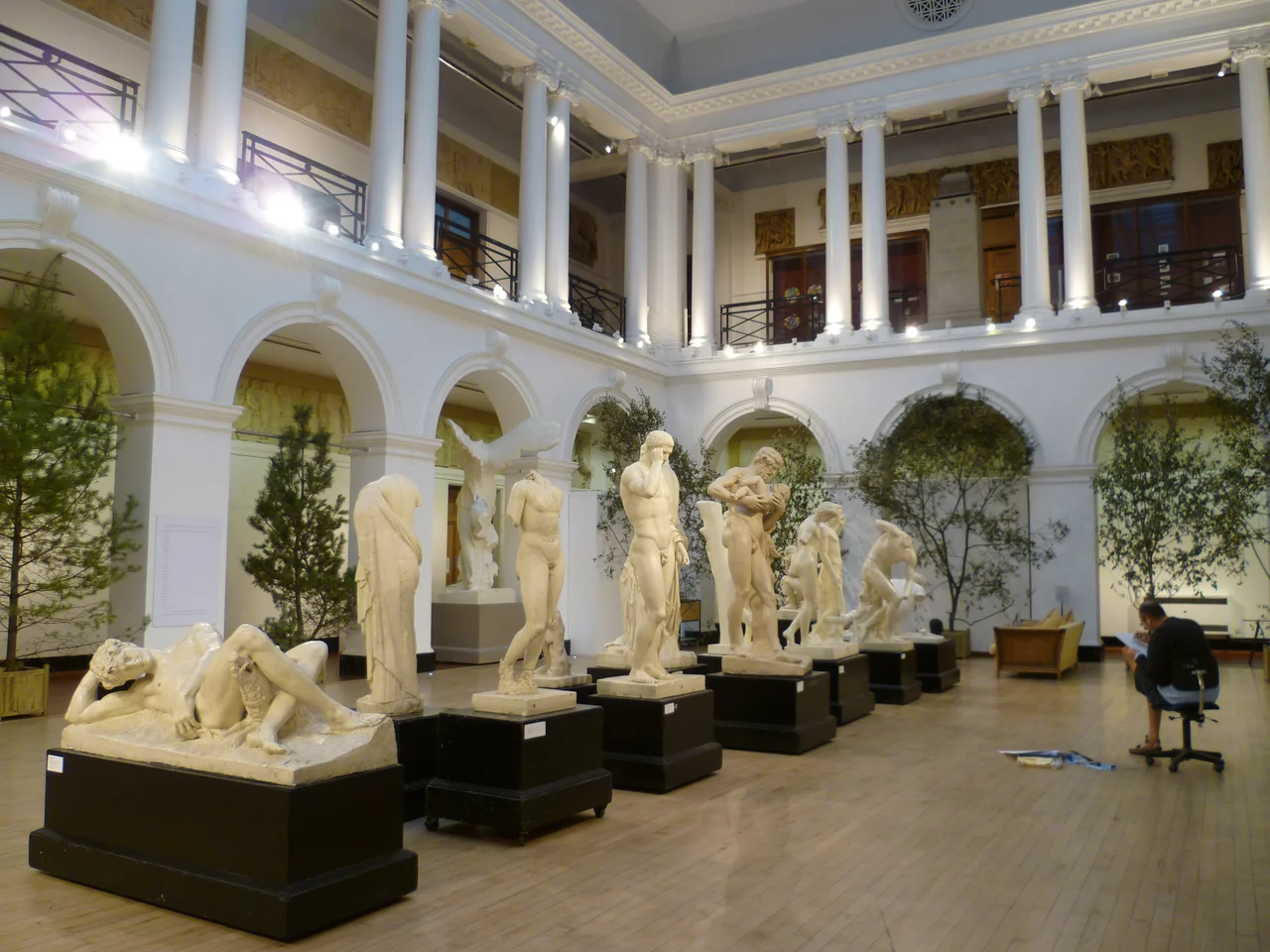
The cattle market closed in 1909, and on its site above the Grassmarket rose a red sandstone palace of Beaux-Arts ambition. Inside the new Sculpture Court, plaster casts of the Elgin Marbles stood watch over the first students of Edinburgh College of Art - reminders that this institution, though only newly named, traced its lineage back nearly 150 years to a small drawing school created to teach Scottish weavers how to design a better cloth.
From Looms to Landscapes
The school began in 1760 as the Trustees Drawing Academy, founded by a Parliament-appointed board with a practical brief: train designers for Scotland's textile industries. At its first rooms on Picardy Place, pupils learned to draft patterns for linens and damasks. The first master was a French painter, William Delacour, and his successors - Alexander Runciman, David Allan - kept raising the academy's ambitions. By the early nineteenth century the curriculum had drifted from pattern-making toward fine art. Alexander Nasmyth, who would teach Scotland to paint its own landscape, walked these classrooms. So did Andrew Wilson. The Board of Trustees also built the colonnaded Royal Institution on the Mound - now the Royal Scottish Academy - and from 1826 the school met there, in chambers fit for a national academy of art.
The Lauriston Place Building
John Wilson's red sandstone building of 1909 still anchors the campus. Working for the firm of John More Dick Peddie and George Washington Browne, Wilson produced a Beaux-Arts pile listed Category A since 1970, with the Sculpture Court at its heart. The casts of the Elgin Marbles displayed there are now interrupted, season by season, by changing exhibitions of student work - a quiet conversation between Phidias and twenty-year-olds with clay under their fingernails. Around the original block grew the Architecture Building of 1961, the L-shaped Hunter Building of 1977, and in 2003 the nine-storey Evolution House by Reiach and Hall - a speculative office block that ECA repurposed for its art and design library. In 2017 the campus absorbed the former Lothian fire brigade headquarters, the old Museum of Fire.
The Roll of Alumni
The list of names that have passed through ECA reads like an index to twentieth-century Scottish creativity. Sir Basil Spence designed Coventry Cathedral here, and New Zealand's Beehive parliament. Sir Eduardo Paolozzi, the sculptor whose mosaics line London's Tottenham Court Road station, learned his trade in the Sculpture Court. Pilkington Jackson, who later cast the statue of Robert the Bruce that overlooks Bannockburn, made the college's own war memorial in 1922. Sir Nicholas Grimshaw left to design the Eden Project. The painters Anne Redpath, William Gillies, John Bellany and Dame Elizabeth Blackadder all emerged from the studios; Richard Wright won the 2009 Turner Prize. Among the musicians: Sir James MacMillan, the conductor Sir Donald Runnicles, and Roy Williamson of The Corries, who wrote Flower of Scotland.
Strategy: Get Arts
In August 1970 the college turned its galleries over to STRATEGY: GET ARTS, a wholesale invasion of the Edinburgh International Festival by Dusseldorf's avant-garde. Joseph Beuys arrived with felt and fat and his quiet theatricality. The event left a permanent mark on Scottish conceptual art. Two years later the artist Stephen Willats came up from London at the invitation of the students' union for a three-day seminar on art and community - a conversation that grew into the Edinburgh Social Model Construction Project, which spread out into Leith, Morningside, Slateford and Silverknowes. In 1982 the Sculpture Court hosted a retrospective of Patrick Geddes, the polymathic Scots biologist and town planner whose ideas had shaped the college's planning curriculum since 1932.
Joining Edinburgh
ECA spent the twentieth century as a Small Specialist Institution, partnered for degree purposes with Heriot-Watt University from 1968. In 2004 it began awarding degrees through the University of Edinburgh instead, and after several years of closer cooperation the two merged in August 2011 - a marriage briefly soured when Education Secretary Mike Russell publicly criticised ECA's finances. The Lauriston Place campus is now five subject areas within the university's College of Arts, Humanities and Social Sciences: the School of Art, the Reid School of Music, the School of Design, the School of History of Art, and the Edinburgh School of Architecture and Landscape Architecture. Over 3,000 students draw, model, design and compose here. From 2020 to 2023 the Sculpture Court even housed the Edinburgh International Book Festival - another institution finding shelter under the same Beaux-Arts roof.
From the Air
Edinburgh College of Art sits on Lauriston Place at 55.9458 N, 3.1996 W, directly opposite Edinburgh Castle and above the cobbled bowl of the Grassmarket. From the air, look for the symmetrical red sandstone block immediately south of the castle rock, with the Hunter Building forming an L around its inner courtyard. Edinburgh Airport (EGPH) lies 6 nm west on the 270 radial; Glasgow (EGPF) is 35 nm west-southwest. Recommended viewing altitude 2,000-3,000 ft AGL on a westbound transit from the Firth of Forth toward Murrayfield. Edinburgh sits beneath the Edinburgh CTR; obtain clearance before entering controlled airspace.
Nearby Stories
- Ardoch Roman Fort 2.2 km away
- Craignethan Castle 3.1 km away
- Haddington 3.8 km away
- Balvaird Castle 4.3 km away
- Battle of Kilsyth 9.4 km away
- Siege of St Andrews Castle 9.9 km away
- Neidpath Castle 11 km away
- Melrose Abbey 15 km away