
Edinburgh International Festival
The festival owes its existence to a horse. In 1944, deep in the war, Lord Rosebery's Ocean Swell won the Jockey Club Cup, one of only two major races still being run while the bombs fell. Rosebery handed the winnings - around 10,000 pounds - to a small group dreaming of an arts festival that might 'heal the wounds of war.' Edinburgh Town Council matched the gift. John Maynard Keynes's Arts Council added more. Three years later, in August 1947, Rudolf Bing opened the first Edinburgh International Festival of Music and Drama in a city still on rations.
The Glyndebourne Lunch
The idea took shape over a wartime lunch in a London restaurant on Hanover Square, where Bing - Austrian-born general manager of Glyndebourne Opera - met Henry Harvey Wood of the British Council, Sidney Newman of Edinburgh University, and the arts patron Lady Rosebery. Bing argued that bombed-out European cities would not stage festivals for years; Britain could fill the gap. The town he had in mind needed three things: theatres enough to hold an ambitious programme, scenery worth visiting, and citizens willing to embrace the disruption. He had visited Edinburgh in 1939. The castle reminded him of Salzburg, where he had once been festival director before fleeing the Nazis. Harvey Wood recommended Edinburgh. Sir John Falconer, the Lord Provost, said yes.
The First Three Weeks
The opening season ran from 22 August to 11 September 1947, with concerts, opera, ballet, drama, film, and Scottish piping on the castle Esplanade. The Vienna Philharmonic appeared under Bruno Walter, who had left Europe after the Anschluss in 1938 - the reunion of conductor and orchestra was the moral heart of the first festival. In the years that followed, almost everyone came. Furtwangler. Barbirolli. Beecham. Boult. Pierre Monteux. The pianist Artur Schnabel. Lotte Lehmann. Then Karajan, Bernstein, Solti, Klemperer. The string players Yehudi Menuhin and Isaac Stern. Soviet artists like the pianist Sviatoslav Richter, the cellist Mstislav Rostropovich, the violinist David Oistrakh. By the festival's third decade Pierre Boulez, Claudio Abbado, Daniel Barenboim, Jacqueline du Pre and Itzhak Perlman were regulars on the Edinburgh stages.
Opera Without an Opera House
Edinburgh had no purpose-built opera house, and still does not - the Festival Theatre on Nicolson Street, a converted Victorian variety hall, was only remodelled for the role in 1994. The founders solved the problem by importing companies. Glyndebourne brought two productions each year from 1947 to 1951. Hamburg State Opera replaced them in 1952 with six. La Scala arrived in 1957. Over the decades the singers who passed through Edinburgh staged opera included Maria Callas, Joan Sutherland, Birgit Nilsson, Boris Christoff, Luciano Pavarotti, Dietrich Fischer-Dieskau and Tito Gobbi. Many works received their world premieres here - T. S. Eliot's The Cocktail Party in 1949 and The Confidential Clerk in 1953; Sir James MacMillan's Symphony No. 5 in 2019. The Old Vic gave drama equivalent backing, joined later by the Royal Shakespeare Company and the National Theatre.
The Fringe and the Family
From its first year the festival generated a shadow. Companies not invited to the official programme arrived anyway and performed wherever they could find a stage - the basis of what became the Edinburgh Festival Fringe, now the largest arts festival on earth. The Film Festival also began in August 1947 with a documentary programme; later came the International Book Festival, and the British Army's Military Tattoo, first staged on the castle Esplanade in 1950. By the high summer of August, Edinburgh hosts more than 2,500 performances a day across the overlapping festivals. The International Festival itself adjusted: from 2015 it pulled forward into August to align with the Fringe, ending its long tradition of straddling into September.
Where It Happens
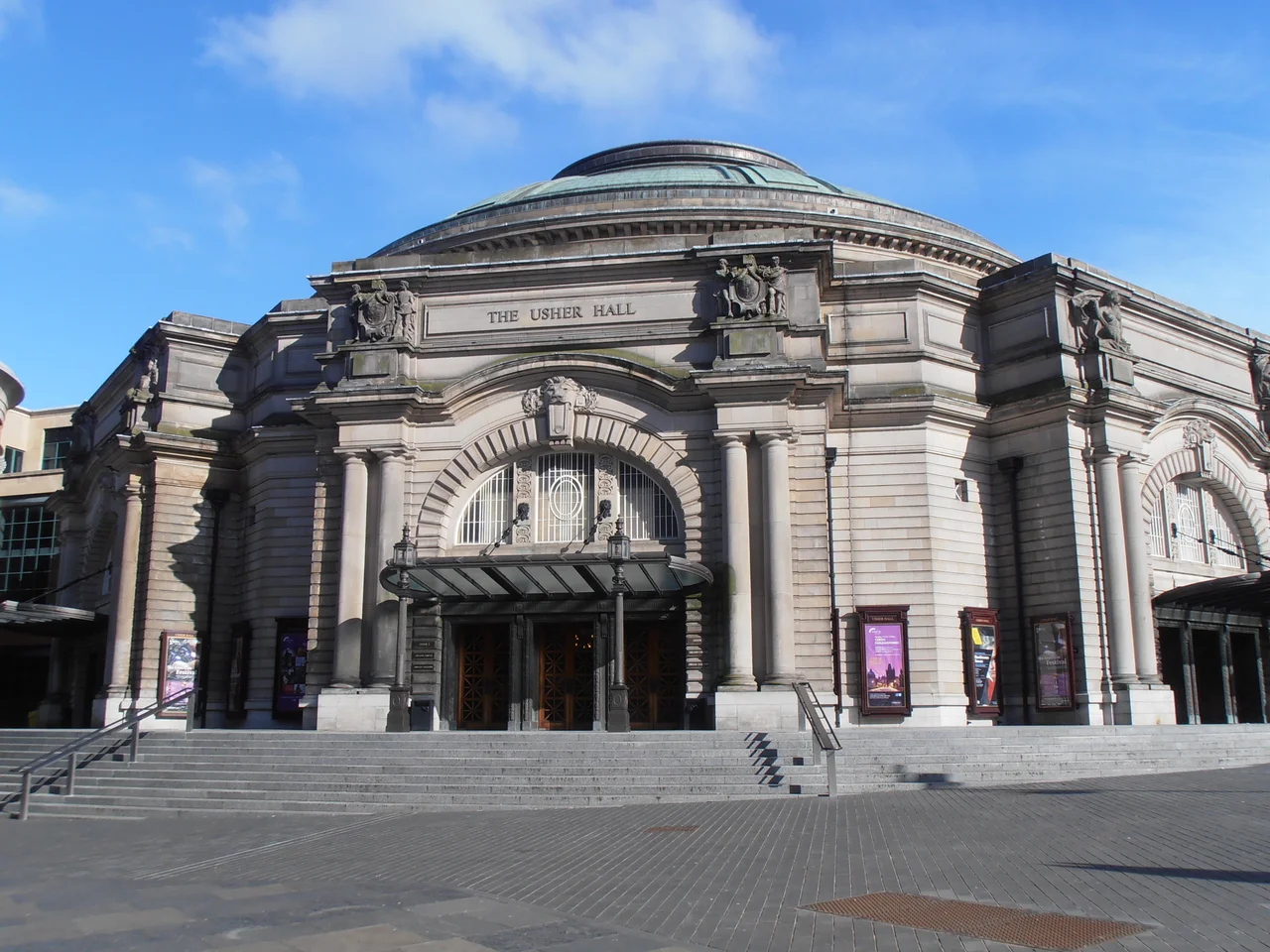
The Usher Hall on Lothian Road, built in 1914, has hosted classical concerts since 1947; the King's Theatre and Royal Lyceum offer drama and opera; the Edinburgh Playhouse on Greenside Place is the largest theatre in Scotland at over 3,000 seats. The Queen's Hall, a chapel converted to a concert venue in 1979, is home to the Scottish Chamber Orchestra. The Hub on Castlehill - originally the Tollbooth Church of 1842-44, its Gothic spire the highest point in central Edinburgh outside the castle - has served since 1999 as the festival's box office and offices. The Dunard Centre, a new 1,000-seat concert hall on St Andrew Square, is due to open in 2029. The current festival director is the Scottish-Italian violinist Nicola Benedetti, who took the post in October 2022.
From the Air
The International Festival is centred on Edinburgh's Old and New Towns, with venues clustered around 55.953 N, 3.189 W. Key landmarks visible from altitude: the Usher Hall on Lothian Road (just west of the castle), the Festival Theatre on Nicolson Street, the spire of the Hub above Castlehill, and the Edinburgh Playhouse near Calton Hill. Edinburgh Airport (EGPH) lies 6 nm west. The Edinburgh CTR covers the entire city; in August expect heavier rotary traffic carrying VIPs and broadcast crews. Recommended viewing altitude 2,500-3,500 ft from a southerly transit between Holyrood Park and Arthur's Seat for the full sweep of the Old Town venues.
Nearby Stories
- Ardoch Roman Fort 2.2 km away
- Craignethan Castle 3.1 km away
- Haddington 3.8 km away
- Balvaird Castle 4.3 km away
- Battle of Kilsyth 9.4 km away
- Siege of St Andrews Castle 9.9 km away
- Neidpath Castle 11 km away
- Melrose Abbey 15 km away