
Edinburgh, Leith and Newhaven Railway
Picture the scene in 1847. A passenger boards a train at Edinburgh's brand-new Canal Street station, beside what will one day be Waverley. A stationary steam engine somewhere above grips an endless cable. The coaches descend through a gas-lit tunnel, 1,052 yards long, on a slope of one in 27. They emerge near a sandy slope at Scotland Street. At Granton harbour they roll directly onto a ferry. Across the Forth at Burntisland, a fresh locomotive takes them on. Two more changes - another ferry across the Tay, another train - and they arrive in Dundee. This was the world's first roll-on, roll-off train ferry. It worked.
Why the Tunnel
The Edinburgh, Leith and Newhaven Railway was authorised in 1836 to link the capital with its Firth of Forth harbours. The trouble was geography. Leith and Newhaven sat at sea level on the north shore; Edinburgh lay on a high ridge of volcanic ash and glacial debris a couple of miles south. To plant the line's southern terminus at Princes Street Gardens - the only flat ground close to the city centre - the engineers had to drive a tunnel north under the New Town, descending steeply to reach the coastal flats. Property owners along the route worried for their houses. The work was difficult through shifting sand. The tunnel ran 49 feet below St Andrew Street, 37 feet below Princes Street. Steam locomotives couldn't manage the incline; instead a stationary engine and cable hauled the coaches up and down.
Granton, Buccleuch, and the Ferry
While the railway was being built, the Duke of Buccleuch was constructing his own deep-water pier further west at Granton. By 1844 his Granton-to-Burntisland ferry was outstripping the rival routes from Newhaven and Trinity. The railway company faced ruin if it could not reach Granton, so it sought a new Act of Parliament, changed its name to the Edinburgh, Leith and Granton Railway, and pushed its tracks west to the pier. The Granton extension opened on 19 February 1846. The next year the Scotland Street tunnel was completed and the Princes Street terminus opened. Thomas Grainger had designed both the tunnel and the ferry. The pioneering train-ferry vessel Leviathan, with adjustable ramps that could meet the rails at any tide, was the work of a young engineer named Thomas Bouch - decades before his Tay Bridge would collapse and his Forth Bridge plans were scrapped.
The Edinburgh-to-Dundee Adventure
By 1849 the line had absorbed itself into a longer scheme, renamed the Edinburgh, Perth and Dundee Railway. The journey from Edinburgh to Dundee began at what is now Waverley. Coaches were rope-hauled up the tunnel to Scotland Street, then run by steam locomotive to Granton, then loaded onto a ferry to Burntisland in Fife, then taken by a Fife train across to Tayport, then transferred to a second ferry across the Tay, and finally hauled into Dundee on a third train. Four legs, two ferries, and a tunnel - all to reach a city 50 miles away as the crow flies. The North British Railway swallowed the whole operation in 1862 and started diverting traffic. The tunnel was closed in 1868 and replaced by a longer surface line around the eastern edge of the city through Abbeyhill. Canal Street station was demolished. Its southern portal lay buried until 1983, when builders working on Waverley Market rediscovered it.
The Forth Bridge Changes Everything
In 1890 the Forth Bridge opened at Queensferry, eight miles upriver. The ferry route from Granton became suddenly redundant - trains could now cross the firth without leaving their rails. The line's purpose as part of a trunk route to Dundee evaporated overnight. But Edinburgh's north side had grown into suburbs, and the railway took on a second life carrying commuters. Piershill, Easter Road, Powderhall and Leith Walk stations opened in the 1890s; Leith Central, on a new branch, opened in 1903 on a lavish scale, expecting heavy traffic from the booming port. The investment was poorly timed. Edinburgh's electric trams, unified and modernised in 1920, drained passengers from the suburban railways within a decade.
The Long Twilight
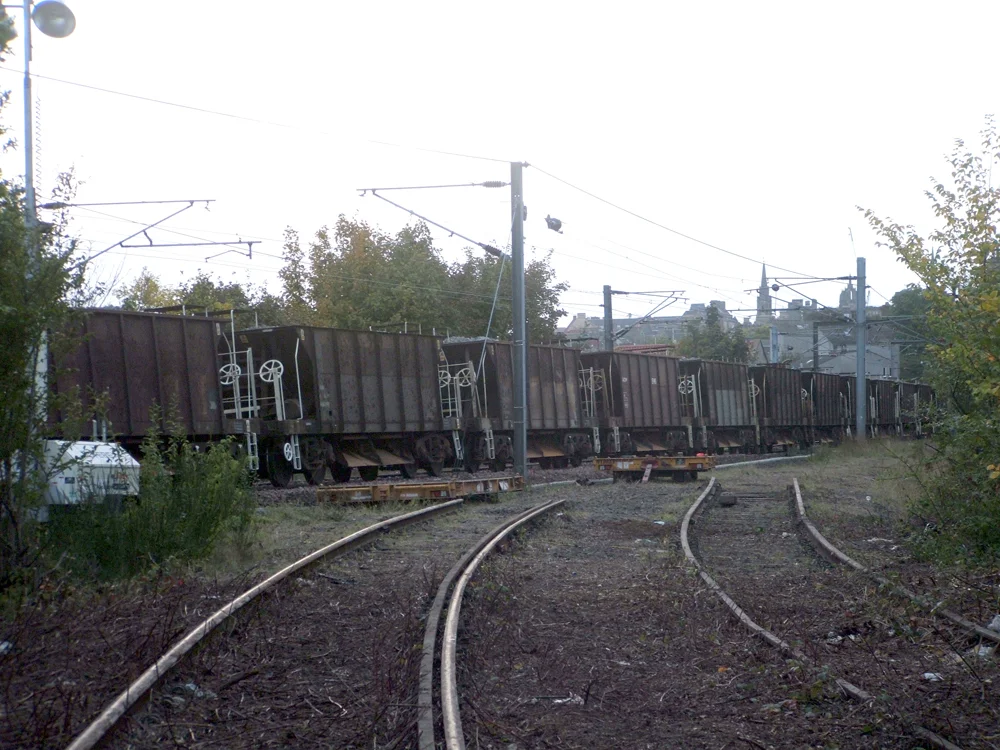
Station after station closed. Powderhall went in 1917 and never reopened. Leith Walk lasted until 1930. The Granton route was abandoned in 1925. Passenger services from North Leith to Waverley ended on 16 June 1947. Leith Central limped on with timetabled services until April 1952, then survived as a depot, then closed altogether in 1972. The infamous derelict shell - which Irvine Welsh used as the setting for the scene in Trainspotting where Begbie meets his alcohol-ravaged tramp of a father - is now a Tesco supermarket at the foot of Leith Walk. One short section of the original alignment soldiered on into the 21st century, carrying waste containers from a refuse plant at Powderhall to a landfill in old limestone quarries near Dunbar. That last working remnant of the Edinburgh, Leith and Newhaven Railway closed in 2016.
From the Air
The historical alignment of the Edinburgh, Leith and Newhaven Railway runs roughly north-south between Edinburgh Waverley (55.952 N, 3.190 W) and Granton harbour on the Firth of Forth (55.978 N, 3.231 W), a distance of about 3 nm. The Scotland Street tunnel portal site, now a children's playpark, lies near 55.961 N, 3.190 W. Edinburgh Airport (EGPH) is 6 nm west; Dundee (EGPN), the line's eventual destination via two ferries, is 35 nm north across the Firth of Forth and Firth of Tay. The Forth Bridge that ended the ferry route is visible 8 nm west-northwest near 56.0 N, 3.39 W. Recommended viewing altitude 2,000-2,500 ft from a southbound transit along the Firth of Forth coast.
Nearby Stories
- Ardoch Roman Fort 2.2 km away
- Craignethan Castle 3.1 km away
- Haddington 3.8 km away
- Balvaird Castle 4.3 km away
- Battle of Kilsyth 9.4 km away
- Siege of St Andrews Castle 9.9 km away
- Neidpath Castle 11 km away
- Melrose Abbey 15 km away