
Edinburgh Trams
Edinburgh ripped out its old tram network in November 1956, replacing it with diesel buses in what then seemed like progress. Half a century later the city changed its mind. The plan announced in 2003 was bold: a network of new light rail lines reaching across the city. The execution was painful. By the time a single tram finally rolled down Princes Street on 31 May 2014, the project had cost 776 million pounds, fallen years behind schedule, and provoked a public inquiry. What opened was a fraction of the plan - just 8.7 miles, airport to York Place. But the trams returned to Leith in 2023, and the people who waited two decades now find the things hard to imagine the city without.
The Old System
Edinburgh ran a horse-drawn tramway from 1871, electrified the lines through the 1920s, and at the network's peak operated 33 routes across the city. Leith - which had been swallowed by Edinburgh in 1920 - had run its own electric trams since 1905 on different track gauge and voltage, requiring passengers to change at Pilrig. The unified network operated for three more decades until the city council voted in 1952 to shut the whole thing down in favour of diesel buses. The last tram ran on 16 November 1956. Edinburgh's tram tracks were ripped up; its overhead wires came down. For the next 67 years, the most ambitious public transport project in the city was the bus.
The Long, Painful Project
Plans for a new tram network were authorised by the Scottish Parliament in 2006 - the Edinburgh Tram (Line One and Two) Acts received Royal Assent that April. The original scheme had three lines totalling 33 km of track. Construction began on Line 1a in 2008. Work was riven by disputes between Transport Initiatives Edinburgh and the main contractor, Bilfinger Berger; lawsuits and delays mounted. By 2011 the scheme had been cut back to a single short route from the airport to York Place. The opening, repeatedly postponed, finally came on 31 May 2014. The full bill - 776 million pounds for an 8.7-mile single route - was about double the original estimate. The Scottish Government convened a public inquiry under Lord Hardie that took ten years to report; its findings appeared in 2023. The line itself, however, started carrying passengers and turned profitable in 2016, two years ahead of forecast.
The Newhaven Extension
In March 2019 the City of Edinburgh Council approved an extension of 4.7 km from York Place, down Leith Walk, through the historic port, and on to Newhaven. Construction began in November 2019 - just months before COVID-19 paralysed the world - and the new section opened on 7 June 2023. For the first time in nearly 70 years, Leith was directly connected to central Edinburgh by rail. The full route now runs 18.5 km from Edinburgh Airport at Ingliston to Newhaven, with stops at St Andrew Square, Princes Street, Haymarket, Murrayfield, Edinburgh Park, and Gogar Roundabout, and the new Leith corridor stops including Foot of the Walk, The Shore and Ocean Terminal. Trams run every seven to ten minutes, from 04:26 to 23:50, taking 55 minutes end to end.
The Trams Themselves
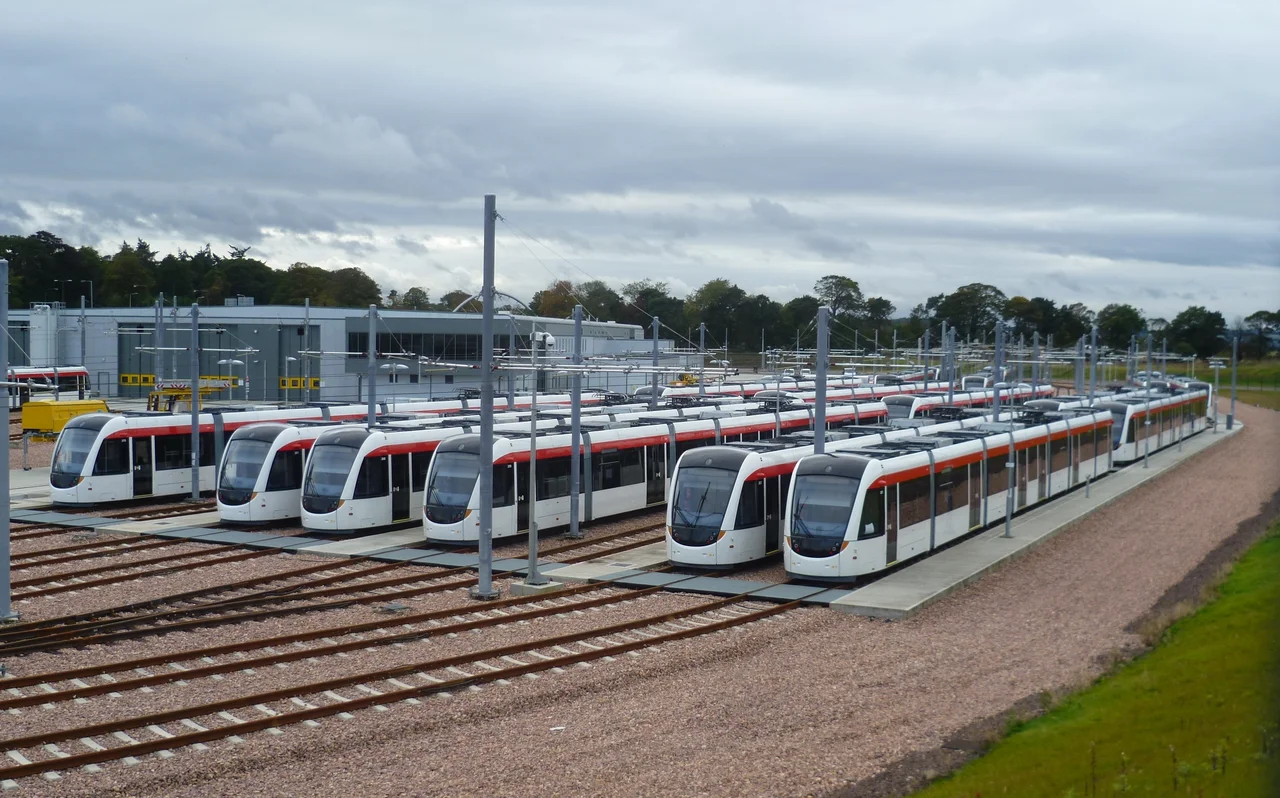
The fleet of 27 vehicles is built by Spanish manufacturer CAF - Construcciones y Auxiliar de Ferrocarriles. They are Urbos 3 model, bi-directional, 42.8 metres long, with low-floor access to meet UK accessibility rules. The original 40-million-pound contract specified enough trams for the full Line 1a and 1b network. When the scheme was cut back to York Place, the city found itself with too many vehicles and tried unsuccessfully in 2011 to lease ten of them to Transport for London for use on Tramlink in Croydon. The first tram was delivered in April 2010 and displayed at Princes Street as a kind of promise to the bewildered public, then moved to storage in Broxburn until the line was actually ready. The 27th tram arrived in December 2012. They wear advertising wraps.
Cyclists, Pedestrians and the Hazards of Rails
The Edinburgh tram has had a difficult relationship with cyclists from the start. Bike wheels can wedge in the rail grooves at exactly the wrong angle, or skid on the metal in wet weather. A study published in 2018 found that 191 cyclists had been hurt seriously enough to require hospital treatment in the first two years of operation. By September 2022 the BBC reported, using Freedom of Information data, that 422 cyclists had been involved in tram-track accidents and 196 had won compensation claims totalling nearly 1.3 million pounds. On 31 May 2017 a medical student died after her bike wheel apparently caught in a rail and threw her into the path of a minibus on Princes Street. On 11 September 2018 a pedestrian was struck and killed by a tram at Saughton; the Rail Accident Investigation Branch found the warning bell too quiet, and Edinburgh Trams was fined 240,000 pounds. The company has since fitted louder horns and redesigned the crossing where the death occurred.
From the Air
The Edinburgh Trams route runs 18.5 km from Edinburgh Airport (EGPH, 55.95 N, 3.36 W) east to Newhaven on the Firth of Forth (55.985 N, 3.20 W), passing through central Edinburgh. From altitude, the airport terminus is at the south end of EGPH; the line then follows segregated track parallel to the Glasgow-Edinburgh railway through Edinburgh Park, leaves the railway alignment at Haymarket, runs east along Princes Street through the New Town, then north along Leith Walk to the port. The Newhaven terminus sits beside the Firth of Forth roughly 1 nm west of Leith harbour. Stops are visible from low altitude as paired platform islands. The entire alignment lies within Edinburgh CTR; expect frequent rotary traffic to and from Edinburgh Airport on east-west tracks. Recommended viewing altitude 1,500-2,500 ft on a transit along Princes Street between Haymarket and St Andrew Square.
Nearby Stories
- Ardoch Roman Fort 2.2 km away
- Craignethan Castle 3.1 km away
- Haddington 3.8 km away
- Balvaird Castle 4.3 km away
- Battle of Kilsyth 9.4 km away
- Siege of St Andrews Castle 9.9 km away
- Neidpath Castle 11 km away
- Melrose Abbey 15 km away