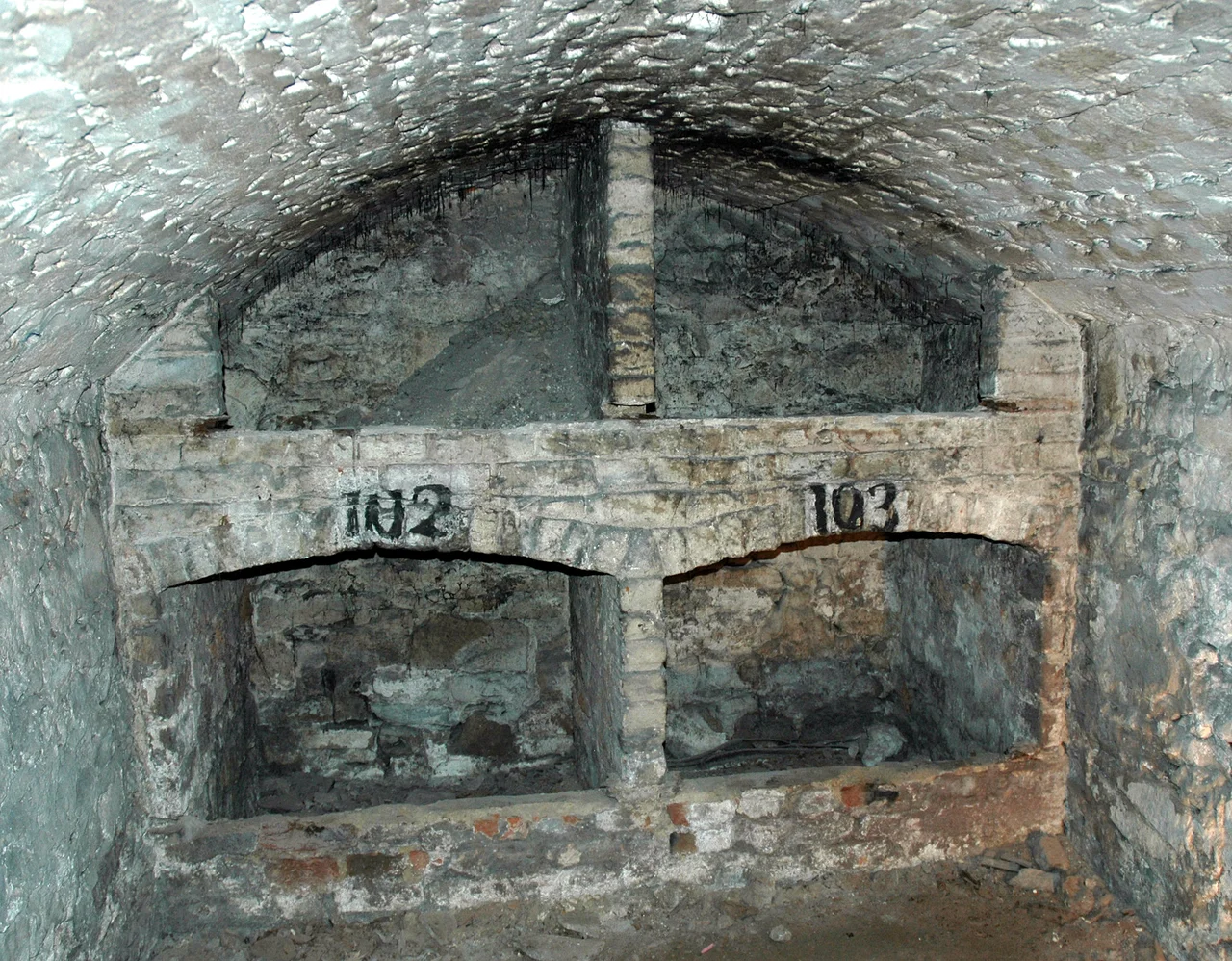

Edinburgh Vaults
Walk down South Bridge today and you would never guess that you are crossing a viaduct. The Cowgate gorge falls away beneath your feet, but tenement walls hide nineteen arches and roughly 120 chambers from view. For about thirty years after the bridge was completed in 1788, these spaces hummed with cobblers and taverns and the orderly business of Edinburgh's first purpose-built shopping street. Then the water came in. Then the people came in. Then everyone forgot they had ever been there at all.
A Bridge That Forgot to Be a Bridge
The South Bridge Act passed Parliament in 1785, and the bridge itself was finished three years later, linking the High Street to the rising University of Edinburgh on the Southside. Only one of its nineteen arches is visible now - the Cowgate arch, where Niddry Street drops into the gorge. The rest were enclosed behind tenements so the bridge could double as a commercial street, with shops fronting the road above and stockrooms, workshops, and taverns tucked into the arches below. The rooms ranged from cramped two-metre cubbies to airy chambers of forty square metres. It was an audacious piece of urban engineering: bridge and shopping arcade and warehouse complex, all in one. It was also rushed. The surface above had never been properly sealed against rain, and by 1795 the vaults were already flooding.
When the Water Won
By the 1820s the merchants had given up. Damp had ruined their goods, the air was foul, and the better tenants had moved out. What came next was a quieter kind of occupation. The Cowgate had become Edinburgh's poorest district as the Industrial Revolution drew workers into the city, and families with nowhere else to go drifted into the abandoned rooms above their heads. Conditions were brutal. There was no sunlight, no running water, no sanitation. Fish-oil lamps fought a losing battle against the stench. Some rooms held more than ten people. By around 1860 even the destitute had left, and the vaults sealed themselves into silence. Burke and Hare, the West Port murderers who supplied corpses to medical schools, are sometimes said to have used the chambers - there is no evidence they ever did. The real story did not need embellishing.
An Illegal Distillery Under the Bridge
On 24 June 1815, an exciseman named McKenzie and two officers traced the smell of mash to one of the deaf arches just off the middle of the bridge. The Edinburgh Evening Courant reported the bust the following Saturday. Whoever ran the operation had bricked over the original door and plastered the wall to hide it. The new entrance ran behind the fireplace of a bedroom upstairs: pull out the grate and you would find an iron door fitted exactly to the opening. A trap-door and ladder led down to the still. Someone had even tapped into one of the town's water mains and broken through a neighbouring vent to vent the smoke. The smugglers had been working there for eighteen months. The arch in question, the article noted with antiquarian precision, is the one now occupied by The Caves venue.
Rediscovery and Oyster Shells
The vaults were rediscovered in the 1980s by Norrie Rowan, a former Scottish rugby internationalist, who found a tunnel leading into them. Through that same tunnel in 1989 he helped the Romanian rugby player Cristian Raducanu slip away from the Romanian secret police and claim political asylum - weeks before the revolution that brought down Ceausescu. Rowan and his son Norman spent the 1990s clearing the chambers by hand, removing hundreds of tonnes of rubble. They found middens of broken plates and medicine bottles, the discarded toys of children who had lived underground, and thousands upon thousands of oyster shells, the cheap protein of the Edinburgh poor. The Caves and The Rowantree now host weddings and Fringe shows. On the north side of the Cowgate arch, other vaults run ghost tours. The lost city kept its inhabitants' names from the record, but their oyster shells remember them.
Pilgrims at the Fringe
Each August during the Edinburgh Festival Fringe, the chambers under the bridge transform into one of the festival's busiest venues, with more than sixty shows a day rotating through The Caves and The Rowantree alongside vaults that sit dark the rest of the year. In 2023 the Fringe premiered Brief Candle, a play by David R. Ford that imagines the Great Fire of Edinburgh through the eyes of a teenage girl living in the Vaults. The chambers also feature in Gary Mill's novel Blackfriar and in Maggie Craig's One Sweet Moment. The story of the Vaults keeps finding new tellers, partly because the original residents could not tell their own.
From the Air
Edinburgh Vaults sit beneath South Bridge in the Old Town at 55.9494N, 3.1872W. From the air the bridge is essentially invisible: it looks like a continuous tenement street running south from the High Street to Chambers Street. Use Edinburgh Castle on its volcanic plug to the west and Arthur's Seat to the southeast as orientation. Edinburgh Airport (EGPH) lies 9 nm to the west. Approach from the north over the Firth of Forth and the Forth bridges for the classic Old Town silhouette; recommended altitude 2,500-3,500 ft for the cityscape, dropping to 1,500 ft for detail. Edinburgh's weather is famously variable - the haar (coastal sea fog) can settle on the city even when the surrounding hills are clear.
Nearby Stories
- Ardoch Roman Fort 2.2 km away
- Craignethan Castle 3.1 km away
- Haddington 3.8 km away
- Balvaird Castle 4.3 km away
- Battle of Kilsyth 9.4 km away
- Siege of St Andrews Castle 9.9 km away
- Neidpath Castle 11 km away
- Melrose Abbey 15 km away