
Elis (city)
Homer named it. Strabo described it. Pausanias walked its streets and catalogued its temples in detail. By the mid-19th century, when scholars went looking for ancient Elis in the northwestern Peloponnese, they found almost nothing — some masses of tile and mortar, a few sculpted fragments, one small octagonal building. The ancient city of Elis had not merely declined. It had essentially dissolved back into the plain along the Peneios River, leaving classical literature as its most durable monument.
A City That Administered the Olympics
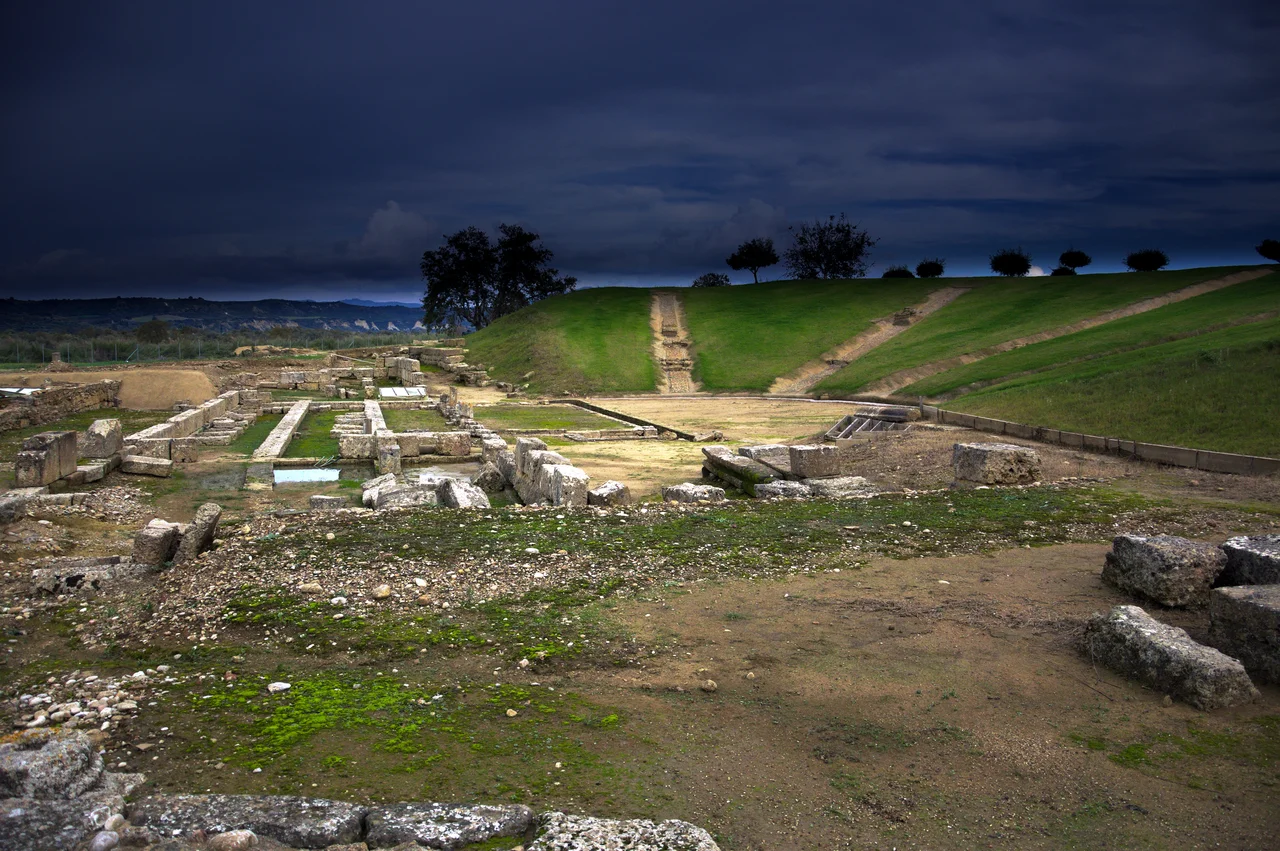
Ancient Elis was the capital city of the polis — the city-state — of Elis, in the northwestern Peloponnese to the west of Arcadia. It occupied a distinctive site: the Peneios River, just before it broadened onto the coastal plain, was squeezed from the south by a peaked hill nearly 500 feet high. That hill was the acropolis of Elis. The city spread at its foot, crossing the river — Strabo says the Peneios flowed through the city — though the public buildings appear to have concentrated on the left (southern) bank.
What made ancient Elis unusual was its relationship to the Olympic Games at Olympia, roughly 35 km to the southeast. Every athlete competing in the Ancient Olympics was required to spend a mandatory month training at Elis beforehand. That obligation made Elis's gymnasium the largest in all of Greece — not because the city was exceptionally powerful, but because the Olympics made the training requirement citywide law. Athletes came from across the Greek world. The city's officials, the Hellanodicae, who presided over the Games, were selected by lot from the city's local tribes and spent ten months before each Olympiad receiving instruction in their duties at the Hellanodicaeum.
The Gymnasium and the Agora
Strabo placed the gymnasium beside the Peneios. It was a vast walled enclosure bearing the general name Xystus, divided into three internal sections — the Plethrium (named for its dimensions), the Tetragonum (named for its square shape), and the Malco (named for the softness of its soil). Runners had their own separated tracks, screened by rows of plane trees. The Malco contained the Lalichium, the senate-house of the Eleians, which doubled as a venue for literary performances.
The agora doubled as a hippodrome for horse exercise. Rather than the continuous colonnaded halls typical of later Hellenistic design, its stoae were separated by streets, built in the older manner. The southern stoa — a triple row of Doric columns — was where the Hellanodicae gathered during the day. A separate building, the Hellanodicaeum, housed their training and administrative offices. A second stoa, called the Corcyraean, was said to have been built from a tenth of the spoils taken from the Corcyraeans; it contained, on one side, a temple of Aphrodite Urania housing a gold-and-ivory statue by the sculptor Pheidias.
Pausanias, who visited in the 2nd century AD, recorded temples of Apollo Acacesius (the principal temple of the city), Helios, Selene, the Graces, Silenus, and Hades — the last opened only once a year. Near the theatre, which stood on the acropolis slope, was a temple of Dionysus with a statue by Praxiteles.
From Aristocracy to Democracy
Elis had once been an aristocratic city: its founding ruler Oxylus and the Aetolian settlers who followed him established themselves on the acropolis, and the city served as the seat of the ruling families. The rest of the population lived in unwalled villages scattered across the plain. After the Greco-Persian Wars, the aristocratic monopoly was abolished and a democratic government installed. The population of eight surrounding townships moved into the capital — a voluntary synoikismos, a physical merging of communities into one urban center.
This democratic reorganization reshaped the city's physical form. The citizens left the new city unfortified, trusting in the religious prestige of the Olympian sanctuary to protect them. The Hellanodicae, formerly drawn from aristocratic families, were now appointed by lot from the newly created local tribes. Pausanias recorded that there were 12 Hellanodicae at the 103rd Olympiad, just after the Battle of Leuctra, when the Eleians briefly recovered their full territory — but later, when the Arcadians stripped away the district of Triphylia, the number dropped to eight, one per remaining tribe.
The Acropolis and What Remains
On the acropolis stood a temple of Athena, housing another gold-and-ivory statue by Pheidias. By the 19th century, when the German classical scholar Ernst Curtius visited, the summit of the hill preserved the ruins of a later castle whose walls had been partly built with fragments of Doric columns — almost certainly from that temple of Athena, repurposed when the stone was available and the temple was not.
The acropolis hill is today called Kalokaspoi in Greek. In the Middle Ages, the Venetians who occupied the region gave it the Italian name Belvedere — the beautiful view — which tells you something about what they found when they looked out from it, if not about what had once stood on it. A philosopher named Pyrrho, founder of the school of philosophical skepticism, was buried nearby at a place called Petra; Pausanias noted the tomb. The city that once administered the most famous athletic competition in the ancient world left almost nothing a visitor can touch.
What Literature Preserved
The city of Elis survived in literary form long after its physical remains dispersed into the soil. Homer's Catalogue of Ships in the Iliad mentions Elis as a town of the Epeii. Strabo described its gymnasium. Pausanias catalogued its temples, stoae, statues, and civic buildings with the thoroughness of someone who knew he was creating the sole record. That record is what scholars work from today, correlating his account with the modest archaeological traces that excavation has turned up along the Peneios.
The ancient site lies near the modern town of Ilida (also spelled Ilia), which preserves the region's ancient name. The flat ground between the river and the acropolis hill, where Strabo placed the gymnasium and agora, has produced pottery and sculptural fragments consistent with an inhabited site of significance — but the grand gymnasium the ancient world knew is not there to excavate. It persists in Strabo's sentence, and in the rule that every Olympian competitor had to spend a month in Elis first, which was enough to make the city's training ground the largest in Greece.
From the Air
The site of ancient Elis lies at approximately 37.89°N, 21.37°E, near the modern town of Ilida in the Peneios River valley of the northwestern Peloponnese. At 2,000–4,000 feet, the valley narrows visibly where the acropolis hill — Kalokaspoi, with its medieval castle remnants — juts southward into the plain. The Peneios River is visible below. The agricultural plain of Elis stretches broadly to the west toward the coast. The nearest major airport is LGRX (Araxos), approximately 30 km to the north-northeast. Ancient Olympia lies roughly 35 km to the southeast, visible in clear conditions.
Nearby Stories
- Astras 4.5 km away
- Heraea (Arcadia) 5.3 km away
- Battle of Lepanto 6.7 km away
- Ionian Islands 9.7 km away
- Saint Gerasimos Monastery 14 km away
- Alpheus (deity) 16 km away
- Salmeniko Castle 19 km away
- 2018 Ionian Sea Earthquake 20 km away