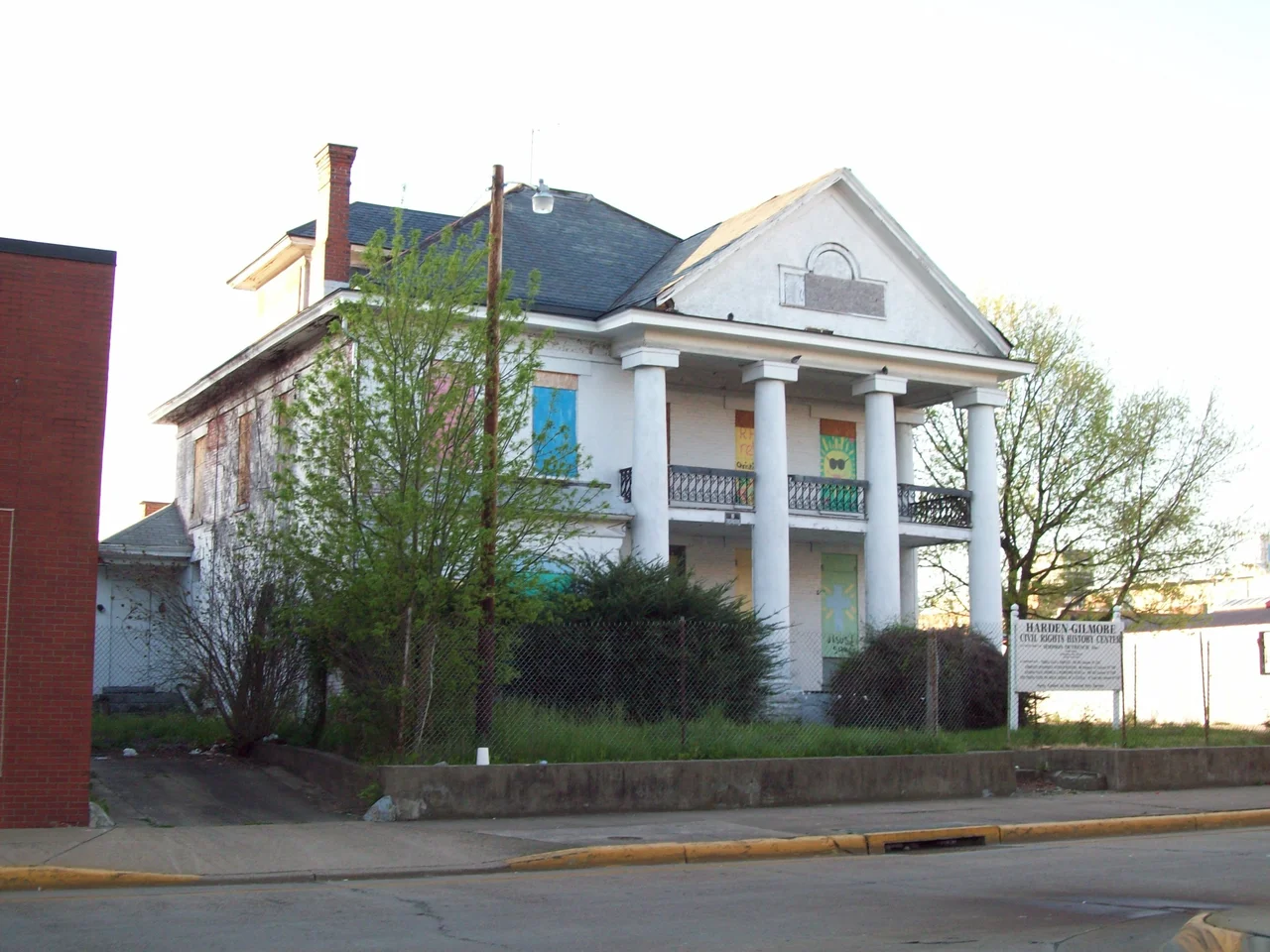

Elizabeth Harden Gilmore House
On a half-acre lot in a commercial block of Charleston, West Virginia, a brick Classical Revival house with a columned portico has stood since around 1900. For nearly half a century it was the home of Elizabeth Harden Gilmore - the first licensed African American female funeral director in West Virginia and one of the most quietly consequential civil rights organizers in the Kanawha Valley. The house held the family upstairs and the Harden and Harden Funeral Home downstairs. It also held the strategy sessions, the planning meetings, and the activists who built the Charleston sit-ins of 1958 to 1960. Elizabeth Gilmore was the woman behind much of that work. The house she lived in is on the National Register of Historic Places. The story of who she was is less widely told than it should be.
The Funeral Home
Elizabeth Harden was born in 1910 in Charleston. She trained as a funeral director at the Eckels College of Mortuary Science in Philadelphia and returned to Charleston with the credentials and the determination to practice. In 1940 she became the first licensed African American female funeral director in West Virginia and opened Harden and Harden Funeral Home with her first husband, Silas Harden. The business operated out of the family's Classical Revival home at the corner of Broad and Shrewsbury Streets - a building that gave dignified service to a Black community whose dead had previously had limited options for proper memorial care. The funeral home occupied the lower floors; the Hardens lived upstairs. The building's columned portico greeted visitors from the street. Funeral homes are intimate parts of community life. Harden and Harden was, for the Black families of Charleston's East End and South Hills, the place where generations of relatives were buried with full ceremony.
Civil Rights Work
By the late 1950s, Elizabeth Gilmore had become a central figure in the Kanawha Valley's civil rights movement. She co-founded the Charleston chapter of the Congress of Racial Equality (CORE) and served as one of its principal organizers. In 1958, she helped lead a campaign to desegregate Charleston's downtown lunch counters, employing the same sit-in tactics that would become national news two years later in Greensboro. The Charleston sit-ins succeeded in desegregating major lunch counters by 1960 - quietly, and without the violence that marked similar campaigns in the Deep South. Gilmore was a participant, a planner, and a backstop. Her funeral home provided a meeting place. Her professional standing as one of Charleston's prominent Black business owners gave her institutional weight in negotiations. She was later appointed to the West Virginia Board of Regents in 1969 - the first African American to receive such an appointment - where she served until the late 1970s, including terms as vice-president and president. She died in 1986.
Why the House Matters
Historic preservation usually trades in big structures and grand stories: capitols, mansions, courthouses, battlefields. The Elizabeth Harden Gilmore House is not big or grand. It is a brick house of modest scale on a city block whose surroundings have been substantially altered. The house has 'undergone some alteration and deterioration,' as the National Register form puts it - a kind way of saying the building has been through hard decades. But its significance does not rest on architectural perfection. It rests on the fact that the work of desegregating Charleston was planned, coordinated, and partly conducted from these rooms. The columned portico at the entrance carried, for nearly half a century, the comings and goings of activists, mourners, and ordinary citizens of Charleston's Black community. It was added to the National Register in 1988, two years after Gilmore's death, for that reason.
Walking Past Today
If you walk by the corner of Broad and Shrewsbury today, you will see a building that does not announce its history. The portico is still there. The brick is still mostly the original. The neighborhood around the house has shifted, with commercial buildings encroaching on what was once a more residential block. Plaques are not the same as places. But the place is the place. Elizabeth Harden Gilmore did her civil rights work here, lived here, raised her family here, ran her business here. The fact that we now have a state in which Black West Virginians can eat at any Charleston lunch counter has many causes, but among them is the patient organizing work that came out of this house. The funeral director who became a civil rights organizer is not a story you hear often. The house is one of the places where you can still see where it happened.
From the Air
The Elizabeth Harden Gilmore House sits in Charleston, West Virginia at 38.35 degrees north, 81.63 degrees west, at the corner of Broad and Shrewsbury Streets a few blocks east of downtown Charleston between the State Capitol complex and the river. Best viewed at 3,000 to 5,000 feet AGL: look for the corner brick building among the East End street grid; the gold dome of the state capitol is a few blocks east along the Kanawha River. Yeager Airport (KCRW) is on the ridge just north of downtown. The Kanawha River and the capitol dome are reliable orientation landmarks.
Nearby Stories
- Mystery Hole 6.5 km away
- West Virginia Colored Children's Home 9.4 km away
- Clay, West Virginia 13 km away
- Staats Mill Covered Bridge 14 km away
- Hobet Coal Mine 23 km away
- Appalachia 23 km away
- Fred M. Vinson Museum and Welcome Center 30 km away
- Ponn Humpback Covered Bridge 43 km away