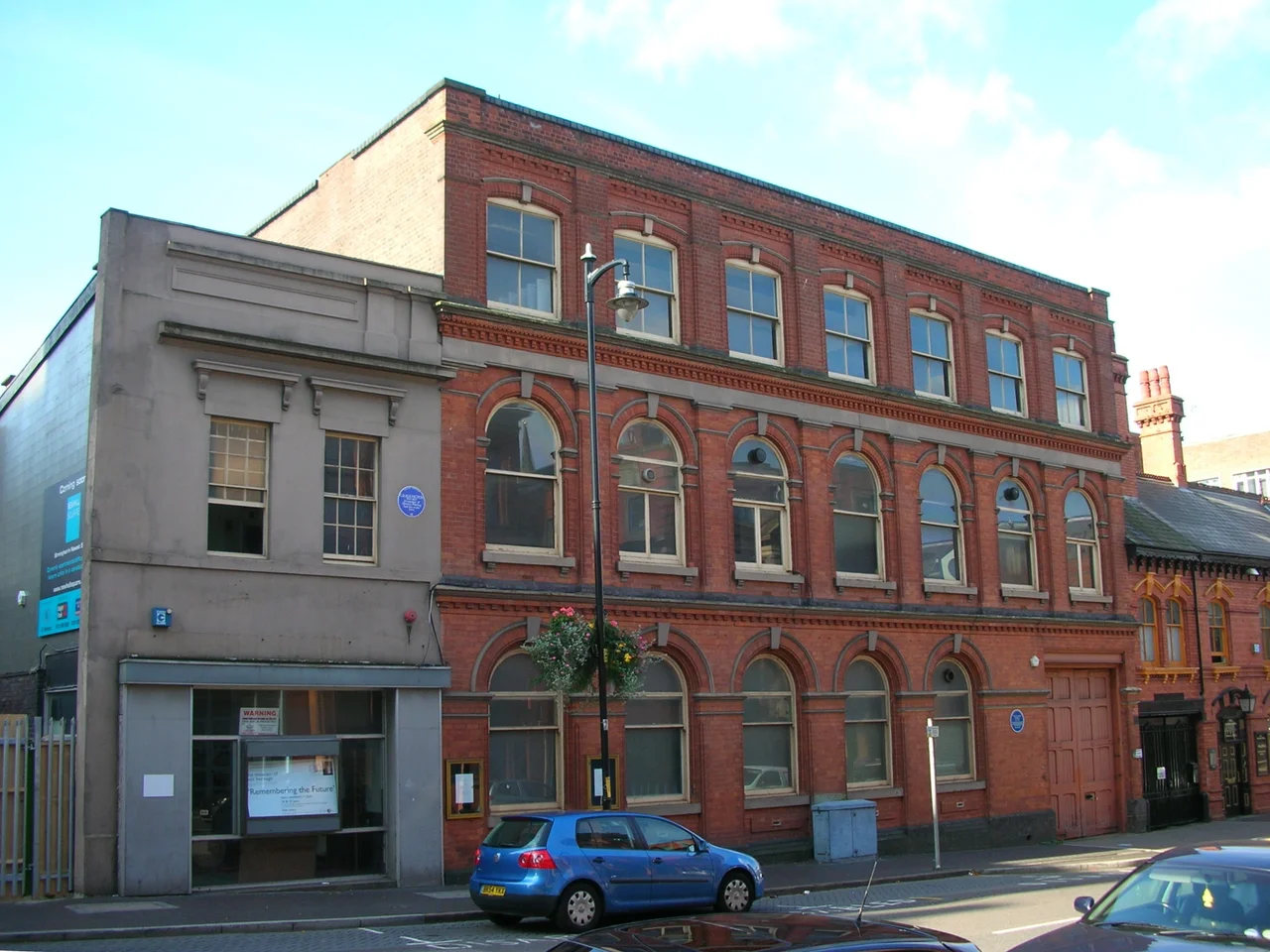

Elkington Silver Electroplating Works
On 25 March 1840, George Elkington and his cousin Henry filed a patent that quietly changed the table settings of the British Empire. They had figured out how to plate one metal with another using an electric current and a bath of cyanide solution. Until then, silverware meant either solid silver, which was expensive, or Sheffield plate, which involved fusing thin silver sheets to a copper base by heating and rolling. Electroplating let you deposit a uniform skin of silver onto anything conductive, in any shape. Within a decade, Elkington's factory on Newhall Street in Birmingham was supplying the world. By the 1850s, dining rooms in Liverpool, Bombay, and Buenos Aires gleamed with silver that had been electrolysed onto base metal in a vat in the West Midlands.
Cyanide, magnets, and the new industry
The Elkington works stood opposite the Birmingham Assay Office, the institution that hallmarked precious metal in the Midlands. The original factory was built in 1838 and grew along the banks of the Birmingham and Fazeley Canal, with workshops bridging the now-filled Whitmore's Arm. Inside, the work was both delicate and dangerous. Plating baths used solutions of silver cyanide and potassium cyanide, chemicals that killed quickly if mishandled. By the early 1850s the factory ran a steam-powered generator with sixty-four permanent magnets arranged in a circle around a rotating wrought-iron armature. This was the Woolrich Electrical Generator, built in 1844, and it was the earliest electrical generator put to industrial use anywhere in the world. The current it produced peeled silver from a sacrificial anode and laid it, atom by atom, onto teapots, candlesticks, and trophies waiting in the bath.
The accidental birth of plastic
One of Elkington's employees, a Birmingham metallurgist named Alexander Parkes, started experimenting with cellulose nitrate dissolved in alcohol and camphor. In 1856 he patented a substance he called Parkesine, the first man-made plastic. He exhibited it at the 1862 International Exhibition in London, where it won a bronze medal for moulded combs, knife handles, and decorative knick-knacks made of a material no one had ever seen before. Parkes' company eventually failed because Parkesine cracked and shrank as it dried, but his idea did not. American inventor John Wesley Hyatt refined the formula in 1869 and patented celluloid, which became billiard balls, photographic film, and shirt collars. Two of the blue plaques on the Newhall Street facade record the building's parallel inventors. One reads George Elkington, electroplating. The other reads Alexander Parkes, plastics.
The Museum of Science and Industry
The Elkington works was largely demolished in the mid-1960s, but the part that remained on Newhall Street became Birmingham's Museum of Science and Industry in 1951. For nearly fifty years the building housed the city's collection of working steam engines, locomotives, and machine tools. The star exhibit was the Smethwick Engine, a Boulton and Watt rotative beam engine built in 1779 and first run in 1797 to pump water back up the Birmingham Canal. After decades pumping at Smethwick, then Ocker Hill near Tipton, it arrived at the museum in 1959 and is now the oldest working steam engine in the world. The Woolrich Generator, built on this very site in 1844, was also on display. The museum closed in 1997, and the collection moved to Thinktank at Millennium Point in Eastside when that opened in September 2001.
What stands today
Birmingham City Council put the site up for redevelopment in 2002. Planning permission was granted in 2006 for a mixed-use development called the Jewellery Box, with 234 apartments rising over the old workshops. Construction started in 2008, and further flats were added over the car park in 2019. The Grade II listed Queen's Arms pub, with its elaborate terracotta facade, still stands next door, anchoring the corner within the Jewellery Quarter Conservation Area. The Smethwick Engine still runs at Thinktank, hissing and rocking on its great wooden frame as visitors watch. The Woolrich Generator sits there too. Both survived the move, and both began life inside or alongside the long-vanished factory whose chemists figured out how to make silver flow through wires.
From the Air
The Elkington Silver Electroplating Works site sits at 52.484 degrees north, 1.906 degrees west, in Birmingham's Jewellery Quarter just north-west of the city centre. From 1,500 to 2,500 feet AGL, look for the dense grid of small workshops and the Birmingham and Fazeley Canal threading through it. The St Paul's Square area and the Birmingham Assay Office on Newhall Street are easiest to spot. Birmingham International (EGBB) is fifteen kilometres east-south-east, Coventry (EGBE) is twenty-seven kilometres south-east, and Wolverhampton Halfpenny Green (EGBO) is twenty-six kilometres west. Industrial haze can settle over the city centre in still summer weather.
Nearby Stories
- Shepshed 8.5 km away
- Battle of Evesham 11 km away
- Hixon rail crash 12 km away
- Battle of Cropredy Bridge 12 km away
- Wenlock Priory 15 km away
- RAF Shawbury 16 km away
- Market Bosworth 17 km away