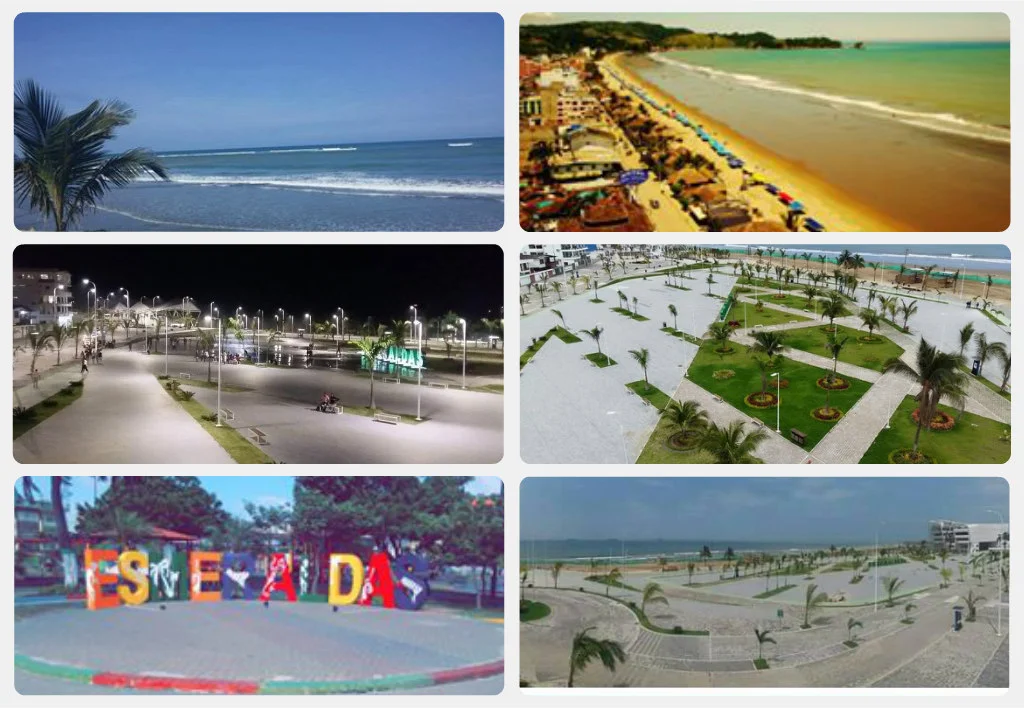
.jpg)
Esmeraldas, Ecuador
The green province gets its name from emeralds the Spanish thought they would find and never quite did. The city of Esmeraldas sits at the mouth of the Esmeraldas River, where the north Pacific coast of Ecuador bends toward Colombia and the jungle thins into mangroves. This is the capital of Afro-Ecuadorian Ecuador, the terminus of the country's trans-Andean oil pipeline, a working seaport, a soccer factory, and the Pacific's answer to Cartagena. It is also a city that has shaken more than once in living memory - most recently in December 2016, when a 5.8-magnitude earthquake rolled through downtown.
A Ship, a Wreck, a New Republic
In 1553, a Spanish slave ship carrying enslaved Africans from Panama to Peru ran aground on the rocks of this coast. Around two dozen of the captives escaped into the forests inland. Over the following decades, they and later escapees built free, self-governing communities along the Esmeraldas coast, defending their territory against Spanish re-enslavement. Their leader - eventually recognized even by the Spanish crown - was Alonso de Illescas, an Afro-Cape Verdean whose diplomatic skill kept the maroon settlements intact through a century of imperial pressure. Modern Esmeraldas Province is the cultural descendant of those free Black and Indigenous communities. The result is a city whose music, food, and football reach directly back to that founding act of resistance.
Oil at the End of the Pipeline
The Trans-Ecuadorian Pipeline - completed in August 1972 and running 504 kilometers from the Amazon oil fields over the Andes and down to the coast - ends here. Its refining facility and the nearby port of Balao turned Esmeraldas into the industrial hinge of Ecuadorian oil. The refinery expanded to 90,000 barrels per day in 1987, then to 110,000 in 1995, and the oil industry became the city's largest employer. Wood, wood chips, and bananas still move through the commercial port, but the quiet economic truth of Esmeraldas is that nearly every major decision made in Quito about energy eventually lands on this shore.
A Province Sounds Different
Esmeraldas is the wettest part of Ecuador's coast, though the climate is officially classified as hot semi-arid - a label that captures the dry months from May to December but undersells the thick fogs that roll in off the Humboldt Current the rest of the year. The cultural sound of the province is marimba music, the rhythm of call-and-response singing, and the steady drumming that underpins both. The kitchen runs on coconut milk, plantain, and fresh seafood - ceviche, encocado, the snapper and tuna and corvina pulled from the fleet that still works the river mouth. The indigenous Cayapa people live in the rainforests inland, and the La Tolita archaeological zone preserves artifacts from one of the Pacific coast's most sophisticated pre-Columbian cultures.
A Soccer City
For a city of its size, Esmeraldas produces a disproportionate share of the players who wear Ecuador's national jersey. Enner Valencia, born here in 1989, has captained the national team and played professionally in Turkey for Fenerbahçe. Pervis Estupiñán plays for AC Milan. Piero Hincapié plays for Arsenal on loan from Bayer Leverkusen. Darwin Rivas and Gustavo Vallecilla have also made professional careers in Europe and North America. The pattern is old enough to predate any of them - generations of Afro-Ecuadorian players have come out of the neighborhoods and pickup fields of this city, and a striking number end up at the highest levels of the global game.
Edges and Cautions
The coastal highway from Esmeraldas runs north through La Tola and south through Atacames, Súa, Same, Muisne, and Quinindé, stitching the province together and making the beaches accessible from Quito in a long day's bus ride. The Carlos Concha Torres airport at Tachina handles flights to the capital, with international service that has come and gone. The U.S. State Department advises caution near the Colombian border because of organized crime activity that spills south into the northern edges of Esmeraldas. None of that defines the city, but it shapes how travelers move. Come prepared, stay aware, and the Pacific side of Ecuador reveals a history that does not sound like the rest of the country.
From the Air
Esmeraldas sits at 0.95°N, 79.67°W at the mouth of the Esmeraldas River on Ecuador's northwestern Pacific coast. Nearest airport: Colonel Carlos Concha Torres Airport (SETN/ESM), 3 km east across the river in Tachina. Recommended viewing altitude 3,000-6,000 ft to take in the river mouth, the Balao oil terminal, the commercial port, and the string of beach towns running south toward Atacames. Expect persistent cloud cover and fog from the Humboldt Current, especially during the dry season.
Nearby Stories
- Mache-Chindul Ecological Reserve 30 km away
- San Miguel (Ecuador) 32 km away
- Mira River 47 km away
- 1906 Ecuador–Colombia earthquake 73 km away
- History of Ecuador (1830-1860) 85 km away
- Canoa 134 km away
- Bahia de Caraquez 177 km away
- Malpelo Plate 253 km away