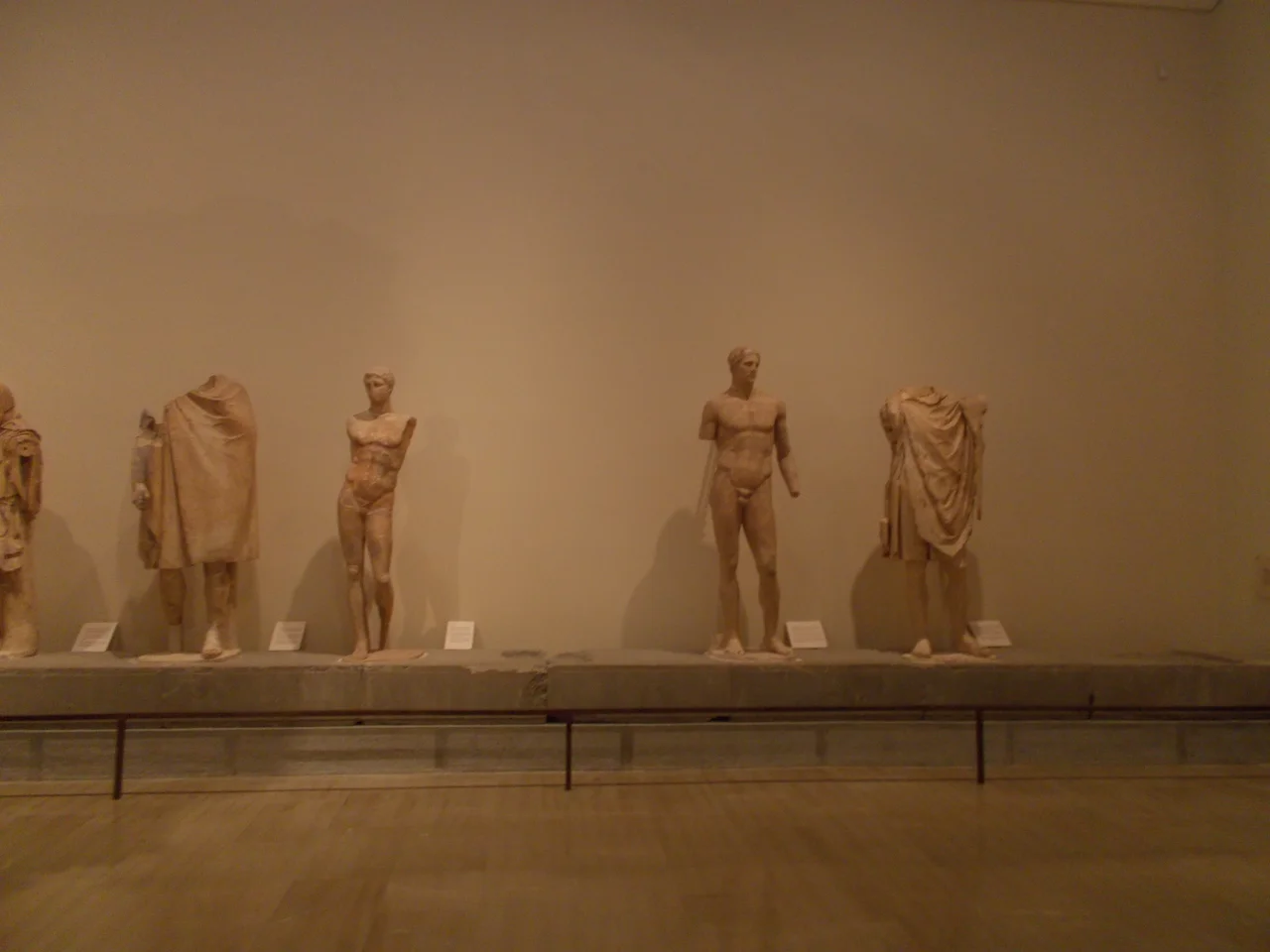

Ex-Voto of Daochos
The inscription cut into the marble tells you what Agias of Pharsalus accomplished: first place at Olympia in the pankration, five victories at the Nemean Games, three at the Pythian Games, five at the Isthmian Games — and, crucially, 'none while living had set up trophies against his hands.' The statue that accompanies those words is 2 meters of carved marble so finely observed in its musculature and poise that scholars have attributed it to the workshop of Lysippus, the greatest sculptor of the age. It stands in the Delphi Archaeological Museum today as the centerpiece of one of the most unusual monuments in Greek antiquity: a family tree rendered in stone, commissioned not by a king but by a politician honoring his ancestors at the most sacred site in the Greek world.
A Ruler's Gift to Apollo
Daochos II was the tetrarch of Thessaly and the hieromnemon — the sacred representative — of Pharsalus in the Delphic Amphictyony, the council of Greek city-states that administered the sanctuary at Delphi. Between approximately 336 and 332 BCE, during his term of office, he commissioned an elaborate votive offering: nine marble statues on a long base, placed in or near the Treasury of the Thessalians, to the northeast of the Temple of Apollo.
Eight of the figures represented members of Daochos's family across several generations. The ninth was a god, most likely Apollo himself, shown seated and holding a lyre. Each human figure bore an inscription identifying it — the ancestor's name, offices held, victories won — a combination of genealogy and advertisement carved into Parian marble and set before the god the family served.
Nine Figures, One Family
The lineup of figures begins with Acnonius, the great ancestor, identified as tetrarch of the Thessalians. Then comes Agias, son of Acnonius, whose athletic inscription reads like a roll call of Panhellenic glory. Next is Telemachus, Agias's brother and a wrestler whose victories matched his sibling's. Agelaus, the younger brother, won the children's sprint at the Pythian Games. Daochos I, son of Agias, governed Thessaly for twenty-seven years — 'not by force but by law,' his inscription says, during a time when the region flourished. His son Sisyphus I received Athena's blessing in battle, protected from wounds from the day he first put on armor.
Daochos II himself occupies the eighth position, his inscription identifying him by his offices: tetrarch, hieromnemon of the Amphictyony. His own statue survives only from the feet down. The ninth and final position was reserved for his young son, apparently too young to have done anything yet worth inscribing.
The Hand of Lysippus
The statue of Agias is the key to the monument's artistic identity. Lysippus, court sculptor to Alexander the Great and one of the most innovative figures in the history of Greek sculpture, had already made a bronze of Agias at Pharsalus. The marble version at Delphi so closely resembles what scholars can reconstruct of that bronze — in the proportions, the slight elongation of the figure, the naturalistic treatment of the body at rest — that the Delphi group is now attributed to Lysippus's workshop, if not to the master himself.
The statues were found in fragments during the great French excavations at Delphi in 1894. Reassembled, Agias stands with the relaxed authority of someone who has already proven everything he needs to prove. The pankration — the ancient all-in fighting discipline that combined wrestling and boxing with almost no restrictions — required precisely that combination of power and composure the statue projects. Agias won at all four major Games. The stone remembers it.
Politics in Marble
The ex-voto of Daochos is not simply piety. It is also, transparently, a political statement. By 336 BCE, Philip II of Macedon had reshaped the Greek world, and Daochos was a known Macedonian supporter. Setting up a monument at Delphi — the most pan-Hellenic of sanctuaries — that celebrated his family's long service to Thessaly and to Apollo was a way of claiming legitimacy, of inscribing his house into the sacred record at the moment when Macedonian power was transforming Greek politics.
The Thessalians had long had their own treasury at Delphi, and Daochos placed his monument there. Each inscription moves backward through time, building the case that this family had always led, always served, always won. The monument in the museum at Delphi, where the figures stand in their original order on a reconstructed base, makes that argument visible even now — a fourth-century BCE family portrait, carved in marble and dedicated to a god.
From the Air
The ex-voto of Daochos was dedicated at Delphi, located at 38.483°N, 22.501°E on the southern slopes of Mount Parnassus in Phocis, central Greece. From altitude the sanctuary is recognizable as a series of terraced structures cut into a dramatically steep hillside above the valley of the Pleistos River, with the Sacred Plain stretching toward the Gulf of Corinth to the south. Approach from the southeast at 7,000–9,000 ft offers a clear view of the entire Delphi complex. The nearest major airport is Araxos (LGRX) on the Peloponnese coast, approximately 130 km to the southwest; Athens International (LGAV) is approximately 185 km to the east and is the more commonly used gateway for visitors. The statues themselves are now housed in the Delphi Archaeological Museum, just outside the sanctuary enclosure.
Nearby Stories
- Battle of Vasilika 7.9 km away
- Siege of Negroponte (1470) 8.5 km away
- Battle of Kalavryta 13 km away
- Church of the Nativity of the Theotokos, Limni 14 km away
- Pellene 16 km away
- Panagia Varnakova Monastery 18 km away
- Megara 21 km away
- Karpenisi 41 km away