.jpg)
Fan Museum
Picture an object so intimate you can hold it in one hand, so coded that a flick of the wrist once signaled a rendezvous, a refusal, or a declaration of love. Now picture a museum built around that object - the only one of its kind anywhere in the world. On Croom's Hill in Greenwich, two graceful Georgian townhouses built in 1721 conceal more than six thousand hand fans, the oldest dating to the eleventh century. The Fan Museum opened here in 1991, and it remains a wonderfully eccentric corner of the Greenwich World Heritage Site.
Two Houses on Croom's Hill
The buildings themselves tell half the story. Constructed in 1721, when Greenwich was still a riverside village distinct from London, the pair of Grade II* listed townhouses sit on the slope of Croom's Hill, looking down toward the great green sweep of Greenwich Park and the river beyond. Their bricks have weathered three centuries of London soot, wars, and weather. By the late twentieth century they had been carefully restored - paneling repaired, ceilings rescued - to house a collection that needed exactly this kind of refined Georgian setting. The fans of duchesses and dance halls now hang in rooms built when many of those duchesses were still alive.
Six Thousand Whispers
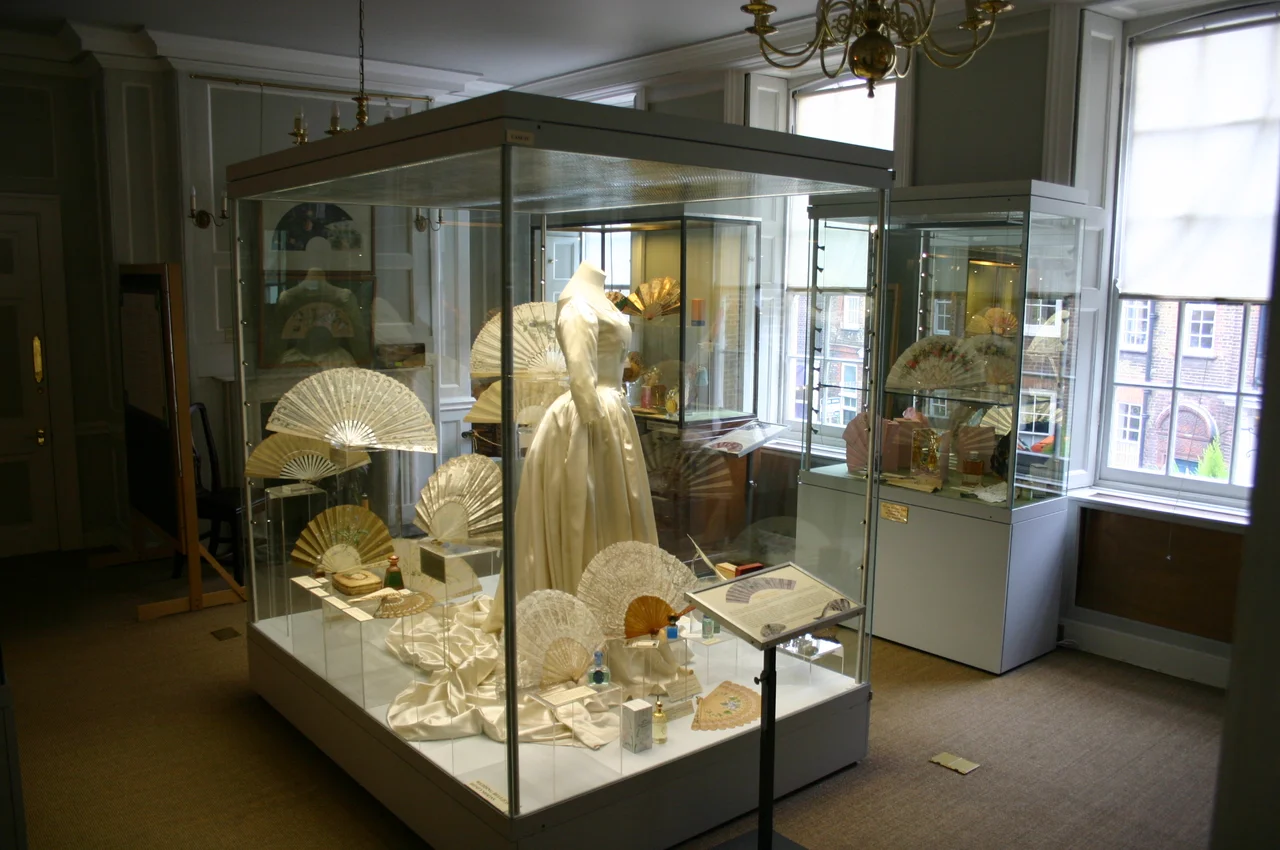
The collection numbers over 6,000 fans and related materials as of 2023, ranging from an eleventh-century example to twentieth-century commercial pieces handed out at department stores and theaters. The strongest holdings are eighteenth and nineteenth-century European fans, the era when the fan reached its zenith as both fashion accessory and silent language. Painted vellum, pierced ivory, mother-of-pearl, lace, feathers, silk, sequins - the materials read like an inventory of a vanished luxury trade. Conservation concerns mean the whole collection is never on display at once. Instead, rotating exhibitions pair with a permanent educational display covering history, manufacturing, and the surprising variety of fan forms - cockade, brisé, telescopic, mourning, advertising.
The Orangery and the Garden
Behind the houses, the surprise unfolds. A small orangery, its walls covered in murals, opens onto a Japanese-style garden where the parterre is laid out in the unmistakable curve of a fan. A pond ripples, a stream runs through the planted beds, and the geometry of the lawn echoes the radiating ribs of the very objects on display indoors. Tea is served here. The garden was designed to extend the museum's central conceit into living form - the fan as horticulture, the fan as architecture. On a still summer afternoon, with the parterre in bloom, it is one of the quieter pleasures hidden in Greenwich.
A Language Almost Forgotten
What makes the museum more than a curio is what it preserves alongside the objects themselves: knowledge. The reference library and educational programs teach how fans were made, sold, used, and read. In Georgian and Victorian Europe, a fan held a particular way could signal commitment or rejection, eagerness or boredom. It cooled the wearer, yes, but it also worked as a kind of social semaphore. The Fan Museum has hosted fan-making classes, attended over the years by visitors ranging from schoolchildren to royalty - in 2019 the Duchess of Cornwall joined one. Few museums devote themselves to an object so widely owned and so quickly forgotten. Here, the hand fan gets its hearing.
From the Air
Coordinates 51.4786 N, 0.0078 W on Croom's Hill in Greenwich. Best viewed from low altitude with the broad green of Greenwich Park to the east and the River Thames curving north. Nearest major airports London City (EGLC, about 4 nm northeast) and London Heathrow (EGLL, about 16 nm west). Clear weather reveals the Old Royal Naval College and Royal Observatory complex nearby.
Nearby Stories
- Battle of Britain, Northfleet 1.1 km away
- Bayham Old Abbey 5.4 km away
- Catharine Macaulay 6.4 km away
- Hatfield rail crash 8.8 km away
- Chequers 8.9 km away
- Chelmsford Cathedral 10 km away
- Queen Victoria Hospital 13 km away
- Fishbourne Roman Palace 36 km away