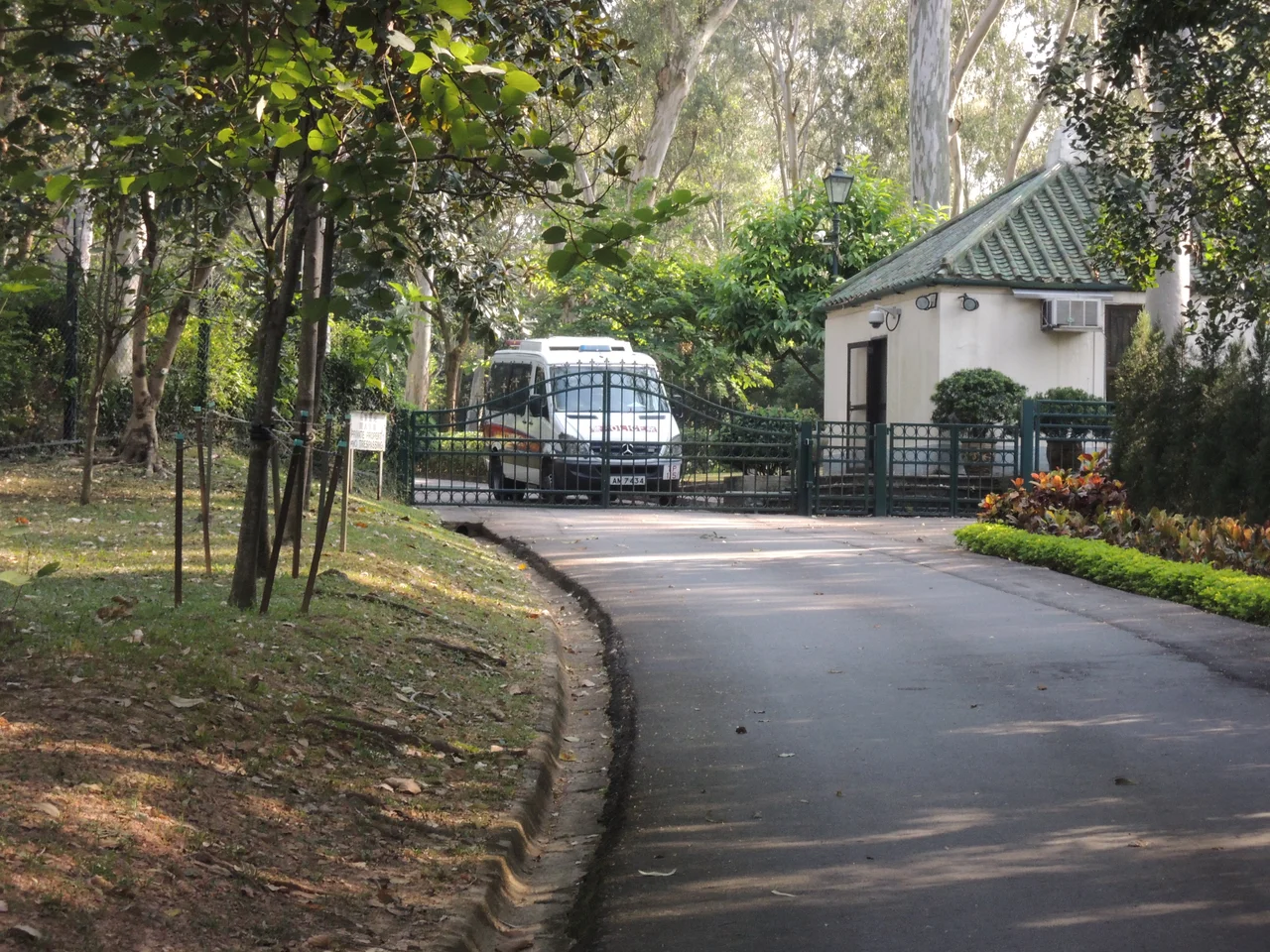

Fanling Lodge
The governors of Hong Kong used to escape to the hills. Not to Victoria Peak, where Mountain Lodge perched above the city in expensive splendour, but to the quieter New Territories, where a modest colonial house sat tucked inside the grounds of the Hong Kong Golf Club. Fanling Lodge, designed by government architect Stanley Feltham in 1933 and completed a year later at a cost of HK$140,000, was never meant to impress. It was meant to breathe — a place of weekend respite from the heat and ceremony of colonial administration, shaded by trees, its back garden enclosed by walls of local grey brick and stone. Mountain Lodge was demolished in 1946. Fanling Lodge is still here.
A Country House Born of Frugality
Governor Sir William Peel made the case in 1932 with characteristic colonial practicality: the repairs and upkeep on Mountain Lodge were simply too expensive. The solution was a new residence, farther from the city, cheaper to maintain, and better situated for weekends away from the port's relentless commerce. Fanling, in the northeastern New Territories, offered space, shade, and cooler breezes. The 2.3-hectare wooded lot Feltham chose sat within the Hong Kong Golf Club — a detail that gave the property an unusual privacy, golf-course greenery buffering it from the road. By the time the Lodge was completed in 1934, it had a swimming pool, a tennis court, and a wood-and-stone pergola. The architectural style was plain and purposeful: a colonial bungalow built for comfort, not for show.
War, Teachers, and Soldiers
The Japanese occupation of Hong Kong during World War II ended the governors' retreats abruptly. When peace returned, the Lodge took on an unlikely second life. Between September 1946 and 1948, it served as a provisional campus for the Rural Teachers' Training College — Hong Kong Official Rural Normal College — sheltering the educators the colony urgently needed to rebuild its postwar schools. It was a brief interlude before another kind of tenant arrived. In the early Cold War years, with the People's Republic of China established across the border in 1949, Fanling Lodge was considered too geographically sensitive for civilian use. The British armed forces took it over and held it until 1960. The property had, in just over two decades, been a holiday home, a schoolroom, and a barracks.
Secrets Over the Back Lawn
After returning to official use, Fanling Lodge quietly became something more significant. The source material records that discussions here between Hong Kong officials and British Prime Minister John Major in 1996 covered questions that would shape the territory's future: new accounting arrangements for monetary control, the linked exchange rate system, the establishment of what would become the Hong Kong Monetary Authority in 1993, and issues arising from a Sino-British Memorandum of Understanding about the new airport at Chek Lap Kok. Behind those grey brick retaining walls, in a wooded lot beside a golf course, some of the most consequential negotiations of Hong Kong's final colonial chapter were conducted. Diplomacy, it turns out, prefers quiet gardens.
Controversy and a Grade I Listing
After the 1997 handover, Fanling Lodge stayed on as an official residence of the Chief Executive. The transition was not without friction. Tung Chee-hwa, Hong Kong's first Chief Executive, was criticized by the Democratic Party for not using the property; opponents argued the government should give it up rather than maintain it for a leader who wasn't there. In 2005, at the start of Donald Tsang's tenure, two permanent staff were recorded as maintaining the Lodge. The Architectural Services Department spent HK$856,000 on upkeep between 2010 and 2015. When new development plans for the North East New Territories raised the possibility of demolition, heritage advocates pushed back. In September 2014, the Antiquities Advisory Board granted Fanling Lodge Grade I historic building status — the territory's highest designation for structures with outstanding historic significance. The Lodge, and the adjacent Fanling Clubhouse (rated Grade II), may now be incorporated into future new town development rather than erased by it.
Fanling from the Air
Flying over the northeastern New Territories at 3,000 feet, the dense green canopy around the Hong Kong Golf Club makes Fanling Lodge nearly invisible — a deliberate kind of modesty for a building that has held considerable secrets. The Sha Tau Kok Road corridor traces the border with Shenzhen just a few kilometres north. To the southwest, Fanling station anchors the East Rail line that threads down to Kowloon. The region's patchwork of development and farmland, walled villages and golf fairways, stretches beneath you — a landscape where colonial-era buildings still hide, unexpectedly, among the trees. Hong Kong International Airport (VHHH) lies roughly 50 kilometres to the west, across the harbour and the Pearl River delta. A good day to overfly is any clear winter morning, when the New Territories open wide under cool, low-humidity air.
From the Air
Coordinates: 22.4986°N, 114.1169°E. Recommended viewing altitude: 2,500–4,000 ft. The Lodge sits inside the Hong Kong Golf Club grounds in Kam Tsin, near Fanling. Look for the wooded 2.3-hectare lot just off Castle Peak Road — Kwu Tung. The Sham Chun River and the Shenzhen border lie a few kilometres to the north. Nearest airport: Hong Kong International (VHHH), approximately 50 km to the west. Clear winter days offer the best visibility over the New Territories.
Nearby Stories
- Chapel of St. Francis Xavier 3.5 km away
- Cuiheng 4.1 km away
- 2015 Shenzhen Landslide 16 km away
- Shunde 31 km away
- Wanshan Archipelago 37 km away
- Nanxiong Formation 96 km away
- Heyuan 149 km away
- Checheng Fu'an Temple 629 km away