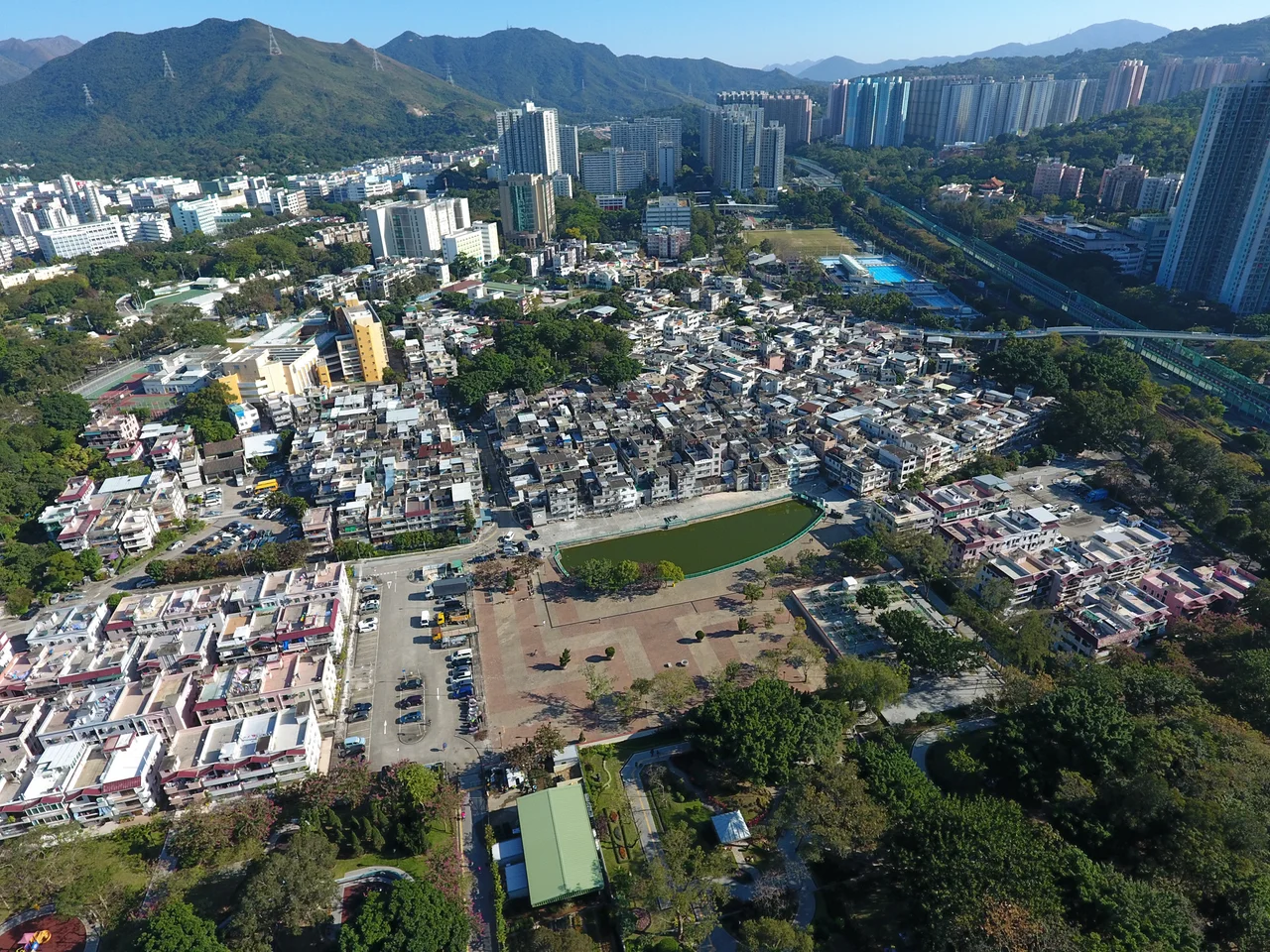

Fanling Wai
The cannons still stand near the entrance gate-tower, small and blackened, pointing outward from a village that has stood since the Ming dynasty. Fanling Wai — the wai means walled village in Cantonese — was built by the Pang Clan during the Wanli reign, sometime between 1572 and 1620, on land in what is now Hong Kong's North District. The walls were built for a reason: this was a frontier landscape, and a clan that had traveled from Gansu province to Jiangxi to Guangdong over the course of centuries knew better than to leave its homes unprotected.
A Thousand Years on the Road
The story of Fanling Wai begins long before the village was built. The Pang Clan's recorded history traces their ancestors to Gansu province in northwestern China. From there they moved to Jishui County in Jiangxi province in 739. During the Northern Song dynasty — the period between 960 and 1127 — successive migrations carried them south, first to Chaozhou and then to Dongguan. By the time the Southern Song dynasty collapsed and China fell into Mongol-ruled chaos, the Pangs had already arrived in what would become Hong Kong. They settled during the Southern Song period, 1127 to 1279, and established themselves in the Fanling area. Centuries later, when conditions were stable enough to build permanently, they chose the walled form: the traditional *wai* that signaled both permanence and defensive resolve.
What the Walls Still Hold
Fanling Wai is not a single village but a cluster of three settlements: the original Ching Wai (also called Chung Wai), the only fully walled hamlet of the group and the first to be built; Pak Wai; and Nam Wai. Each has its own character, though the Pang identity runs through all of them. The Pang Ancestral Hall in Pak Wai is a Grade I historic building — the highest heritage designation in Hong Kong — a testament to the architectural care the clan invested in structures meant to last. The Tsz Tak Study Hall in Nam Wai holds Grade II status. And the entrance gate-tower of Ching Wai, along with its southwest and northwest watchtowers, earned Grade III designation, though the structures visitors see today were rebuilt in 1986. The original walls were replaced, but the intention — enclosure, protection, continuity — remains.
The Distinctive Pond and the Three Gods
What makes Ching Wai immediately recognisable, apart from the cannons, is the pond. Traditional *wai* design incorporated water as both a practical and cosmological element: ponds reflected good fortune inward and served as a water source during sieges. The layout of Fanling Ching Wai integrates the pond, the gate-tower, the watchtowers, and the buildings into an arrangement that is simultaneously defensive and auspicious. Nearby, the Pang Clan also built a Sam Shing Temple — dedicated to three deities: Pak Tai, Kwan Tai, and Man Cheong. The temple was relocated in 1948 to its present position west of Ling Hill, along Jockey Club Road, when the original site was needed for other purposes. The three gods — of cosmic order, of martial virtue, and of scholarly achievement — reflect the range of things a clan needed to prosper: peace, strength, and learning.
Continuity in a Changed Landscape
Modern Fanling has grown up around the old walled village, and the tension between preservation and development is visible throughout Hong Kong's North District. Fanling Wai has fared better than many. Heritage designation has given the key structures legal protection, and the Pang Clan itself remains active — maintaining websites, Facebook pages, and formal family networks that connect descendants near and far. The Tai Ping Hung Chiu ceremony, a major Taoist ritual event held periodically in the Fanling area, draws participants from across the Pang diaspora. The walled village is no longer a defensive necessity, but it continues to function as something perhaps more durable: a physical anchor for a family identity that has survived a thousand years of migration, dynasty change, and transformation. The cannons at the gate are ornamental now. But they point outward still.
Flying Over the Walled Villages
From the air, the walled villages of Hong Kong's New Territories are surprisingly legible: compact rectangular footprints, often surrounded by fish ponds or agricultural lots, set among the newer housing estates that have grown up on all sides. Fanling Wai lies near the heart of Fanling town, at approximately 22.4975°N, 114.135°E. Approaching from the north, you can trace the East Rail corridor south from the Shenzhen border; Fanling station sits a short distance east of the old village cluster. From 2,500 feet on a clear day, the contrast between the irregular rooflines of the old *wai* and the grid of surrounding residential blocks is striking. Hong Kong International Airport (VHHH) is approximately 50 kilometres to the west. In winter, when the New Territories shed their haze, the whole of the North District opens up beneath you.
From the Air
Coordinates: 22.4975°N, 114.135°E. Recommended viewing altitude: 2,000–3,500 ft. Fanling Wai sits within the town of Fanling; look for the compact walled footprint among residential blocks near Fanling station on the East Rail line. The Shenzhen border and Sham Chun River are visible a few kilometres to the north. Nearest airport: Hong Kong International (VHHH), approximately 50 km west. Winter months offer the clearest views over the New Territories.
Nearby Stories
- Chapel of St. Francis Xavier 3.5 km away
- Cuiheng 4.1 km away
- 2015 Shenzhen Landslide 16 km away
- Shunde 31 km away
- Wanshan Archipelago 37 km away
- Nanxiong Formation 96 km away
- Heyuan 149 km away
- Checheng Fu'an Temple 629 km away