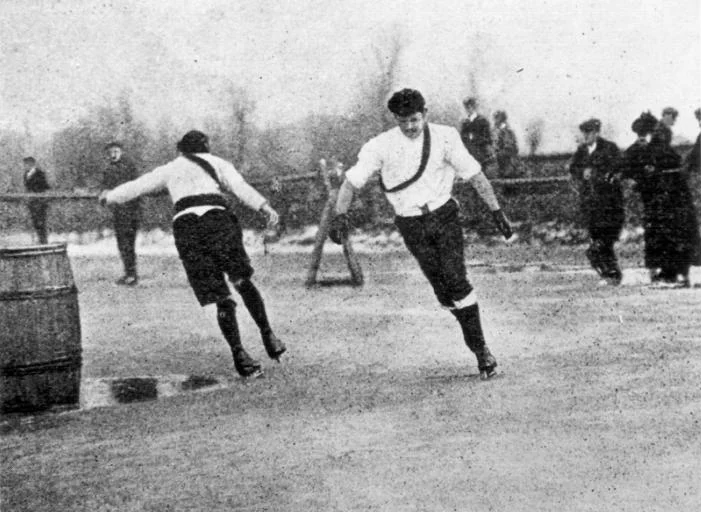

Fen Skating
In the winter of 1854, Turkey Smart, a man from the village of Welney on the Cambridgeshire-Norfolk border, dramatically ended the reign of champion Larman Register. That winter was exceptionally cold. A month's frost from late January saw Smart race at Outwell, Welney, Benwick, Mepal, March, Deeping, Ely, Peterborough, and the Grand Skating Match at Wisbech — winning twelve times, losing once, at Salter's Lode. His total winnings came to £54 15 shillings and a leg of mutton. One of the Lancashire skaters who came south to challenge the fenmen, and lost badly, said afterwards: "We are the best men in our parts, but we run. These fenmen flee."
A Sport Built on Flooding
The Fens of East Anglia were made for skating in ways that few other landscapes match. The flat, easily flooded meadows, the wide drains and washes, the rivers that stretched for miles in straight lines — when it froze, all of this became a natural racing circuit. Bone skates have been found in the area dating from the medieval period. By the seventeenth century, metal-bladed skates were in use in the Fens. Racing was the preserve of working people — most of them agricultural labourers — who competed for prizes of money, joints of meat, or clothing, hung outside village pubs to be skated for the following day. Championship matches drew 16 or 32 competitors paired off in heats, with the prize money split among the finishers according to how far they progressed. A typical purse in the mid-nineteenth century was £10, at a time when agricultural labourers typically earned about 11 shillings a week.
The Welney Families
The small village of Welney, three miles from the nearest railway station on the banks of the Old Bedford River, produced so many top skaters that it became known as the metropolis of speed skating. Turkey Smart dominated the 1850s; his brother-in-law Gutta Percha See ran close behind him. Fish Smart — who took his nickname from his swimming prowess, not his speed — was champion for a decade from 1878. Fish Smart left Welney to work construction sites around England and had a spell in Egypt on the unfinished Sudanese railway, but returned to the Fens when it froze. James Smart, the youngest brother, took Fish Smart's title at Lingay Fen in 1889 and became Britain's only ever world champion speed skater when the National Skating Association took him to the Netherlands. He set up an agency in Britain to sell Norwegian-style skates. Albert Dewsberry, the only fenman ever to beat Fish Smart in his prime, had his left leg amputated below the knee in 1882 following an accident. He entered the 1887 championship with a cork leg, was beaten in the first round, and was rewarded with a collection from the crowd.
The Equipment They Used
Fen skates were called pattens, fen runners, or Whittlesey runners. The footstock was beechwood. A screw at the back was driven into the heel of the boot; three small spikes at the front kept the skate steady; leather straps secured the foot. The metal blades were slightly higher at the back than the front, producing the characteristic low, bent-forward posture of fen skating — quite different from the upright style of figure skaters. By the 1890s, competitors had begun switching to Norwegian-style skates for racing. The Wisbech and Fenland Museum holds a collection of early bone skates, pattens, and Norwegian-style examples alongside the broader story of fenland sport. A pair of iron skates from the Museum of Cambridge — made entirely of metal — dates to the eighteenth century.
Bandy, Ice Cricket, and the Governing Body
Fen skating produced more than speed racing. The Bury Fen Bandy Club, founded near Bluntisham in Cambridgeshire, formulated most of the rules of modern bandy under the captaincy of Charles Goodman Tebbutt and his brothers, and introduced the game to the Netherlands and other northern European countries in the 1880s. Ice cricket was also played in the Fens, though it never achieved bandy's reach. The National Skating Association was founded in the Guildhall in Cambridge on 1 February 1879, with a founding committee that included landowners, a vicar, two Members of Parliament, the mayor of Cambridge, and the Lord Lieutenant of Cambridge. The sport's golden age peaked in the second half of the nineteenth century and has been in long decline since — limited by milder winters and the drainage and development that transformed the flooded meadows into ordinary farmland.
From the Air
Fen skating took place across the broad Fenland landscape north and east of Cambridge, centred on the washlands and flood meadows around towns like Welney, Wisbech, Ely, and Littleport. The general area is at approximately 52.30°N, 0.25°E. From altitude, the Fenland landscape is striking: a flat, drained plain of rectangular fields and straight dykes that was originally marsh and seasonal flood. Cambridge Airport (EGSC) is on the southern edge of this landscape. At 3,000–5,000 feet the vast scale of the Fens, and the way they stretch from Cambridge to The Wash in the north, becomes apparent. Ely Cathedral appears as a solitary stone mass rising from the flat land, visible for many miles.
Nearby Stories
- Walden Abbey 4.6 km away
- Bury St Edmunds 5.5 km away
- RAF North Pickenham 8.1 km away
- Ampthill 9.5 km away
- RAF Wittering 10 km away
- Murder of Una Crown 12 km away
- Colchester Community Stadium 18 km away
- John Bunyan Museum 19 km away