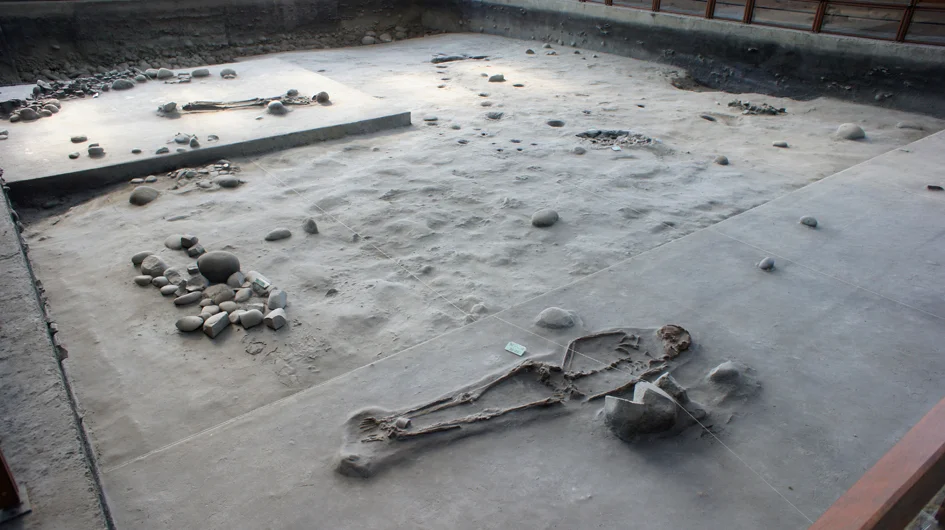

Fengbitou Archaeological Site
Sometime around 3050 B.C.E., people living on a plateau south of Fengshan Hill in what is now Kaohsiung pressed twisted cords into wet clay, shaping pottery that would survive for five millennia. They were among Taiwan's earliest known inhabitants, part of the Tapenkeng culture, and they left behind not only their distinctive cord-marked pots but net sinkers and spearheads that speak to a life organized around fishing and hunting. They were the first of at least three distinct cultures to occupy this 9.7-hectare site, each one layered atop the ruins of the last like pages in a book that no one could read until a Japanese scholar stumbled across it during the Second World War.
Discovery in Wartime
Japanese scholar Sueo Kaneko found the site around 1941, during Japan's colonial administration of Taiwan. Another researcher, Naoichi Kokubu, investigated in 1943. But it was the archaeologist Kiyotari Tsuboi who conducted the first formal excavation in 1945, as the war was ending. Tsuboi presented his findings at an international conference in 1953 and gave the site the name Fengpitou, derived from the Wade-Giles romanization system that Taiwan's archaeological tradition still uses. The site sits on the plateau north of the Chungkengmen Settlement in what is now Linyuan District, and for decades it was known interchangeably by both its formal name and the original local designation of Zhongkengmen. What Tsuboi uncovered was not a single settlement but a palimpsest of cultures spanning more than three thousand years.
Five Thousand Years in Layers
The deepest cultural layer belongs to the Tapenkeng culture, dating from roughly 5,000 to 4,300 years ago. Its artifacts include cord-marked pottery, net sinkers, and stone spearheads, the toolkit of a coastal people who fished the waters off southwestern Taiwan. Above it lies evidence of the Niuchoutzi culture, active from about 4,300 to 3,500 years ago. This layer yielded red cord-marked pottery, ceramic vases and bowls, spindle whorls for textile production, and stone tools including axe-hoes, adzes, and knives. Many of the stone implements are made from picrite basalt, a material rare on Taiwan proper but found on the Penghu islands across the strait, suggesting trade or migration routes that connected the site to a wider world. The uppermost prehistoric layer belongs to the Fengpitou culture itself, spanning roughly 3,500 to 2,000 years ago. Here archaeologists found painted and polished black pottery, cups and jars of increasing sophistication, stone rings and earrings, and shell middens documenting centuries of accumulated meals.
Connections Across the Strait
The picrite basalt tools from the Niuchoutzi layer are among the site's most intriguing finds. Picrite basalt does not occur naturally in the Kaohsiung area. Its presence points toward the Penghu archipelago, some fifty kilometers offshore, where the stone is abundant. Whether the material arrived through trade networks, seasonal migration, or some combination of both remains an open question, but it links Fengbitou to a maritime culture that was navigating the Taiwan Strait thousands of years before the Dutch or Chinese arrived. The site's cultural sequence, from Tapenkeng through Niuchoutzi to Fengpitou, mirrors the broader prehistoric development of southwestern Taiwan, making it a reference point for understanding how human settlement evolved across the region. Remains from the Qing dynasty and the Japanese colonial era also appear in the upper layers, a reminder that the plateau continued to attract habitation long after its prehistoric inhabitants vanished.
A National Treasure Underground
Taiwan's government designated the site a national historic monument on February 11, 2000, upgrading its classification to national archaeological site on May 1, 2006. The distinction matters: as a national archaeological site, Fengbitou receives formal protection against development and unauthorized excavation. The plateau looks unremarkable from the surface, a patch of elevated ground in the suburban sprawl of southern Kaohsiung, but beneath it lies a continuous record of human adaptation stretching back to the time when the great pyramids of Egypt were still centuries in the future. Each layer tells a slightly different story about what people ate, how they made their tools, whom they traded with, and what they valued enough to shape from clay and stone. For a place that most Kaohsiung residents pass without a second glance, Fengbitou holds an extraordinary claim: it is one of the oldest documented windows into the human story of Taiwan.
From the Air
Coordinates: 22.511N, 120.367E, on a plateau in Linyuan District, southern Kaohsiung. The site is inland from the coast near Fengshan Hill. Nearest major airport: RCKH (Kaohsiung International Airport), approximately 7 km northwest. Viewing altitude: 2,000-4,000 ft AGL to see the plateau in its coastal plain context.
Nearby Stories
- Taimali 7.2 km away
- Meinong East Gate Tower 15 km away
- Kunci Temple 20 km away
- Checheng Fu'an Temple 42 km away
- Dongji Island 49 km away
- Orchid Island 69 km away
- South Penghu Marine National Park 77 km away
- Hong Kong 12 549 km away