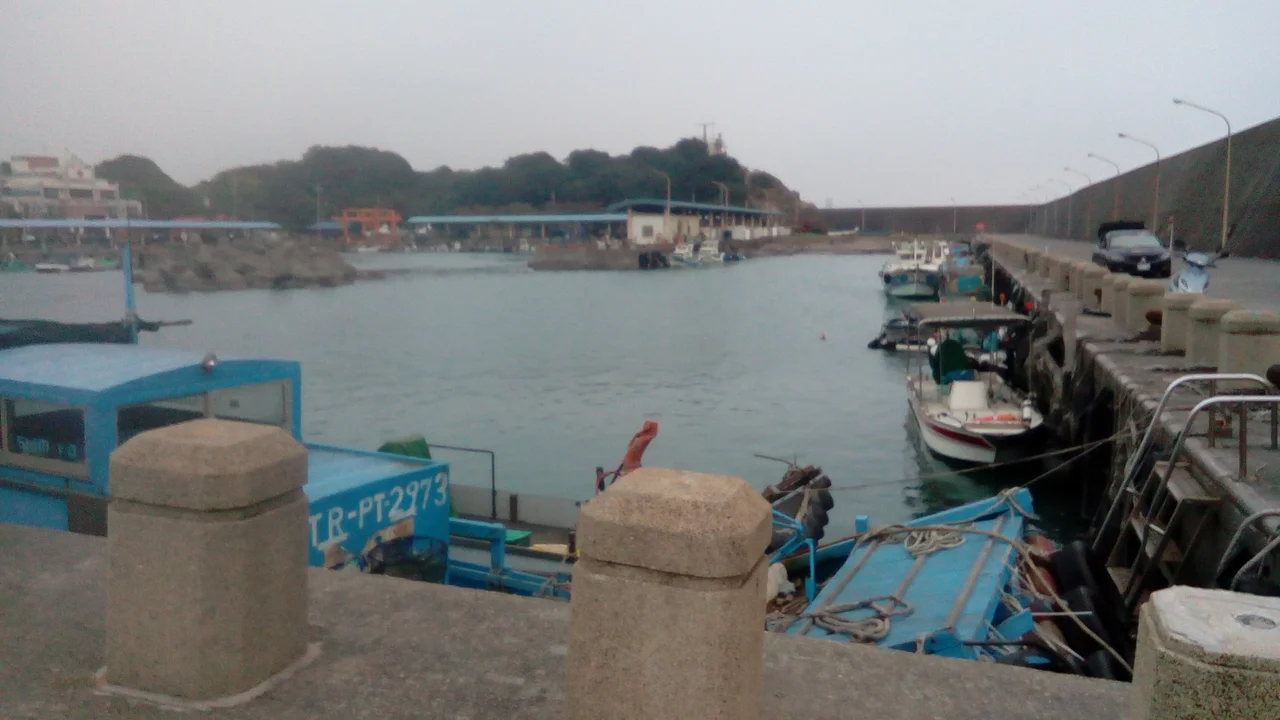

Fengbitou
Somewhere beneath the fishing village of Fengbitou, time folds back more than five millennia. The people who named this place had a gift for precision: *fengbi* for the mountain face that shields it, *tou* for the headland position at the end — head or tail, ancestors always knew where they stood. What they could not have known was that the soil beneath their feet held the layered remains of cultures stretching back to 5,200 years ago, making this small jut of land at the southern edge of Siaogang District one of the most archaeologically significant places in Taiwan.
A Name That Marks the Edge
Geography gave Fengbitou its character before history had a chance to. Wedged against the Taiwan Strait to the southwest and framed by Fengbi Mountain to the east, the settlement occupied a specific corner of the world — the kind of place where fishermen learn to read water and wind the way others read books. Residents named the three positions of the settlement from north to south: Bangkengzi, Dingtou, and Xiatou, each marking a distinct node in the community's spatial memory. During the Qing Dynasty, most people here made their living from the sea. When Japanese administrators arrived and the economy broadened, the village became what locals called *Hai Shan Hai* — a place where the rhythms of agriculture and fishing overlapped without either fully replacing the other. The phrase captures something essential: Fengbitou was always a place caught between things, at the edge of the district, at the edge of the sea, at the edge of recorded time.
Layers Beneath the Village
The Fengbitou Archaeological Site sits just east of the village, in the Wanggong Temple area, spread across a 9.7-hectare plateau that was first investigated by Japanese scholar Sueo Kaneko around 1941. After World War II, Japanese archaeologist Kiyotari Tsuboi excavated the site in 1945, uncovering what would prove to be a remarkably deep stratigraphic record. Three distinct cultural layers were identified. The deepest — Dapenkeng culture — dates to between 4,300 and 5,000 years ago, placing it among the earliest Neolithic cultures in Taiwan. Above it sits evidence of the Niuchouzi culture from roughly 3,500 years ago, and at the top, the Fengbitou culture itself, spanning from about 3,500 to 2,000 years before the present. Taken together, the site documents the prehistoric development of southwestern Taiwan in a single place, which is why Taiwan has listed it as an important national heritage archaeological site.
The Living Village and the Ferry to Liuqiu
Modern Fengbitou carries its history lightly. Fishing never entirely left. The Taiwan Strait still defines the western horizon, and the boats that once sustained generations of villagers under Qing rule have given way to contemporary vessels and, since the summer of 2017, a regular ferry line connecting Fengbitou to Liuqiu Island offshore. The ferry changed something small but meaningful: the village that once felt like a terminal point became a departure point, a gateway rather than an edge. In the Qing Dynasty era, the area was known as Xibiancuo Village, affiliated with the lower reaches of Fenshan Mountain, surrounded by neighboring settlements to the north, east, and southeast. All those neighbors have grown and shifted. Fengbitou, occupying the southernmost margin of Siaogang District, has stayed near the edge — the head, or the tail, depending on which direction you're coming from.
Five Thousand Years in a Corner of Kaohsiung
What makes Fengbitou striking is the distance between what you see and what is there. On the surface: a fishing community, a temple, a ferry dock, the strait glittering in the afternoon light. Beneath the plateau near the Wanggong Temple: five thousand years of human habitation compressed into sediment, polished by archaeologists into a timeline of cultures that predate the Qing, the Japanese, the Dutch, and every other historical force that has shaped Taiwan. The Dapenkeng people who lived here first were Neolithic farmers and fishers. The cultures that followed built on what came before. The layers speak to continuity as much as change. Fengbitou's prehistory is not a buried anomaly — it is the foundation everything else rests on, invisible only because the village above it has never stopped being lived in.
From the Air
Fengbitou sits at approximately 22.514°N, 120.354°E, at the southernmost point of Siaogang District in Kaohsiung. Approaching from Kaohsiung International Airport (RCKH), fly south-southwest for about 12 kilometers. At 1,500 feet you can distinguish the headland where the village meets the strait, with the Wanggong Temple area visible to the east — that plateau near the temple is the archaeological site. The Taiwan Strait opens to the southwest, with Liuqiu Island visible on clear days about 14 kilometers offshore. Ape Hill to the northwest helps orient you toward downtown Kaohsiung. Best visibility in the morning before coastal haze develops.
Nearby Stories
- Taimali 7.2 km away
- Meinong East Gate Tower 15 km away
- Kunci Temple 20 km away
- Checheng Fu'an Temple 42 km away
- Dongji Island 49 km away
- Orchid Island 69 km away
- South Penghu Marine National Park 77 km away
- Hong Kong 12 549 km away